A Note on Defection Messaging

Most of my blogging from this trip will be more about research than traditional travel-blogging, but I’m doing a short e-mail newsletter for friends and family. If you’d like to be included on that list, feel free to comment or e-mail me at scootles7 [at] gmail [dot] com.

So, I’ve been in Uganda for a week now. My research has been slowly progressing, which already puts this trip as wildly more successful than my last sojourn to this country, which I deemed “a failed attempt” at an internship. I’m nervous about the Congo portion of the trip not least because it’s the Congo and all of the associations, realistic and overblown, that come with that, but also because I don’t speak a bit of French, Lingala, or Zande and because the schedule is very, very up in the air. But, for now, it’s nice to be back in Uganda and be (somewhat) active in my work.

So far, I’ve interviewed the head of radio for Invisible Children and the program director for Mega FM, one of the biggest stations in the north. These interviews have all been about defection messaging, also called come-home messaging (dwog paco in Acholi). The messages include former rebels telling other rebels that it is safe to come home, encouraging them to take advantage of the amnesty law. You can find out more about these messages here and even hear some samples clips in different languages at The Voice Project.

It is widely agreed that the radio messages are extremely effective. This isn’t just coming from the people who work in radio, it has been labeled by aid workers and peace advocates as an effective means of encouraging LRA escapes and surrenders for some time now. Mega FM was started with a large amount of funding from DFID with come-home messaging in mind, USAID’s policy on the LRA includes capacity-building on radio defection efforts, and this programming has recently been a primary thrust of Invisible Children, which states that 89% of returnees cite the messaging as one of the reasons they returned.

But not everyone agrees. I met with Tim Allen, professor of development anthropology at the London School of Economics and long-time (like, long-time) follower of the LRA, a month ago and he said that he thought that the role that radio played was vastly overstated. Indeed, in his and Mareike Schomerus’s report on reception centers [pdf] in 2005, their team found that:

Hardly anybody from the sample heard about the amnesty while still in the barracks and reception center staff have confirmed that most who arrive in the center do not know about it.

[…]

Of those who had heard about the amnesty, many had a negative impression of what it actually meant. In the bush, LRA commanders tell combatants that the amnesty is actually a government ploy to lure people out of the bush and kill them. Commanders deny their soldiers access to radios and make every attempt to suppress information.

Many reception centers say that, anecdotally, returnees say that they try to sneak around and listen to radios when they can to hear news from home, and that is how they find out about the amnesty.  This report was written in 2005, so perhaps things have changed between then and now, or perhaps some center staff had different experiences. Allen and his team raise some concerns about the reliability of returnee anecdotes, citing that one of the jobs of reception center staff is to teach returnees how to talk about their experiences in constructive ways. Some returnees may be picking up that they should cite radio regardless of their personal experience, either as an unintentional side-effect of the rehabilitation process or as part of the belief that it will get them better aid packages.The point remains that there is some ambiguity over how much access to radio the lower-level members of the LRA have.

My research is predominantly on how the messaging works, which may or may not assume that it works. I’ve been an ardent supporter of messaging, but Allen and Schomerus provide some important arguments to keep in mind. The biggest spike in returns occurred during a time of both heightened radio programming and a major military attack in the early- to mid-2000s, so it’s hard to figure out which event had a bigger impact. No doubt both played a role, and I’d much rather advocate for radio messages than military action. And so that’s what I’ll be studying, and we’ll see how it goes as I move forwards. See update below.

With two interviews down, I’ve traveled back to my old stomping grounds in Lira today. Tomorrow morning I’ll be visiting Radio Wa, a Catholic radio station here that also did come-home messaging, called karibuni programming, which is inexplicably a Swahili word in a region where few speak it. I might ask about that. I’ll be back in Gulu tomorrow to round out my radio-in-northern-Uganda interviews, and then be moving onto other things. Besides that, I’ve been doing a lot of things most expats do: using the internet, eating street food (although there’s a disappointingly small amount to offer in Gulu), avoiding eye contact with other expats, while also making friends with some expats. Same old, same old, here in Uganda.

Update: Friend of the blog and Director of Civic Engagement at Invisible Children Lisa Dougan had this to say on Facebook:

Question for you: Tim and Mareika’s points (at least the ones you’ve mentioned in your blog) were specifically about whether or not AMNESTY messaging was encouraging defections. That can be differentiated from come-home/defection messaging more broadly. We’ve found that several recent LRA defectors have referenced defection messaging as having a role to play in their surrender/escape, while they might not necessarily specifically mention Uganda’s amnesty policy. Some LRA seem to just need assurances that if they surrender, they will have a safe place at which to defect, where they will not be hurt by the FARDC, FACA, or local community, and they want to know that they will be able to go home. We’ve also been the degree to which reintegration programs/packages are actually more important to LRA defectors than an amnesty certificate itself. The distinction between amnesty (as legal protection from prosecution) and a more comprehensive reintegration program might be something you’ll want to look into. Thanks again for your work.

To which I responded:

I think you’re right to differentiate between amnesty messaging and general come-home messaging, and the first portion of Tim & Mareike’s report that I quoted was specific to amnesty and how the UPDF treated it… but the latter section questioned how often lower-level rebels actually listened to the radio at all. I know a lot of people have told me that rebels sneakily listen in when they can, but the report gives a few reasons to be wary about returnee anecdotes.

I do want to restate that, broadly, I’m on team radio on this topic. I really do think it’s done a lot of good, and I think it’s a positive way to bring about more escapes and surrenders. Looking at some of the data, I just wonder if it’s playing as big a role as we think it is. I think flier drops and aerial loud-speakers are a great addition to this that may indeed improve upon the radio method.

The Modern City

On the bus ride up country yesterday, I read a comment in The Daily Monitor about Gulu municipality’s efforts to claim city status. Gulu town itself is about 150,000 people, but some on the municipal council are trying to incorporate nearby communities to bring the population closer to the 500,000 threshold to achieve city status. The change would give the town more space but also access to more resources. The short comment in the Monitor noted that:

Gulu Mayor George Labeha… has ordered the demolition of grass-thatched housing in Layibi and Laroo divisions as the municipality works towards gaining city status. “Not all residents will be affected, we are targeting areas such as Cereleno, Industrial Area and Limo Sub-ward.” Of course the decision did not go well with some residents, who argue that grass-thatched huts are part of their culture, and development will not force them to abandon them. They added that some of them cannot afford to buy iron sheets.

On the way into town, I saw decent-sized parts of town that are still comprised of grass-thatched huts. The notion that they would have to be destroyed before Gulu could claim city status is a difficult one to accept. As I thought about it, though, I realized that I haven’t seen many (any?) traditional huts in Kampala, despite seeing plenty of informal settlements like shacks and shipping containers. I don’t know how other African cities are, but it sends the message that, in a city, you can have modern poverty, but can’t have homes that are seen to contradict what most think of as “modern.”

Replica of an Acholi house at the Uganda Museum.

Replica of an Acholi house at the Uganda Museum.

It reminded me of my friend Camille’s talk on slum tourism in South Africa (I live-tweeted pieces of it). During the question-and-answer segment after her talk, someone asked how depictions of townships as authentic Africa influenced African perceptions. She responded that, when asked where “the real Africa” was, whites often referenced the townships while blacks pointed to the rural homelands. From what I’ve seen in Kampala and Kigali and Cairo, cities can be African, but this news from Gulu seems to say that one aspect of being African is not compatible with being a city.

That’s not to say that housing that isn’t a hut isn’t African, just that these houses are also African, and all types of housing should be acceptable for a city such as Gulu. I hope that the municipality can find a way to develop into a city, if that’s what is wanted, without shedding the grass-thatched housing elements of the town.

Latin America’s Exception, From the Torture Network to the ICC

About a week ago, Greg Grandin wrote a piece about the CIA’s extensive torture network, noting that, among the 54 countries involved, Latin America was completely absent. The article is a really great read and sheds light on why the region didn’t render itself part of the massive anti-terror network. The history of U.S.-Latin America relations is, of course, a dubious one. Grandin cites Cold War involvement as well as economic failures brought about by neoliberalism as setting the stage, and both the Iraq War and the U.S.’s aggressive post-9/11 militarization as informing the Latin American response to Washington’s requests. He cites several WikiLeaks cables regarding Brazil’s effort to prevent U.S. expansion into South America:

[The cable] went on to report that Lula’s government considered the whole system Washington had set up at Guantánamo (and around the world) to be a mockery of international law. “All attempts to discuss this issue” with Brazilian officials, the cable concluded, “were flatly refused or accepted begrudgingly.”

In addition, Brazil refused to cooperate with the Bush administration’s efforts to create a Western Hemisphere-wide version of the Patriot Act. It stonewalled, for example, about agreeing to revise its legal code in a way that would lower the standard of evidence needed to prove conspiracy, while widening the definition of what criminal conspiracy entailed.

It’s really fascinating to look at the reasons that Brazil and other South American countries might be wary of what the U.S. is trying to use them for. This is also evident in the context of the International Criminal Court. Every single country in South America – and almost all of Central America – are members of the ICC, despite U.S. efforts to prevent such membership in the Court’s early years.

When George W. Bush entered office, he quickly set out to cripple the ICC before it was even officially created. He and like-minded senators targeted the ICC and tried to discourage states from signing the Rome Statute, the founding treaty behind the Court. They passed laws like the American Service-Members’ Protection Act, which barred U.S. cooperation with the Court and prevented military aid and training from going to countries that joined the Court. The White House also set about signing Bilateral Immunity Agreements (BIAs, also called Article 98 agreements) with countries establishing that they would not extradite American citizens to the Court. If states joined the ICC but didn’t sign BIAs, they would no longer receive aid.

The Bush administration worked hard to either isolate the ICC or cripple it by preventing jurisdiction over U.S. citizens. The response wasn’t what conservatives had hoped. By October of 2005, 54 countries had denounced BIAs (pdf), including a number of Latin American countries. While countries around the world issues such statements, Latin American countries had much more to lose in aid dollars, and yet they still refused to cooperate with the U.S. attempt to derail international justice. Ecuador lost more in aid funds than any other country in the world, and Peru and Uruguay both lost over a million dollars, in 2004, with threats of more in years to come.

In 2005, General Bantz Craddock of SOUTHCOM testified before a House committee (pdf) that he was unable to work with 11 countries in his region, and that these countries were turning elsewhere for training and aid, causing severe damage to U.S. influence. Losing its sphere of influence in it’s own backyard, the U.S. eventually backed down, allowing aid to flow into these countries in order to reestablish military support, but apparently not enough to marshal admission into the CIA torture network. It’s not crazy to assume that holding aid hostage for U.S. gains in the early 2000s played a role when it came to trying to build anti-terrorist laws and programs in the region.

Kony 2012 Panel – A Recap

Last night, I had the privilege of attending a panel discussion of the Invisible Children film, Kony 2012. The panel was convened at the New York Society for Ethical Culture as a part of Congo in Harlem, a week-long series of film screenings and other events related to the DRC. It was the best way I could have spent my birthday (I know, right?) and I would like to recap everything covered at the event for all of you who couldn’t be there. (In addition, the Congo in Harlem website should have a full audio podcast up in the near future). Early next week I will also (attempt to) write up my own response to what was said. Below is a run-down of what was said by whom, in a very not-verbatim transcript rendered from my notes.

Continue reading

Weekend Reading: #KONY2012 Edition

A tinge of humor before you read fifty articles about atrocities and development.

Earlier this week, I put together a post on Invisible Children’s new campaign and video, Kony 2012.  It’s gotten a huge amount of readership, which this humble blogger is very proud and thankful for.  Since the whole of the internet joined in what turned out to be a huge debate over both the issue of LRA disarmament specifically and Invisible Children as a whole, I began gathering links to anything I thought was worth reading. The list has gotten a bit bigger than I expected, so I’m re-writing everything here in what I hope to be a more digestible format as an early edition of the weekly reading feature.

Reporting

  • “Stop Kony, yes. But don’t stop asking questions,” by Musa Okwonga at The Independent.
  • UN Dispatch has a two-sided post on sensationalist vs. savior.
  • The Wired’s Danger Room gives a quick look of Kony 2012.
  • A blog post at the Washington Post covers the debate.
  • Michael Dreibert gives a succinct history of the conflict.
  • The Guardian has a long live-feed of updates on the debate.
  • NPR asks if the campaign will actually work.
  • The Guardian has an article including an interview with Jacob Acaye, one of the children featured in IC’s original video, as well as criticisms from Victor Ochen, who runs a great youth rehabilitation center in Lira.
  • The Monitor, an independent newspaper in Uganda, has this report that includes support from the UPDF but a criticism from former Gulu Mayor Norbert Mao – who has worked with IC in the past.
  • The New York Times’ Room for Debate features a number of important voices on the Kony 2012 campaign.

Critiques

There are a number of critical takes on both the Kony 2012 campaign and on IC itself as an organization:

Kings of War has a critique on the military side of the campaign.  African Arguements has a piece up by Angelo Izama about the video’s misrepresentations. A guest post at FP by Michael Wilkerson criticizes the video’s apparent inaccuracies; Wilkerson also wrote about it at The Guardian.  Elizabeth Dickinson writes about the moral conflict of the campaign as well as comparisons to the Darfur advocacy campaign.  Global Voices has a collection of Ugandan criticisms of the Kony 2012 campaign. And here’s another look at the backlash of the campaign. Max Fisher at The Atlantic has a good article criticizing the video as well. An FP article explains that the danger of troops being withdrawn might be unfounded. Adam Branch at the Makarere Institute for Social Research thinks IC is a symptom of US actions and doesn’t affect things on the ground. Timothy Burke questions the goal of Kony 2012’s direct action.

TMS Ruge wrote specifically about how the narrative denies agency to Ugandans. Africa is a Country has a post lambasting IC co-founder Jason Russell and Kony 2012’s white savior narrative.  Amanda and Kate from Wronging Rights wrote a piece at The Atlantic – also they made a drinking game.  Teju Cole tweeted a short burst of criticism against American sentimentality. There’s also a fun, satirical interactive map.  This article in the CS Monitor touches on the need to reach out to African groups. Alex de Waal argues that elevating Kony to “make him famous” isn’t the right way forwards. There is also an article on Kony in the real world.

In Defense

Resolve, Invisible Children, and Enough released a letter to President Obama (pdf) that is a blueprint for the way forward.  Invisible Children also released a response to critiques directly responding to many of the critiques. Paul Ronan, Resolve’s Director of Advocacy, posted this from South Sudan, where he has been doing research in the field.  Anneke van Woudenberg wrote a recent piece for Human Rights Watch explaining the need for action. Senator Chris Coons wrote that we should work together to capture Kony. Invisible Children CEO Ben Keesey responds to financial critiques in this new video.

And a critique of the Visible Children blog in defense of Invisible Children was posted on Facebook by an IC staffer working on the Crisis Tracker. Bridgette Bugay offers a response to criticisms at the LSE blog. Sarah Margon, a former staffer for Senator Russ Feingold (who spearheaded the bill that was passed in 2010) has this defense to offer. Jared White, a development worker at IC’s Uganda office, wrote about the benefits of IC’s three track system.  James Pearson criticizes the video, but give his support to the mission of Kony 2012. A former IC roadie wrote a half-defense at Dave Algoso’s blog.

Things to Think About

Daniel Solomon gives some views on the way forward.  Kings of War’s original post on the topic covered the dangers of “crowdsourcing intervention.”  Shanley Knox does some reflecting on interacting in Uganda as a savior versus a partner.    This World We Live In offers a warning against hubris. Dave Algoso touches on the differences between simplification and distortion in advocacy. Think Africa Press has a piece on Uganda’s military and a survivor’s story that’s important to consider. The Washington Post interviewed Glenna Gordon, the photographer who caught the filmmakers posing with soldiers in 2008.

Siena Anstis provides a number of ways to learn more about the crisis. Hayes Brown looks at whether or not the UN could harness the momentum, while Give Well has an argument for concentrating on malaria, which could actually be stopped if more people paid attention. Mafoya Dossoumon argues that we should hold African leaders more accountable, which is a great point. Daniel Solomon also has a piece on seeing advocacy as discursive, and how that changes the approach. Here is a look at the video’s impact on documentaries. And Aaron Bady put together a list on the “Genre of Raising Awareness of Someone Else’s Suffering .

A Week Later: More Links

Catching Joseph Kony

This Monday, Invisible Children released its newest film – the thirty minute Kony 2012. I’ve been involved with IC since early 2007, and my relationship with them is almost always in flux – ranging from being inspired and truly believing in the work to being a critic of the trendy oversimplification. After helping Resolve and the Enough Project gain support for the LRA Disarmament and Northern Uganda Recovery Act in 2010, IC has embarked on a new mission of trying to effectively end the war in 2012, with this video as a part of the broader campaign.  The video is centered on Jason Russell, one of the founders of Invisible Children, explaining Joseph Kony, the war criminal in charge of the LRA, to his son.  The take-away from the video is that the goal of the next two months is to teach people who Kony is, thus leading to more change and ultimately his capture.

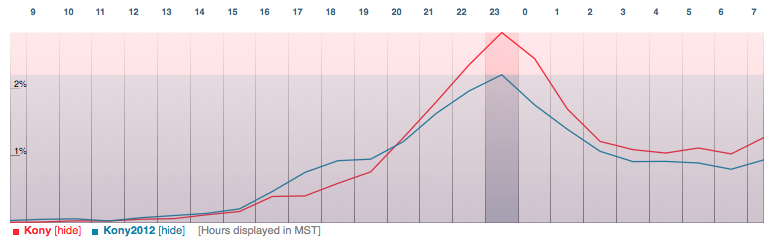
Through most of Monday evening Facebook and Twitter were slowly ramping up in my world. I have met scores of people in my work on the issue, and many of my friends are on the staff at IC, so the hubbub was expected.  By Tuesday afternoon, some staff members were tweeting that, in the first 24 hours, the video had been viewed 800,000 times. Late Tuesday evening, the campaign took up six of the top ten trending topics on Twitter, and “Kony” and “#KONY2012” accounted for 3-4% of all tweets.

The last 24 hours (checked at 7:45am, MST today) of Twitter traffic, from trendistic.

Like many who are aware of the crisis in central-east Africa, I would love to see Joseph Kony brought to justice as soon as possible. Kony is the leader of a highly centralized rebel group comprised of abducted fighters – some of them children. Kony is among the first criminals indicted by the International Criminal Court, and his arrest would go a long ways towards ending the Lord’s Resistance Army as we know it and reinforcing an essential international institution like the Court.

”]As I mentioned, I’ve been a supporter of varying tenacity, and I have disagreed with Invisible Children here and there over the years. I support many of their programs on the ground in the region – granting scholarships for students to attend rebuild schools, teaching displaced people employment skills, and building a radio warning system among them – and am one of the many that first got involved in human rights and activism through their work here in the States. I’ve always felt that there is a huge disconnect between the great work being done in the region and the simplistic, sexy, and purely PR work Stateside, which is a shame. I’m not as much of a critic as others, but I do have a few qualms with the current campaign that’s launching right now.

Invisible Children continues to oversimplify the message of how to get rid of Kony. I understand that advocacy groups need to take really complex problems and boil them down so that it can be disseminated among supporters. As the movement grows, however, the leaders should be better educating their followers.  Being involved for five years, I have yet to see IC expand on its very simplistic history of the war, which is critical to understanding how best to approach ending it.

Something needs to be said about the narrative that IC creates, but I’ll leave that to everyone else.  IC has been running programs in northern Uganda for several years – ineptly at first but more recently they operate like any other aid organization there. Meanwhile, their PR campaigns in the States aim to address the LRA, who left Uganda – which has been in relative peace and experiencing slow recovery – in 2006. The videos blur the lines between the countries, and simplify everything to Kony roaming Africa abducting kids. That’s not to mention that there is no evidence of the 30,000 children figure endlessly repeated by IC and other NGOs, and no discussion of how to define abduction (which is important, since some are forced to help transport supplies before being set free, while others are forced to kill their own family members before being conscripted for life). The story IC creates will drive policy, and it needs to ensure that we have a dialog about the peace-justice debate, the accountability of the Ugandan military, and ways to move forwards without losing momentum.

IC’s campaign for the next two months is heavy on awareness. We supporters are to tell all of our friends and put posters everywhere, and then write messages to 20 cultural leaders (who control public discourse) and 12 political leaders (who are involved with real change). This build up is to April 20th, when we’re supposed to plaster our cities in Kony 2012 posters to “make him famous.” There is footage of “Kony 2012” – to make him as popular as possible – a sort of Public Enemy #1.

When I first got involved with IC, I attended an event that included learning about displacement camps in northern Uganda – an eye-opening experience that really pushed me to start a student organization in college. This year’s big event is to put up posters. This is all in the name of garnering more name recognition for Kony to make him (in)famous, but when you get the most bipartisan congressional support for any Africa-related bill in history and you claim hundreds of thousands of youth support you, you’ve gotten the word out. Claiming that nobody knows about Kony (the video says “99% of people” have never heard of him), is absurd. There is enough attention that we can move from awareness to action now. It’s time to pursue real change – front and center. E-mailing the Chairman of the Senate Foreign Relations Committee should not just be a side-note to hanging up flags and tweeting at Oprah, who is probably sick of IC distracting her from her work in South Africa anyways.

As Daniel Solomon notes (and you should definitely read his post), if people are tweeting at me to watch the video and aren’t reading the ICG report to learn more, then a vital part of the campaign has missed the mark. Mark Kersten also calls out the campaign in a post you should read, and here’s a critique of “crowd-sourced intervention.”

After six years of building a massive youth-led base in America – including raising millions of dollars in record time and directing masses of young people – we have passed the deadline for moving forwards. In the film, IC tells us the Kony 2012 campaign expires at the end of the year – a movement has an expiration date alright, and it’s important to freshen up the whole IC movement.

Update: The list of related links has moved to a new post, as it continues to grow.

Rethinking Local

Recently, I’ve run into some interesting articles going against the “buy local” mantra, mostly via @cblatts. In particular, I read an article on the book industry and one on food – and while neither were groundbreaking, they did make me stop and think about what really helps the community – whether that community is where I live or a more abstract community like authors or farmers. This is stuff I’m not well-versed in and I definitely have some reading to do, but this is just a small part of me trying to clarify my opinion – and I’m taking you along for the ride.

The first piece I read was this Slate article explaining that Amazon was better than local bookstores. The author spends most of his time explaining why Amazon is better for the customer and for “literary culture”  because it can afford to lower prices, effectively allowing people to buy and read more books. I do a share of shopping on Amazon, but I also love book stores. I always enjoyed wandering the aisles in Borders and I got coupons for 30-50% off an item, which brought the prices down enough to be comparable. I love the stuffy, crowded atmosphere of Old Town Books in Tempe, and there’s even a cat that lives there. But I’m not delusional about the role bookstores play in the industry – or the role Amazon plays. I think the article is right in pointing to Amazon not as the killer of literary culture but its savior.

The second piece I read was a short note from Ben Casnocha about buying food locally versus globally. Buying local (and organic) is definitely become a trend for the suburban hipsters among us. I visit the ASU Farmers Market every once in a while for some good tamales, but I’ve never gone full-local for my produce. But what I never thought of was what buying local does to the global – the farm workers in poorer countries that aren’t benefiting from the trend. Casnocha later put up quotes from Matt Ridley’s The Rational Optimist:

This is what it would take to feed nine billion people in 2050: at least a doubling of agricultural production driven by huge increase in fertiliser use in Africa, the adoption of drop irrigation in Asia and America, the spread of double cropping to many tropical countries, the use of GM crops all across the world to improve yields and reduce pollution, a further shift from feeding cattle with grain to feeding them with soybeans, a continuing relative expansion of fish, chicken and pig farming at the expense of beef and sheep (chickens and fish convert grain into meat three times as efficiently as cattle; pigs are in between)

As people continue to buy into the whole organic lifestyle, it inevitably bleeds into more than just your neighborhood farmer’s market. But that quote is (in my opinion) an important thing to remember – rural farmers in developing countries have been selling organic and local for years because they have to. The best way for them to increase their revenue is by increasing their inventory or by expanding their customer base. When you barely make enough to cover expenses and survive, it’s difficult to invest. When not abused, things like pesticides and international barges can help tremendously. While many suburbanites with the time and money continue to choose to buy local, it’s important to remember that not everything that’s good for your community can (nor should) be extrapolated to the global level.

Rwanda isn’t a Model for Anything but Autocracy

About a year ago, I attended a conference about human rights in Africa.  One of the keynote speakers was a PhD candidate in justice studies who spoke mostly about the Arizona state legislature’s divestment related to atrocities in Darfur.  But she made an off-hand comment about Rwanda that made me double take. I’ll paraphrase it to something like “the streets are clean and the cities are safe, it’s come a long way since 1994!” It wasn’t the main point of her speech, so I shook it off, but not before writing a small post about my own thoughts on Rwanda. But it seems it might be time for another.

I attended an event last month where I saw Carl Wilkens speak. Wilkens is well known for being the only U.S. civilian to remain in Rwanda during the genocide, where he helped aid many Tutsis that were in hiding.  He had a lot to say about his work at the time and his personal story, and it was very moving.  I picked up a copy of his recently published memoir and hope to read it soon.  Hearing him speak, I could tell he cared a lot for Rwanda’s well being – he continues to do work there and seems to have a deep connection with the country.  Given what he went through, it’s hard to blame him.  During the Q&A portion of the event, though, I was struck by his strong support for the current regime there.

First, someone asked how Rwanda had changed.  Wilkens qualified that the government was somewhat overreaching and even used the word “autocratic,” but also argued that the streets were clean, crime was down, and people were safe.  He ignored that petty criminals are whisked away and never seen again and that the civil society and press are severely choked by government restrictions (both of which I mentioned in the aforementioned post).  Recently, the genocide survivors group Ibuka condemned Paul Rusesabagina’s Lantos prize.  Ibuka is one of the biggest survivor groups, but it has been aligned with the government ever since its more outspoken leaders were purged by Kagame in 2000.

And then someone asked what African country could be seen as a model for the way forwards. I was expecting something like Botswana, but instead got accolades for Rwanda again.  Wilkens explains that the Rwandan government was establishing infrastructure, citing efforts to lead an information-based economy in Kigali to lead the region. As some have mentioned, that can’t be the only solution.  An authoritarian government that stifles opposition cannot grow much further than Rwanda has.

Once you clean up your streets (by banning plastic bags and arresting people for begging) and shore up your border (by invading your neighbors and stealing their resources) and win “popular” elections (by intimidating and threatening opposition groups), you can’t call your country a beautiful model for new African governance. I’ve spent years learning about Uganda, and I sure as hell love a lot of things about that country. But in learning to love that country, I’ve also learned to call a spade a spade. No matter how close you are to Rwanda, it’s important to take a step back and call an authoritarian government what it is, with no excuses or apologies.

Why Norway is Great

Today, Norway suffered a terrible attack. An explosion tore through central Oslo, killing seven and hospitalizing almost a hundred more, and a shooting rocked a Labor Party youth camp in Utoya where over 80 young activists lost their lives. I have always thought that Norway was a great country, and it pains me to see this happen anywhere – but especially Norway. Prime Minister Jens Stoltenberg said that Norway’s answer to the attack would be “more democracy, more openness” and said to terrorists, “you will not destroy us.” Championing democracy instead of war in the face of terror is one way to win my heart.

In addition, Mark Goldberg added to why we love Norway so much:

I have never been to Norway, but I still love the place — and I am not alone. Norway is among the most beloved nations in the international community and for good reason.

Norway has a population about the size of the state of Kentucky. It is the 47th largest economy in the world, putting it between Chile and Romania.Yet, for a country as small as Norway, it is arguably the most generous country in the world.  It allocates a full 1.1% of its Gross National Incometo international development activities. This puts Norway on top of all developed world countries in its relative contributions to global poverty reduction. (By comparison, the United States contributes about 0.2% of its GNI to official development assistance–roughly the same percentage as Greece.)

Beyond its official development assistance, Norway is among the most generous countries in the world when it comes to responding to natural and man-made disasters. When tragedy strikes somewhere in the world, the Norwegian government steps up. Last year, it gave $832,585,693 for crises like Haiti, Burma, and Sudan.  Earlier this month, when UN agencies began to warn of a hunger crisis in Somalia, Norway stepped up with a big relief package.

My thoughts are with Norway, like a lot of people tonight.

The Next Chapter of TOMS Reads Like the Last One

So, this week TOMS made a huge announcement with a coordinated, nation-wide reveal: their expanding beyond shoes. The idea is to expand the One for One model to fit everyone’s needs – not everyone is in need of shoes, but some need eyeglasses, for instance. And, as one might guess, with TOMS revealing a new campaign I thought about revealing a new blog post about it.

The One for One model has spread around, despite TOMS having trademarked the phrase. There are many companies that match purchases through giving, but TOMS still feels like a rock in my Converse. While others have contacted partners in developing areas to work with, TOMS continues the shoe-drop model. As before, my main gripe about TOMS is the lack of sustainability involved in handing out shoes to tons of people who need them. It does nothing to buttress the economy or to help recipients improve their livelihoods – save adding shoes to their wardrobe.

If the next chapter for TOMS included opening manufacturing centers in developing countries and employing people to build and sell the shoes instead of handing them out, that’d be an improvement. Training local people to become business leaders allows them to rise up by their own bootstraps and it provides a new service to the community (if there is a gap in that sector, which there isn’t always). If you decide to add finance training, micro-loans, and other services you’d really be in business.

But the next chapter of TOMS included eyewear. The One for One model shifted slightly with this expansion. Instead of just glasses-for-glasses, it’s eyesight-for-eyesight. You buy a pair of shades and TOMS will either give out glasses, provide prescription medication, or perform eye surgery on those in need. Pretty sweet, right? Well, only kind of. I see some improvement in providing health services, but TOMS isn’t building anything sustainable here. They say that giving people sight will improve education, health, and economy but really, it’s only improving eye sight. The members of these communities will only be impacted in that they can see better and that they will depend more on the next development NGO to roll into town.

Back to that paragraph about sustainability: if you want to buy glasses that do something more than help you see better, try Warby Parker. It’s a company I only recently heard about, so I am not endorsing it, mostly because in some instances they give glasses at the conclusion of a free eye exam, which isn’t really sustainable. But their partner is. VisionSpring does more than provide the glasses – they also train low-income women to sell glasses to people in their communities for $4, even providing them with a eye-care-business-in-a-bag.

The co-founder of Warby Parker used to direct VisionSpring, where he first put together the idea that you can avoid aid dependence if A. the recipient makes the decision to get glasses, and doesn’t just have them given to him or her, and B. the recipient gains ownership over the glasses literally by paying for them. On top of all of that, they help train and employ women who are in need of income. Win, win!

Warby Parker partners with VisionSpring, which is an amazing group – so if you feel like making an impact with your glasses that seems like a better option. If you’re feeling good you can even donate directly to VisionSpring! And – as usual – if you’re going to try to make a difference in others’ lives, make sure it’s a positive difference.