A Day at the Executive Mansion

This post is the political and analytic post about the DC trip. For the general trip run-down, click here.

Friday was the big day, and in the morning I took a stroll down F St. to the White House gate, and started meeting all sorts of great fellow advocates. Once we all got together, we went through security and headed into the Eisenhower Executive Office Building, one of two office buildings that flank the White House on the premise. We filed in and took our seats in a small auditorium, and listened to the following and surprisingly long list of speakers.

  • Gayle Smith (Director of the NSC) and co-founder of the Enough Project,  talked about America’s transition from a unilateral actor to a multilateral actor in development and international affairs, and emphasized the importance of security, economics, and values in humanitarian aid. She talked a lot about long-term solutions and referenced some advancements in the aid sector.
  • Erin Mazursky (Youth Advisor, USAID), formerly of STAND fame, talked about the link between youth advocacy and conflicts, emphasizing the importance of the younger generation to be involved. Herself a product of that, it was great to hear her talk about her work for USAID in helping youth around the world, and she said that many in the development sector see advocacy as “the wind in our sails,” which is always uplifting to hear.
  • Andrew Sweet (from the Office of Conflict Management and Mitigation at USAID), who used to be at the Enough Project, talked a lot about OCMM’s work in producing alert lists of countries at risk of falling into conflict. He also made several references to conflict assessment and contributions to local reconciliation efforts to prevent conflicts in post-conflict zones. In response to some questions, he also referenced that the U.S. was going beyond MDGs in a lot of developing countries, with other goals such as legitimate political systems, justice, and security.
  • Brooke Anderson (Chief of Staff of National Security Council) took a lot of questions and tried very hard to understand where all of us advocates were coming from. In the course of answering questions, she referenced the importance of crisis mapping and that problems in the DRC needed to be addressed, but our group did not get any LRA questions in really.
  • Esther Brimmer (Assistant Secretary for International Organizations at the State Department) talked primarily about the UN, saying that the U.S. needed to not just support peacekeeping mandates but also to ensure they had viable plans. She referenced the UN’s role in Côte d’Ivoire and the Human Rights Council. She dodged a question about the LRA, probably because it wasn’t really in her job description. However, she did say that witness protection was a priority, which it definitely needs to be. When asked how to face opponents to UN funds, she reiterated the importance of sharing the burden of peacekeeping around the world.

Originally, myself and two others were supposed to meet with Jon Carson, the director of OPE, to express a little bit of urgency about the President’s LRA Strategy. That got cancelled at the last minute, and I ended up joining everyone for a self-guided tour through the East Wing! From there we split up for lunch before reconvening, and then the following people spoke:

  • Mark Doms (Chief Economist, Department of Commerce) gave a prolonged talk about the current recession, replete with pretty graphs and humorous interludes. Talking points included European debt problems, international uncertainties in the global market, and dependence on foreign fuel.
    Plouffe taking questions
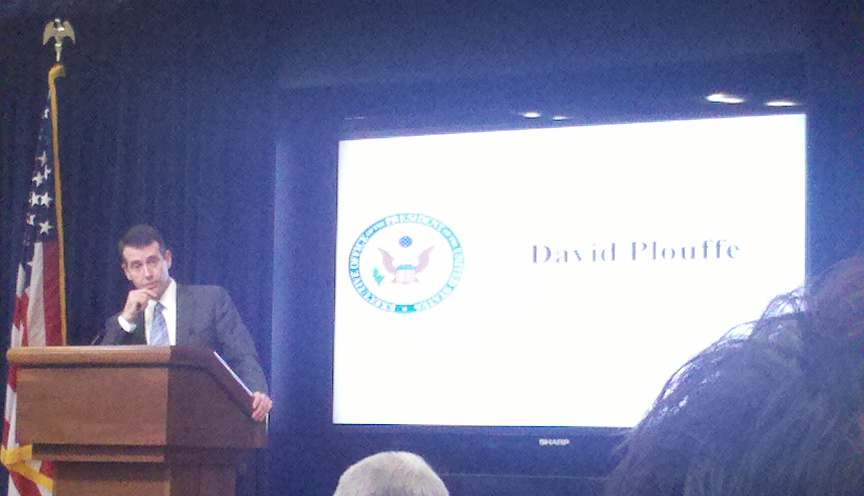
  • David Plouffe (Senior Advisor to the President), also former campaign manager for the Big O, talked a lot about how to move forwards, shifting between calling himself a progressive but also mentioning the importance of balancing budgets. He took questions for a long time, and when asked what President Obama wanted his foreign policy legacy to be, he speculated that it would be ending the war in Iraq, giving AfPak the attention it needed, reestablishing the U.S. leadership role, and non-proliferation (a la START). In short, a “cleaner and safer planet.”
  • Alexia Kelley (Director, Center for Faith-Based and Neighborhood Partnerships) talked about her office’s work across the country and ways to partner with the government in communities. It’s also worth noting that during this segment I slipped out to use the restroom and upon my return I passed the First Dog, Bo. It was pretty legit.
  • Brad Cooper (Director, Joining Forces) talked about the launch of his program, which is a support system for military families and is definitely going to be getting bigger.
  • Anne Filipic (Deputy Director, OPE) emphasized the importance of taking our experiences home and spreading the word about the White House’s outreach programs. OPE is holding all sorts of round tables and focus groups across the country to get a better idea of what exactly people are wanting to see from the presidency, which is a pretty great effort. She also referenced ways to connect with the White House via technology.
    Carson taking questions

  • Jon Carson (Director, OPE) didn’t meet with me privately, but instead came to talk to everyone, which was pretty cool. Referencing the small size of OPE, he called on individuals to act as conduits for making sure people in the communities’ voices were heard. When asked about the LRA by one of our own, he said that building networks was an imperative, and called on involving diaspora groups (which I have always been on the fence about, given a majority of them’s contempt for Museveni). When we challenged him to get a strategy going, though, he seemed to take to heart that advocates like us really want to see the Executive Branch give a little and get some skin in the game. He later referenced that, when it came to cuts in the budget, community activism was the key to keeping money where it was needed the most.

As the White House event closed up, one of my fellow advocates – a child psychologist in Kentucky that works in Uganda rehabilitating former child soldiers through art – presented Jon Carson with letters and a drawing made my children addressed to President Obama. Carson assured her that he would pass them along, which is great news.

In the aftermath of the event, we congregated outside the White House and a few of us did interviews with Ricky from Discover the Journey, who was filming a short segment on Resolve’s work at the White House. I did my little part, and also hung out with some great people by the gate.

And that was my day at the White House. It was a pretty neat experience, and it was great to be surrounded by such a great group of advocates. Not all of the speakers were great, but the briefing overall was wonderful. Thanks go to Resolve for the invite and to Citizens for Global Solutions were setting up the briefing in the first place and for hosting a neat workshop the following day at their offices.

There and Back Again

This is a short post about my trip to DC this weekend, highlighting museums and meals with friends. To see why I was going to DC, click here.

I’m home from an extended weekend in DC. It has been truly one of the most amazing weekends spent with some great, great new friends – if not family. The Resolve invited me and a small group of advocates to Washington for a mixed bag of great events. What was supposed to be the pinnacle of the itinerary was the mother of all reasons to go to DC – an invitation to the White House.

The Allen Lee, my home for the weekend

The Office of Public Engagement was holding a Community Leaders Briefing – part of an ongoing series – and this one was specific to foreign policy, particularly related to conflict and development. And so I went to DC, and was received in open arms by the Resolve crew.

Upon arriving, I checked into the shadiest building ever, in a pretty area central to everything (Foggy Bottom). From there I wandered the Mall and had lunch at the Old Ebbitt Grill (which is older than the Civil War, what?!) and visited the Museum of National History before meeting up with Adam for dinner at a tall and narrow restaurant called Matchbox. It was really nice to catch up and chat, and I got to see what DC calls Chinatown.

The next day was a long and thorough walk through the permanent exhibit at the United States Holocaust Memorial Museum. The exhibit is huge and well worth the three and a half hours I spent there, and I also perused the other exhibits before heading for lunch at the USDA. From there I trekked across town to the Resolve office, where I met old friends and made new ones. It was great to see everyone a day early and hang out in the office. I was able to finally put faces to names and voices and also got to chat with some great people. From there I left for a rendezvous with Caitlin, a fellow advocate that was – like me – flying in with little to do. We went to a cafe near Dupont and hung out for a while before departing.

Friday was the big day at the White House, which I’ll write about later. After that I wandered the Mall with a few people before we headed to Busboys & Poets, a cafe/book shop that had slam poetry that night. It was my first slam, or whatever

WTC antenna, with 9/12 headlines in the background

you want to call it, and it was a lot of fun. Saturday we went to a workshop in East Market hosted by Citizens for Global Solutions which was pretty neat. During the lunch break I wandered the market with a few friends and ended up doused by a rain cloud. After the workshop I ended up wandering with some friends to pick up flowers, go to a coffee shop, and then a wonderful BBQ at the house of one of Resolve’s staff.

The very last day, I wandered with Caitlin past a few memorials before dashing through the rain for brunch back at Old Ebbitt. It was the weirdest meal ever, with french toast stuffed with ham and wrapped in bacon and drizzled in syrup. So, if I die of a cardiac arrest anytime soon, that’s why. From there, we walked a bit before saying final goodbyes and I went to the Newseum, which is a really neat museum whose facade has the first amendment in giant letters. Running short on time until my flight, I made a quick tour through today’s front pages and saw a piece of the Berlin Wall, a fallen statue of Lenin, and the antenna from the World Trade Center. The whole museum was really interesting and had some great exhibits on lots of things, from terrorism through the ages to natural disasters like Katrina. I ended up rushing off through a sculpture garden on my way to the airport, where….

I waited forever for the train to the airport, checked in and went through security and got to my gate with 40 minutes to spare. Grabbed lunch and sat, and then saw the plane arrive. As we got really close to departure time, I got word that it wouldn’t be leaving for Newark for another 75 minutes because of storms there – and I’d miss my connecting flight. So I went through the long process of trying to get a plane, then had to go back to the ticketing counter and ended up having to go back through security and ended up on a tiny regional plane. It was the first time I ever set foot on a tarmac, and I took a bus across the runway to a small plane and boarded it and read on a 20 minute flight to Philadelphia before rushing to my next plane to Phoenix. Made it home and slept, and here I am now. Trip: over’d.

And Summer Turns to Autumn…

A year ago, I was returning from 10 weeks of adventurous interning in Uganda, ready to get back to my job, busy myself wedding planning, and getting back in the overloaded schedule of classes. This August, I’m in a slightly different situation. I began the year by getting married (awesome!) and teaching up a storm, but the reality of my circumstance is that – except a two-week stint as a long-term sub – I’ve been unemployed for virtually all of 2011.

I had high hopes for starting a new school year tomorrow, but my hopes have so far been dashed. As school districts across the East Valley begin with their respective staffs, I’ve been getting pretty down about the prospects. During this summer I’ve applied for six positions (every single one I found) and have had no luck so far. I’m leaning on substituting, but don’t really know the reliability of that either.

I’ll be spending most of this week in Washington, DC – because unemployment is the most opportune time for vacations – and when I get back I think I’ll be hunkering down for any sort of income I can get my hands on. In the meantime I’m also trying to find ways to build up my academic resume for next year’s prospects when my wife is done with school. I have relatively no idea where I’m headed right now, so it’s been a grueling road so far. I’ll continue to jump on every teaching opportunity I can, but in the meantime I’ll be on the old-fashioned job-hunt. Hopefully things will look upwards at some point. I can’t really go a whole year without a job.

Neurotic Groceries

It’s just about everyday that I hear somebody say “I’m so OCD!” because they’re tidy or they like things organized. In addition to the tiny detailed fact that you can’t be a disorder, that’s also not all that OCD is. But that’s not the point I’m making. The point I’m making is that I’m OCD I get a little neurotic about pretty much one thing only: groceries.

The few times Kim and I both go to the store, she ends up abiding by my routine or observing as I correct her. My shopping cart will perpetually be divided between frozen, refrigerated, and room temperature. And room temperature will be divided between will-go-in-pantry and will-go-in-fridge, will-go-to-pets, and will-go-elsewhere (toiletries, for example). As we shop, if things slide or get misplaced, I’ll frequently stop and rearrange them. When it’s check out time, I put all of the frozen things on the conveyor belt first. They are followed by refrigerated goods, room temperature foods going in the fridge, room-temperature foods going in the pantry, pet-related things, and then the toiletries and miscellany.

Unpacking groceries tends to be just as fun, but Kim often at least unpacks things and leaves them on the counter, which lets me sort things in some sort of order that I can deal with. Kim manages to play the role of accommodating significant other very well, actually.

So anyways, this is my major thing. Do you have any quirks?

Why Norway is Great

Today, Norway suffered a terrible attack. An explosion tore through central Oslo, killing seven and hospitalizing almost a hundred more, and a shooting rocked a Labor Party youth camp in Utoya where over 80 young activists lost their lives. I have always thought that Norway was a great country, and it pains me to see this happen anywhere – but especially Norway. Prime Minister Jens Stoltenberg said that Norway’s answer to the attack would be “more democracy, more openness” and said to terrorists, “you will not destroy us.” Championing democracy instead of war in the face of terror is one way to win my heart.

In addition, Mark Goldberg added to why we love Norway so much:

I have never been to Norway, but I still love the place — and I am not alone. Norway is among the most beloved nations in the international community and for good reason.

Norway has a population about the size of the state of Kentucky. It is the 47th largest economy in the world, putting it between Chile and Romania.Yet, for a country as small as Norway, it is arguably the most generous country in the world.  It allocates a full 1.1% of its Gross National Incometo international development activities. This puts Norway on top of all developed world countries in its relative contributions to global poverty reduction. (By comparison, the United States contributes about 0.2% of its GNI to official development assistance–roughly the same percentage as Greece.)

Beyond its official development assistance, Norway is among the most generous countries in the world when it comes to responding to natural and man-made disasters. When tragedy strikes somewhere in the world, the Norwegian government steps up. Last year, it gave $832,585,693 for crises like Haiti, Burma, and Sudan.  Earlier this month, when UN agencies began to warn of a hunger crisis in Somalia, Norway stepped up with a big relief package.

My thoughts are with Norway, like a lot of people tonight.

Not Cool, Netflix.

People are pretty grumpy with Netflix’s recent price change, and – as consumers – it’s in their economic interests to gripe. But Netflix is doing more than just charging you a little extra. They’re enacting the brilliant plan of having prices low enough to keep you, but still make enough to keep competition at bay.

By this, I mean that Netflix was amazing when it started. I joined Netflix pretty early on, and it’s always been a pretty awesome company as far as low prices and magically speedy shipping. The annoying thing isn’t that Netflix is raising prices (although that does bother my wallet a bit), but that Netflix kept its prices low for years while driving Blockbuster and Hollywood Video into the ground, and now that they’re barely alive Netflix is beginning to screw over its customers. There have been a few tiny price hikes recently, with the most recent division of streaming and sending being the biggest.

On top of that, the objective of splitting digital subscriptions and mail subscriptions is built pretty much to encourage you to drop the mail and go digital-only. This will, of course, give Netflix the ability to fire a lot of the people who do the super-fast work or sorting through all the discs you mail in, and Netflix will improve their profit margin even more.

Business at it’s finest, I guess.

In Which I Reminisce About Magic

Last night I went the midnight screening of Harry Potter and the Deathly Hallows Part II – my first midnight screening – to bid au revoir to the Harry Potter film franchise. That said, I echo many people’s feelings that the world of Harry Potter came to a close four years ago with the release of the last book, but the films have been a pleasant and entertaining afterword. Like a lot of people my age, I grew up with Harry Potter. I aged right alongside the protagonists and followed their adventures and battles.

Magic is something particularly fantastic to imagine, and even though I’ve been in a non-fiction, academic streak the call of this type of fiction is still fun. Truth be told, I’ve always wished I could write something creative – and I’ve tinkered with it before. Maybe one day I’ll write something worth reading. In the mean time, I’ll be on the lookout for another book replete with magic, swords, elves, and the lot. ‘Til then:

Mischief managed.

A Year After Kampala

Today is the one year anniversary of the World Cup Bombings in Kampala which claimed over 70 lives. I wanted to put together some sort of post to mark the occasion, even if only to remember the incidents and the lives taken. Last year, I put up a blog post about it at the time, but was pretty bewildered.

For those who don’t recall, one year ago two sites in Kampala were bombed by Somali insurgent group al Shabaab. The attacks hit the Ethiopian Village, a restaurant frequented by Westerners and a place I planned on visiting. I drove by the restaurant a few weeks later and the compound was boarded up – haven’t heard if it ever opened. The attacks also hit the Kyadongo Rugby Club, a field that had been filled with seats and screens to house a viewing party. The attack was in response to Uganda’s involvement in the African Union’s military presence (AMISOM) in fighting for the transitional government in Somalia against al Shabaab.

So, how much have things changed since? In May, some groups reported worries that al Shabaab attacks loomed, but it led to some debate over whether the government had reliable evidence of attacks or if it was exploiting the attacks to dampen contemporary protests over fuel prices. Al Shabaab is still fighting against AMISOM, but there is some speculation that they’ve expanded outside of Somalia. The East African had a report on prospects of expansion due to several conflicts along the Somali-Kenyan border. It seems that al Shabaab is definitely pushing its weight around even though it’s still in the middle of fighting against the transitional government, but the question remains: are another series of bombings on the scale of the World Cup Bombings possible?

On the Subject of Blogging…

Lately, my day-to-day routine has been pretty simple. We’re working on the house a bit here and there, and I’m still on the job-hunt. But in my free time I’ve finally decided to entertain an idea I’ve had for some time, so if you’ll humor me for a moment I’ll introduce you to my more scholarly blog.

Those of you who know me (and if you don’t, you should!) know that I love history and politics and Africa. I’m following that muse with a new blog concentrating on those topics. I’m using it as a tiny platform to do some writing, but also hone my mediocre research and writing skills. So, if you’ll do me the honor, go have a look at Historically Speaking. As of right now it’s a pretty measley weblog with sparse posts on the Vietnam War, Thai politics, and air conditioning. Plus side, it’s replete with tags. Enjoy!