Occupy Phoenix Finally Occupies

Earlier this week I posted some photos of the pre-occupation march and initial occupation at Cesar Chavez Plaza. On Wednesday I returned in between classes for a few minutes and then again in the evening for a few hours. It turned out to be a pretty big night for the occupation.
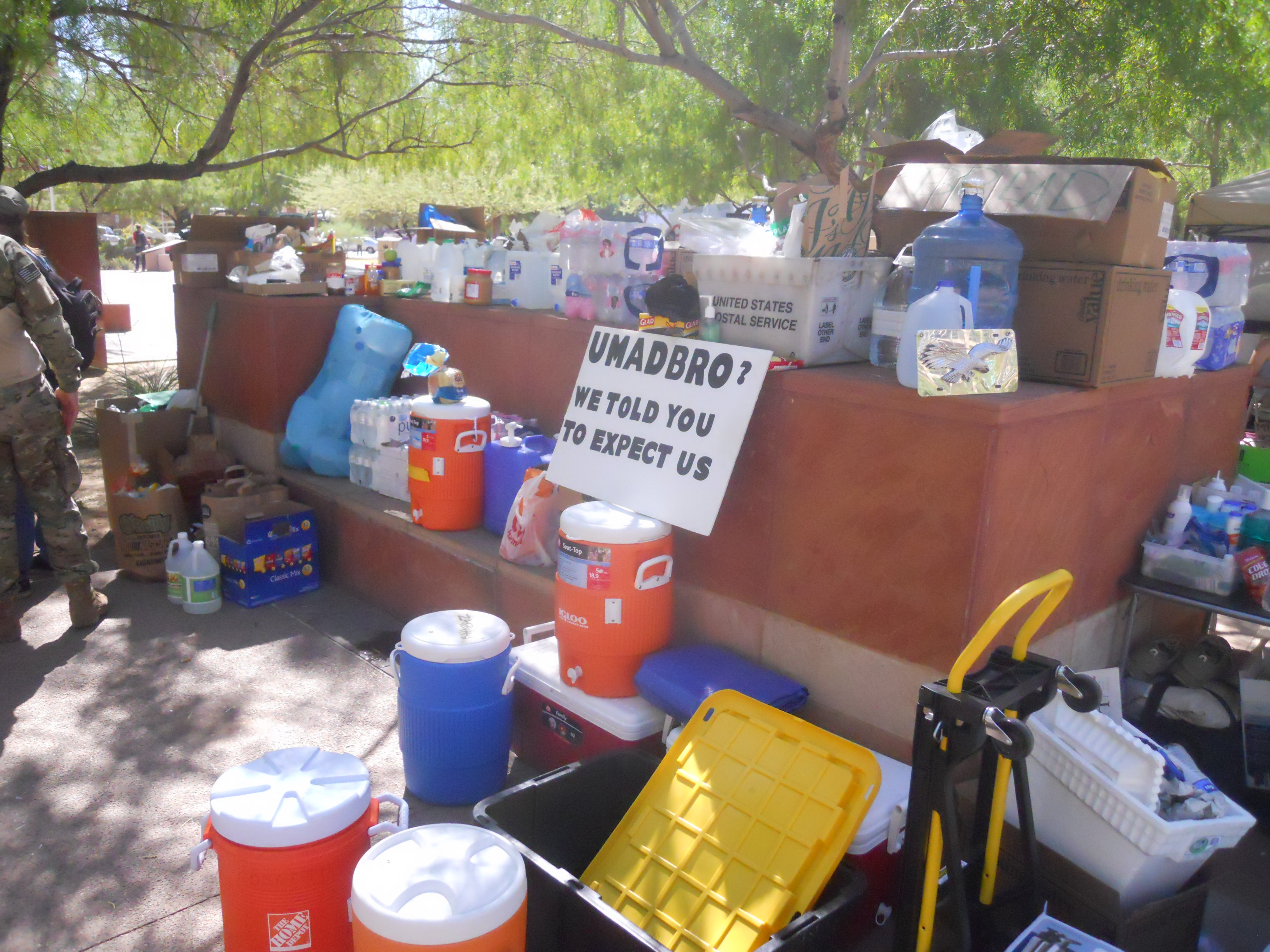
The water and food station near its height.

After the initial confrontation on Saturday, the occupation has been constantly in flux, shifting from plaza to sidewalk. The plaza closes at 6.00 in the evening, and around 5 or 5.30 occupiers pick up and move everything. Cars pull over to load up countless coolers of water and boxes of chips and bread, the first aid station is packed up, everything is taken off site. Protesters remain, but they remain within four feet of the road, on the periphery of the plaza – and they can’t sleep.

In a show of support, several businesses have tried to lend a hand. The Five Guys around the corner has offered its restrooms to occupiers, and those who can patronize there to return the favor. After Wednesday night’s General Assembly a large group walked there to buy dinner, and there was even a proposal to buy cleaning supplies and send crews to clean the bathroom for them as a sign of thanks. A cafe called Conspire has been a hub since the beginning, gathering food there even before the occupation began. On Wednesday there were rumors of the cafe extending its hours to allow occupiers to use the internet and get some rest.

Small emergency GA discusses staying in Cesar Chavez Plaza

On Wednesday, as it got closer to closing time, we began to pack things up. As we loaded water into a truck there was a sudden call for a time-sensitive GA. The police had decided to stop enforcing the plaza closure. It’s hard to say whether it was pressure of the City Manager (who had been somewhat shamed at a city council meeting earlier that morning when occupiers stated that he could have prevented the mass arrests Saturday night by giving an earlier warning) or from police department worries about putting sleep-deprived people on the edge of the road in the middle of the night, but either way they made their decision. We discussed the caveats as a group – sleeping would still be prohibited and no-camping rules were still in effect, and we were trying to figure out where that line fell.

That night, someone brought a kettle of warm pasta, which was a well-received change from the peanut butter sandwiches and chips that we had been eating. More and more people flowed in as we prepared for the general assembly. The number of occupiers has big spikes and lulls, like I’m sure many occupations have. Compared to what I’ve heard from people in New York and Oakland, the occupation in Phoenix doesn’t have the community feel just yet. It might be because there had been so much back-and-forth in the first few days. Last Saturday there was a market place and a library, but both seem to have been shelved during the move. Despite having lasted six days now, when I was in the plaza it felt temporary. During most of the day the plaza had one gazebo, a bench, a computer, and a collection of coolers – the rest was people and food. The authorities must be happy with this – it looks more like a birthday party at a park than a politically engaged and self-sustaining community, if not for the countless signs. But with the plaza opened indefinitely, I hope to see the occupation grow.

General Aseembly on Wednesday Night

It seems that the authorities are already trying to stymie the growth. As the police presence dwindled on Wednesday, the sergeant on the scene discussed with a couple of us some of the finer points of what would be allowed and what wouldn’t be. Right as he left, he told me that the media center – a desktop computer under a tree running the livestream – was borderline and might have to go.

This afternoon, the power to the plaza was cut, shutting down the media center and anything else the occupiers had plugged in. There are a handful of car batteries and two solar panel chargers, but the occupiers don’t have enough to provide power to the whole plaza. In addition (and maybe only because the power is out) the city WiFi network usually available at the plaza is also gone. The occupiers are currently marching, and there is a campaign going to call the mayor to convince him to turn the power back on. Meanwhile, it seems that while the plaza may be open to the occupiers to stay in, they won’t be able to sleep, camp, cook, record, connect, or organize. The city gives, but the city also takes away.

Photos from Occupy Phoenix

Occupy Phoenix has begun this week, although it’s had a rough time. I was only there for the very beginning, but plan on returning tomorrow and give you all another post. Here are some photos from days 0 and 1, followed by a short run-down of what I’ve missed.

Last Friday, there was a pre-occupation march through downtown Phoenix. It lasted a few hours, replete with lots of chanting at numerous locations before ending at Cesar Chavez Plaza, where a group of Arabs were demonstrating against Syrian President Bashar al-Assad. The two groups joined up pretty seamlessly before an occupier read the Occupy Wall Street declaration and a band played some anarchist acoustics.

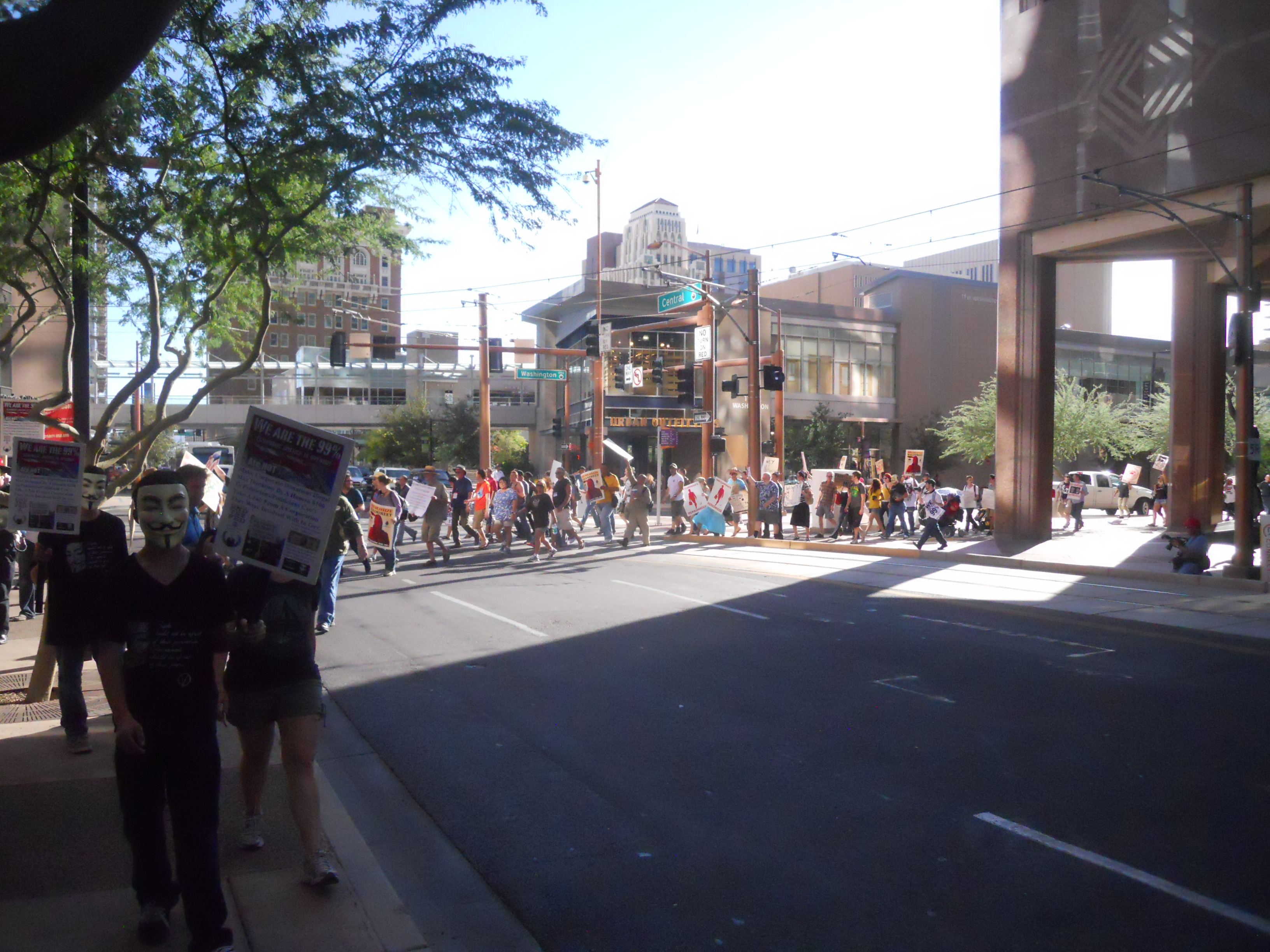
Pre-Occupation March snakes through downtown

Outside Chase Tower, chanting "Chase got bailed out! We got sold out!"

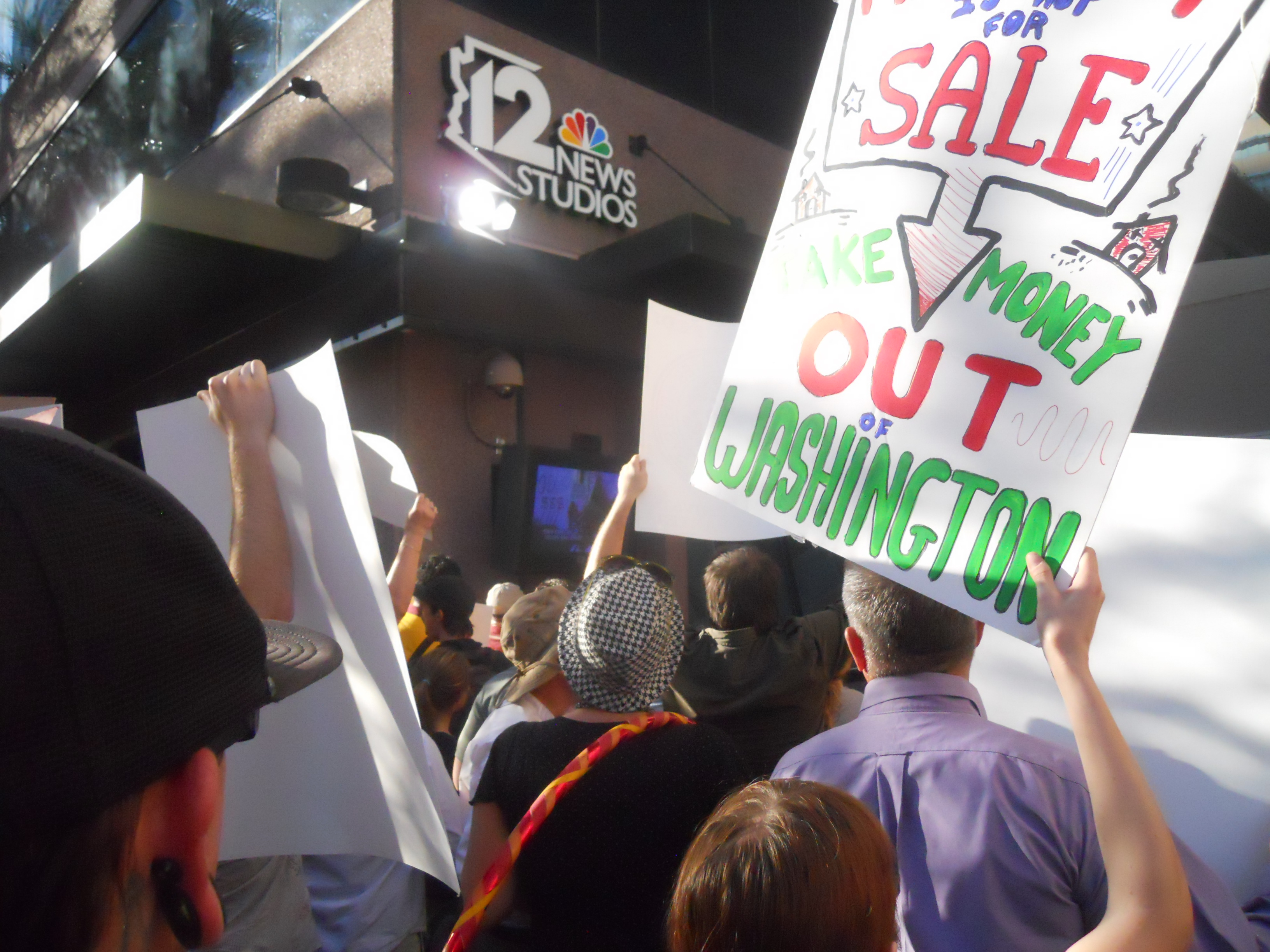
Crowding the Channel 12 studio

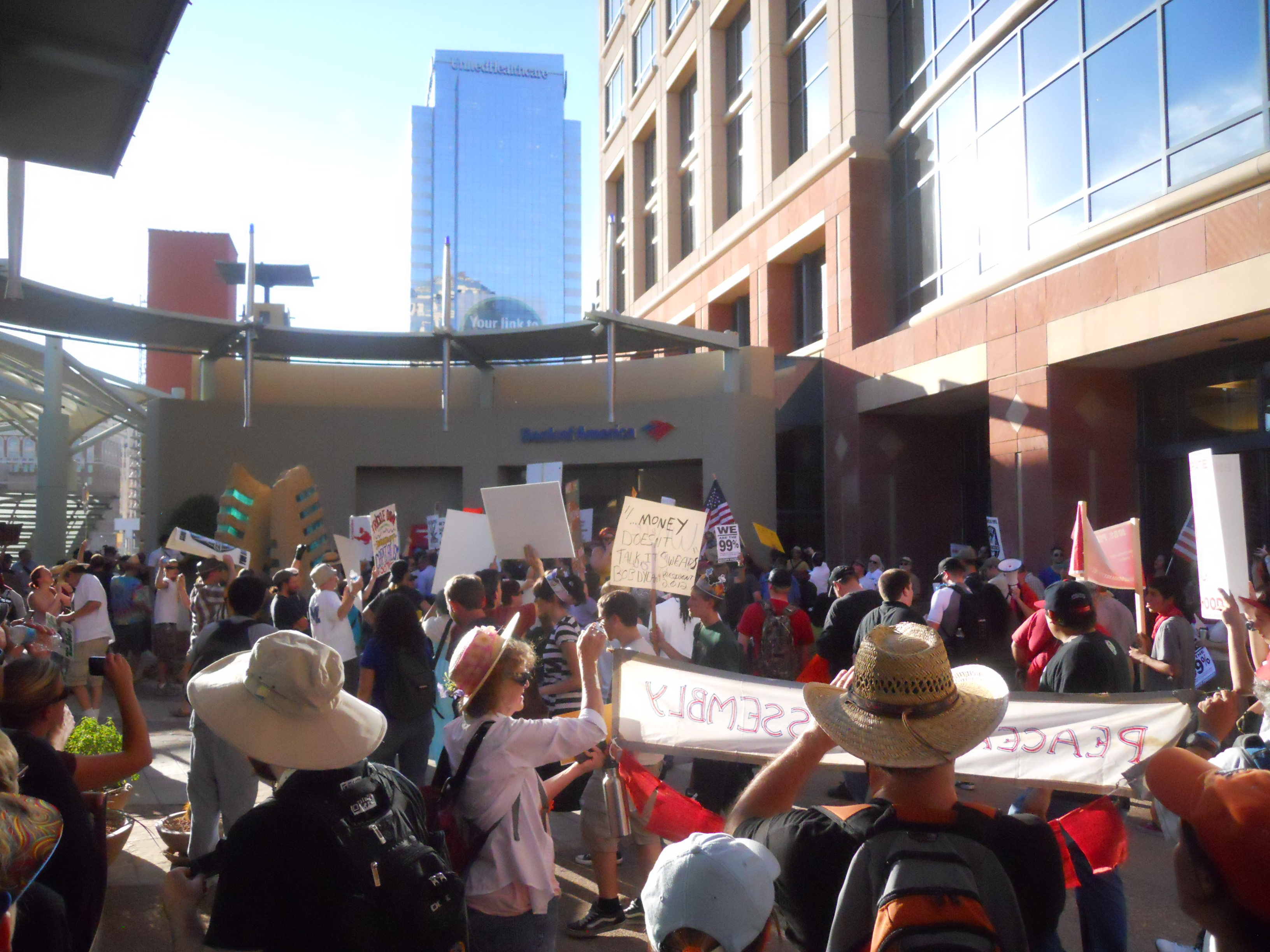
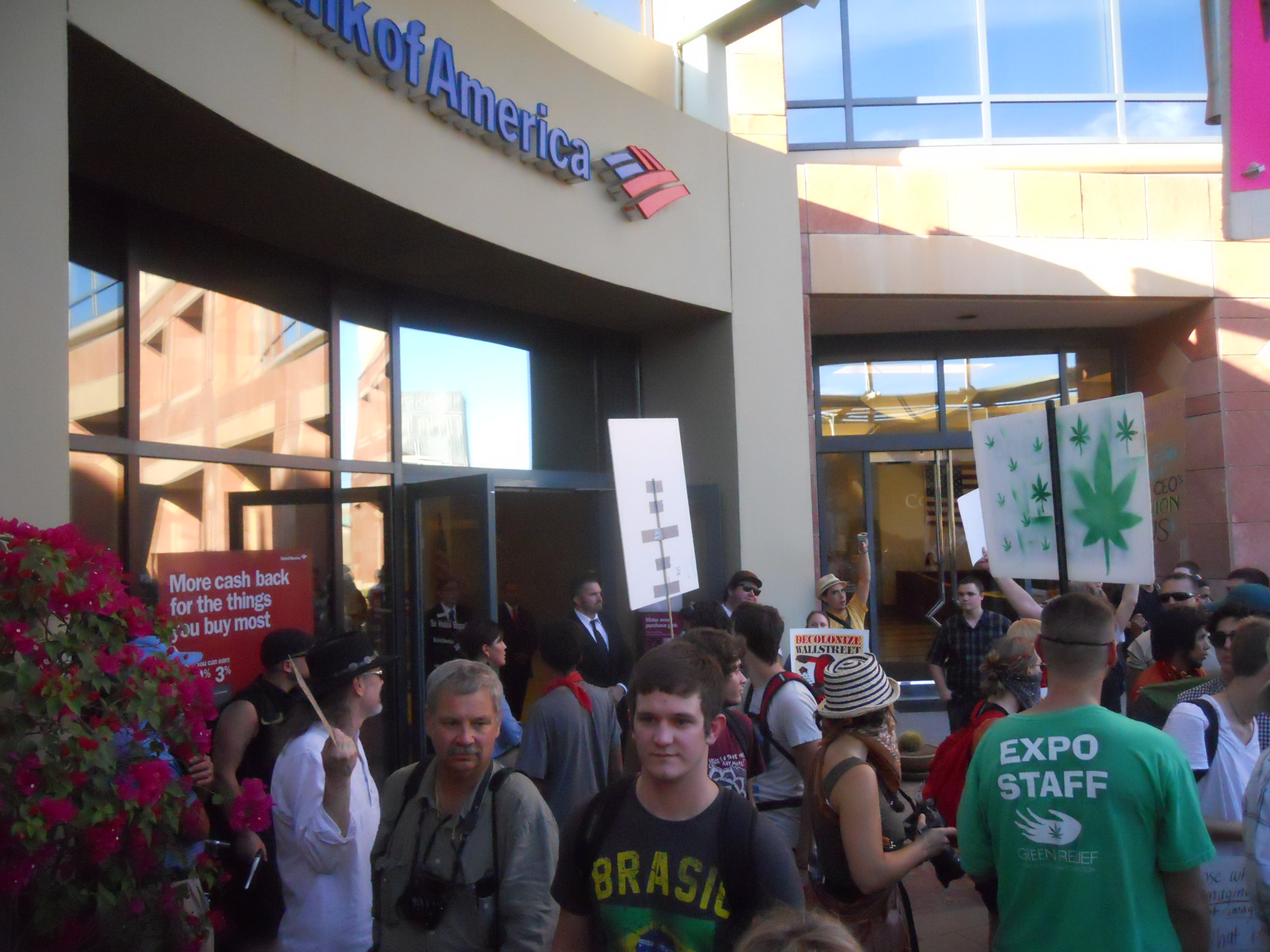
Protesting outside the BofA at Collier Center

Angry suit looks angry.

This is only about half the crowd (I was in the middle) headed towards Cesar Chavez Plaza.

The Syrian demonstration is joined by Occupy Phoenix.

Saturday, protesters returned to Cesar Chavez Plaza to begin the occupation. I arrived about an hour and a half after it began, and missed the armed presence of a local militia, which caused some controversy. What I saw was a small but thriving community. I didn’t get photos of everything, but there was a main circle of speakers outside City Hall, surrounded by smaller circles, a book store, a “free” market, a food table with bagels and pizza, a water station, and people signing petitions for an open primary. The whole plaza was well over 1,000 when I was there, I heard 2,000 quite often.

Speaking outside of Phoenix City Hall

My favorite sign.

Speaking about nonviolence in a smaller circle.

Everything else I know is from Twitter, the Downtown Devil’s Saturday coverage, and the livestream. Saturday night the crowd marched from the Plaza to Margaret T. Hance Park to set up camp. Phoenix Police warned that anybody in the park when it closed would be arrested. After initially claiming to be leaderless, the Occupy Phoenix crew eventually designated representatives to meet with city officials to negotiate a lawful occupation. It was around this time that a rumor circulated that Phoenix Mayor Phil Gordon said that if the police arrested the protesters, he would come out to get arrested. In the end, the negotiations collapsed and the mayor never showed (later stating that his support was behind civil rights groups and anti-SB1070 groups). Police gave four warnings before marching in and arresting about 30 protesters, leading to this epic photograph.

A photo circulating on Twitter: Police close in on protesters on Saturday night.

Sunday morning, the occupation reconvened at Cesar Chavez Plaza early in the morning. A group of protesters marched to the 4th Ave. jail to demonstrate in solidarity with protesters inside, but left after finding out that their presence had put the jail on lock down, restricting visitation rights to the protesters inside. The occupation returned to Cesar Chavez Plaza until the park closed, at which time a Marine veteran and protester sat down and was arrested. Two more protesters were arrested while demonstrating in the middle of a street. The occupation slept on the sidewalks.

Monday’s protest was generally subdued. The occupation moved back into Cesar Chavez Plaza during the day, and was prohibited from sleeping on the ground at night. Protesters were mobile on the sidewalks of downtown, with live music and lots of coffee.

So far, today has seen a lot like yesterday from Twitter and livestream. For this evening’s general assembly, the protesters moved to a county island a block away from Cesar Chavez Plaza. This way they were able to conduct the assembly without worrying about Phoenix PD getting involved, although there were worries that the Maricopa County Sheriff’s Deputies might make an appearance to enforce loitering laws. I heard something about the Phoenix City Council meeting tomorrow regarding urban camping ordinance, and some plans to take part in that, although I’m not sure if it’s a protest or actual involvement in speaking at the meeting.

That’s all for now. More tomorrow!

It’s Rebel Leader-Hunting Season

On Friday, the press began to run numerous stories about the announcement that President Obama had authorized the deployment of about 100 combat-ready troops to Uganda to take an advising role in order to help capture or kill LRA leaders. Obama wrote a letter to John Boehner about the deployment two days after the first troops had landed in Uganda, placing the statement square on a Friday afternoon. This was a scrolling headline for some, but for me it was all over the internets. Stuff like this happens when you’re Facebook is filled with Invisible Children activists and your Twitter is dotted with development wonks and academics that are experts in the region. Let’s look at what exactly is happening here.

Let’s start with why this is happening. In the letter, (which can be found here) Obama references that the LRA are impacting regional security, the passage last year of the LRA Disarmament and Northern Uganda Recovery Act, and national security interests in the region. The troops are destined for Uganda, but will be going to the DRC, CAR and South Sudan as long as each of those countries agree to host them. The troops will be combat-ready, but will only be serving in an advisory role.

Full disclaimer to the few readers that don’t already know, I volunteered with Resolve to help advocate for passage of the aforementioned bill. I’ve continued to work with them to advocate for more action from the Obama administration on this issue. That said, I’m not sure where exactly I stand on this decision. Over the years, I have had at least a few conversations with fellow activists about the possibility of deploying American forces – advising or combating – to remove LRA leader Joseph Kony. Let’s take a look at some of that, shall we?

Why don’t we send some U.S. troops to just go snipe Kony?

Well, for starters, that’s a really bad idea and it probably wouldn’t work.  First we’ll be needing permission to run the operation (well, I guess we don’t need permission if we decide to just fly in on a stealth helicopter and shoot him in the face, but still. We should). Kony could be in one of a few places: northeastern DRC, southern CAR, South Sudan, or Darfur. The DRC has a history of being used as a training ground for atrocities, place to push a rebel group you don’t like or place to start your own rebel group if you want. It’s not fond of having more armed forces in the area. The DRC has already asked the Ugandan military, currently hunting for Kony, to get out. Twice. And it tried to kick out MONUC despite never really solving the 20-rebel-groups-hide-here problem. Supposedly Kabila is “pleased” with the recent U.S. decision, but I can’t read French and he’s changed his mind after the fact before.

Anyways, if we were to send U.S. troops in to do the job, they would face quite a few setbacks. The terrain is densely forested and rural, and there are very few chances to use surveillance such as cell phones and satellite tracking. Kony has historically established wide networks of soldiers around him so that he knows when trouble is afoot. That’s how he’s survived for 25 years, outlasting the Holy Spirit Movement and the UPDA and evading the UPDF, SPLA, and even Guatemalan special forces (killing 6 when the UN tried to catch him a few years ago). He will know what’s up. Not knowing the terrain or the language puts the forces at a disadvantage against a guy who has literally lived in the bush for twenty years.

That, and the specter of Somalia (despite huge differences between the situations) seem to be why Obama has gone with the advisory route, which still smells a little bit like Vietnam to many, but that is also a vastly different situation. Museveni has already given assurances that the Americans are here to advise, not to fight, simultaneously boasting about how the UPDF don’t need help to fight their wars. And so the US “personnel” have begun to arrive in Kampala, and will pretty soon begin to deploy to the other respective countries in the region.

Except for Sudan. While the LRA are currently scattered across DRC, CAR, South Sudan and Darfur, a year ago reports said that Kony was en route to Darfur. Darfur would be part of Sudan, and thus out of reach to both central African militaries and US advisers. I feel like if anybody asked Omar al Bashir if it was okay to enter Sudan to apprehend a leader indicted for war crimes, he might think you were talking about him since, you know, you could be. If Kony hasn’t made it to Darfur yet, he’s probably thinking about it.

But why send the advisers there now?

The LRA Disarmament and Northern Uganda Recovery Act passed in May of 2010, and the requisite strategy on the LRA was released in November of that year. Since those have been around for a while, some are asking, “why now?” Well, since then, all has been quiet on the LRA front until Resolve mentioned AFRICOM’s nudge-nudge that a deployment could happen soon. ABC News reported that the plans have been in the works for over a year, but that resources were not available until now. Some have speculated that the U.S. is rewarding Uganda for its contributions to Somalia’s fight against al Shabaab.

I don’t quite know if that makes sense. Uganda itself is really not concerned with the LRA anymore. The government is dealing with economic protests and its huge effort with AMISOM fighting al Shabaab. The LRA haven’t been active in northern Uganda for years, and when I was in Uganda last year many people told me they were far more concerned with the upcoming elections and Museveni’s continued rule than with a rebel group in the DRC – especially in central and southern Uganda, where civilians never really faced the threat of the LRA. This deployment is fueled by grassroots efforts, and I think that Uganda will accept it as another way for the UPDF to project power in the region.

One other piece that fits nicely that I haven’t seen reported is that it is yet another nod from the Obama administration to support the ICC. After Bush relaxed the hatred late in his term, Obama has stepped it up with a yes-vote on the Libya resolution and a heavy, heavy presence at the ICC Conference last summer. Assisting in the capture of Kony could show real U.S. support for the ICC without all the supposed worries of actually joining up and ratifying the Rome Statute. It’s an international and human rights win without any of the duke-it-out-with-Jesse-Helms bad press.

Will it work, and if not, what will?

I’ve been pushing for the Obama administration to address the crisis for a long time. The region that the LRA operate in has almost zero infrastructure and is completely ungoverned. This is why there is so much lawlessness in these corners of the DRC, CAR, and South Sudan. The key to protecting civilians and ending these types of insurgencies is to make it difficult to operate there. Whether the advisers go there or not, the thing that needs to happen is more support for infrastructure in the region.

Speaking specifically to the LRA, Kony has got to go. There have been reports about how fractured the LRA are, but they are usually followed by a former abductee mentioning that Kony is communicating with other leaders constantly. The LRA has a highly concentrated command structure, and getting rid of Kony could actually resolve the entire issue.

While training troops and assisting with intelligence to find Kony, we also need to help build up government legitimacy and accountability. Resolve indicated in a recent post that the US personnel will be able to investigate UPDF abuses “and (hopefully) hold them accountable to a higher human rights standard as they interact with civilians across the region.” I have yet to see that reported anywhere else, but if that is true it is a huge step. The Ugandan government’s handling of both the civilian population in northern Uganda and abroad has been abysmal and needs to be addressed. The UPDF itself testified that it had committed 501 human rights abuses in 2005 alone. If a handful of advisers can simultaneously help catch Kony and bring accountability into the UPDF, it will go a long ways.

In summation, the decision has little guarantee of succeeding, but there is little risk for the US. AFRICOM has said that the advisers will not be accompanying on any missions to actually capture Kony, only on training missions. This means American soldiers should not be in any real danger, although that’s really hard to say for sure. If Kony is captured, it will be an easy foreign policy win and a great step for human rights in central Africa. If it doesn’t work, the advisers can quietly return and say they did their job, which was to train the regional forces. There’s a lot to gain and not a lot to lose, so why not try it?

Resettling

So, I might be starting my stint as an intern at a local refugee resettlement agency here. After going through the (often-times very long) process of being accepted as a refugee, many people finally find themselves resettling in the Phoenix area. When they first arrive, they get a sparse bit of help directly from the federal government and they begin a process with each state to put them on track to a new life. My task will be to make sure they know the ins and outs of life around these parts.

Earlier this week I sat in on an orientation which including getting people up to speed. The refugees in the room had almost all just arrived within the past week, and many were just beginning to figure things out. Wednesday and Friday I sat in on another, smaller orientation where the group learned about the services they are receiving from the state of Arizona. Before long, I’ll be leading similar orientations to help clients get a feel for what’s going on around them and teaching about state services, mass transit, home rental policies, the justice system, and laws.

A Kitchen with a Different Stripe

Here's the wall when we moved in

This year we’ve been beginning a lot of projects around the house. The completion of the bedroom painting is nigh, and we’ve got a few pieces of furniture in the living room. While some projects have hit hiccups or delays, the kitchen has been moving rather quickly. And so we begin the craftier part of this blog.

Our kitchen doesn’t have much to it, but it’s got a bit of depth. The kitchen goes back, flanked by cabinets and appliances, to a dark purple wall that hangs in the dark under a low ceiling. It’s dark. We’ve been debating what exactly to do with it for quite some time, and finally settled on a novel idea (Kim’s idea, of course): stripes. But to spice it up, we did stripes of the same color instead of the usual dichromatic compliments. Well, almost. We decided to take one color we liked and make alternating stripes of glossy and matte paint. First we primed, and then we scratched our heads at how to make stripes.

I started by painting the heck out of the to-be-matte sections. A few coats of eggshell did the trick. But then, a conundrum. By the way – inexpensive laser levels do not do the trick. We tried that and ended up with slight slants down or faint angles up – and two pinholes in the wall. Not good.

Eventually, Kim cut out some card stock and we had measuring tools that helped keep the tape level. Once the tape was lined up for equal-width beauty we touched a bit more eggshell along the tape to lock in any seepage. It allowed for straighter lines on the finished product, which was wonderful. But before we could get to the finished product, it was glossy time.

Now, the kitchen ceiling is almost finished (it didn’t match the rest of the house’s ceiling, inexplicably), but the kitchen is looking pretty snazzy with this face lift already. Just the paint itself brightens the deeps of the kitchen a lot, not to mention we replaced the original lamp with a little bit of track lighting. The difference between the gloss and the eggshell is more stark than I imagined, but I think it was for the better. We’ve got a bit more to do before we declare the room finished or redone, but it’s definitely on the way there.

Using Maps to Track the LRA

You might be aware that I have a love-hate relationship with trendy activism/development. I’ve always been interested in development, but I’ve been slowly opening my eyes a little more to what actually works and what kinda works and what is actually detrimental. My first foray into what we’ll call “sexy development” was Invisible Children, as most of you know. It’s a pretty sizable tag over on the right, and I was a founding member of the Schools for Schools club at ASU. My relationship with IC has been a close one – it means a lot to me and I care about the crisis in central Africa a lot. To me, IC was the amazing development group that was doing things I had never heard of.

As I grew academically and otherwise, I learned more about what’s happening on the ground in places like Uganda. I realized that lending circles have been going on everywhere for years. I figured out the economics of why in-kind donations are detrimental. I stared the conflict mineral movement in the eye and realized what it’s really done in the DRC. Finally, I realized that IC here and IC in Gulu are very different. Here, it’s the trendy commercial non-profit with the big vans and the MTV-esque movies that started small and grew huge raising money to help people. In Uganda, IC was the small group of naive kids that tried to pioneer forth and finally did what everybody else was doing.

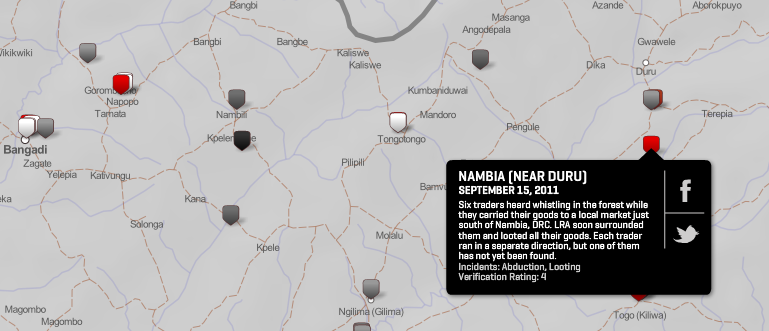
But something happened recently that I thought set IC apart from some of the other trendy activists, and that’s the LRA Crisis Tracker. Invisible Children and Resolve have been working for almost a year to set up radio towers throughout the DRC to establish warning systems and to better track LRA activity. Crisis mapping has become a pretty big field recently, and its use in this region has the potential to be of tremendous help. The information on the mapping tool comes from a variety of sources, including human rights NGOs and journalist reports, and is being updated constantly to give an accurate account of LRA activity and displacement migration. If you’re interested in the LRA or crisis-mapping you should check out the site and peruse the methodology book.

Screen cap of northeastern DRC from today.

Ethical Eating, Or How I Tried to Continue Eating Everything Without Remorse

When it comes to types of diet, I have always been firmly in the omnivore bracket. I have had plenty of friends that run the spectrum of vegetarianism for a variety of health and ethical reasons, but I haven’t really changed much. Taste-wise, I like meat too much and vegetables too little. Health-wise, I still have a hearty metabolism and I keep semi-fit. Ethics-wise, it gets a little fuzzy. I’ll get to a point soon, I promise, but for years I have been aware of the lack of humane treatment of livestock in the farming industry. Kim and I have had plenty of conversations about how meat is made and what kind of food we should actually eat.

I don’t think I’m very close to becoming a vegetarian, but if I had the option I would definitely become an ethical omnivore. This would mean, of course, that I only supported the ethical treatment and humane slaughter of animals. If you raise your cows living in their own waste and you cram chickens into poorly ventilated barn houses, you wouldn’t be seeing my money. If you let your livestock roam freely and killed them humanely, I’d be a consumer. While some think that this doesn’t mean much because I’m still eating a murdered animal, I’ve been a firm believer of nature’s gracing of humans with the means to be omnivores and I know that plants strive to survive just as much as animals even if they don’t have faces. What I’m not a firm believer in is mistreating animals just because you can or just because you’re going to eat them anyways. And so I look to more ethical eating and I find relatively little satisfaction because free range, come to find, means little.

A rigid search for the standards for free-range is relatively fruitless. The term, historically at least, refers to ranchers who allowed their herds to wander without fences – freely. As far as the food industry is concerned, it used to mean farms that kept livestock outside and able to move and perform natural acts – like perching, dust bathing, the like – until it was time for slaughter. But when it comes to the food I eat, what does free-range mean? According to the USDA, it doesn’t really mean much. Evidence A is a pdf with the specifics of a law pertaining to animal welfare:

§ 205.239 Livestock living conditions.

(a) The producer of an organic livestock operation must establish and maintain livestock living conditions which accommodate the health and natural behavior of animals, including: (1) Access to the outdoors, shade, shelter, exercise areas, fresh air, and direct sunlight suitable to the species, its stage of production, the climate, and the environment;

Concerning the National Organic Standards, the USDA had faced the problem of defining what it meant to have “access to the outdoors,” and in a memo in 2002 [PDF] tried and failed to give it an adequate definition:

Access to the outdoors simply means that a producer must provide livestock with an opportunity to exit any barn or other enclosed structure. Access to the outdoors does not require a producer to comply with a specific space or stocking rate requirement. Neither does the requirement mandate that an entire herd or flock have access to the outdoors at any one time nor does the requirement supercede the producer’s responsibility for providing living conditions that accommodate livestock health, safety or well-being.

In other words, “access to the outdoors” means leaving a door open. For some farms, this means a barn house with poor ventilation and no light and packed with chickens wandering in their own filth might have a minuscule enclosed patio with a little bit of sun. And so I continued my search and finally found the words “free-range.” I was exhilarated! It was exactly what I had been looking for all along: the Meat and Poultry Labeling Terms page. That must have a thorough definition of what it means when I buy something that has a “free-range” sticker on it!

FREE RANGE or FREE ROAMING:
Producers must demonstrate to the Agency that the poultry has been allowed access to the outside.

Thanks, Government.

Meanwhile, Back at the Blog…

I have been suffering from a bit of writer’s block on this side of the blogging. Or, rather, my life has bit at a bit of a standstill so there is less about which to blog. One thing this blog has been doing, though, is getting a facelift. Backslash Scott Thoughts is almost two whole years old, and it’s been the same template (even the widgets) since day one. Over the last week or so I’ve been revamping the whole thing, top down. In addition to the cosmetic change here, I’ve been blogging at the history blog (which is now available via a handy dandy link up top) about gerrymandering, Ugandan rebels, the Bill of Rights, the Vietnam Veterans Memorial, and Ralph Nader.

But I am doing more than just blogging at home. We’ve been continuing to renovate the house (on which there is a pending post) and I’m going to hopefully begin volunteering with a refugee group soon, something I’ve wanted to do for a couple of years now. I’m also not quite finished with the blog makeover, so I’ll continue working on that. Ideally, you will be aghast at all of the amazing things I post in the next few weeks. Until then, enjoy the list of special ingredients.

The Longest Interlude

The semester has begun for most, which has meant relatively little change to me. I’m entering 98 days without work right now, not counting the couple of days where I helped my mom rake a yard old school style. I’m signed up to take yet another AEPA test in two weeks, but I don’t entirely know why. The GRE is scheduled for October, and I’m wondering how exactly to prepare for that. In between, I have no idea what I’ll do. With school starting, I’ve found some reprieve in seeing a few friends between classes, and I have a few chores around the house that have yet to be done despite the longest summer ever.

I’ve taken up a hobby that really isn’t all that new. I’ve decided that I’m going to submit whole new writing samples with my graduate school applications, so I’m doing research on a new paper. I’m two pages of writing and several books and articles in and I’m starting to wonder if it’s really worth it. It’s not like my writing has improved that much. The paper only maybe passes the “so what?” test that my history professor always said to use. Looking at my list of hopeful grad schools, I wonder if this would make any difference, or if I’d get into any of these places at all.

Most of the time I teeter between being absolutely bored out of my mind and being daunted by the lamest to-do list. I’ve found myself missing the little things and plotting faraway things and living off a useless sleep schedule, all while checking off things like “go to the store” and “sweep the patio.” I’m weighing a menial job versus volunteer work as far as finding something to do. Bottom line is that I don’t know what I’m doing. I was unemployed for the first five months of this year and it was one of the greatest (most stressful) things I’ve done. The more recent three months have been a bit less eventful. I guess going to the White House beats having a student try to take pills in my class, though.

I’m thinking of setting up a routine. That way I should get my research done in a timely manner, get in some studying for the GRE, and maybe get this kitchen re-vamp underway. And there’s always the task of finding something to blog about. What ever happened to that?

Henry V at Washington, or a Letter to the Resolve Fifteen

This is an open letter to my fellow advocates and dear friends with whom I spent a lot of time (and at the same time not enough) in DC. It’s on this blog instead of an e-mail because what I experienced this weekend really should be on the record. If you want to know why we were there, click here. If you want to see what I did with my own time, click here.

To Whom Advocating for Peace is the Most Paramount Task,

In Lawrence Weschler’s Vermeer in Bosnia, he uses a scene of human rights abuse in Shakespeare’s Henry V to analyze the massacre at Srebrenica. Since we were all in DC as a part of our advocacy against mass atrocities, I thought it was fitting that I thought of a wholly different part of the same play. What we learn from Shakespeare is that, on St. Crispen’s Day, Westmoreland wished they had more troops to fight, to which the King responded – at length – that he would rather die with those who were around him: “we few, we happy few, we band of brothers.”

There were only a few of us that were able to make the trek to Washington this weekend. I boarded my plane knowing two friends would be there, alongside a few who I only knew over the phone, and a handful of strangers. I left with over a dozen friends with whom I can share this experience. And it’s not just an experience of being able to say “I got to see David Plouffe speak” or “Holy crap I just saw Bo in the hallway,” it’s much more than that.

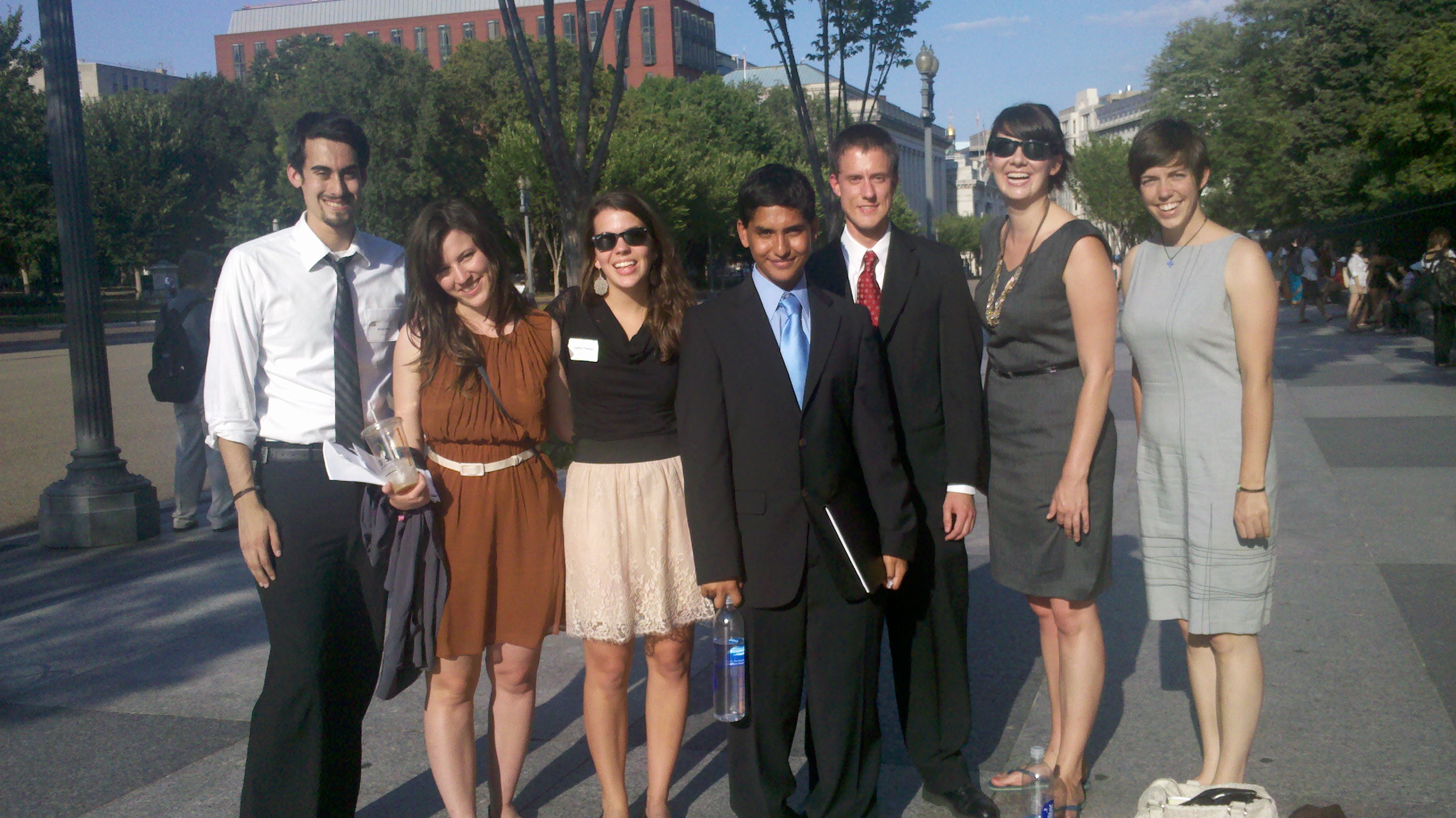
Half of the gang on Pennsylvania Avenue

It’s the fact that I can say that not only did most of us meet for the first time at State Place & 17th Street in the early morning on Friday – and proceed to spend almost all of the next 48 hours together – but that we made true friends and learned a lot from one another during that time. It was with this group of new friends that I learned about the Fourth Estate (which I sadly missed and sounds inspiring) and shared my thoughts on America’s LRA strategy (thanks for listening, Adam). I experienced my first poetry slam at Busboys and ate the greatest sweet potato fries. I met four people whom I could never thank enough for helping me over the years via phone calls and e-mails, and I had three people bear witness to the hostel at which I stayed.

Eugene tells a story. Laughter ensues.

More than learning about USAID’s programs around the world and seeing the White House’s outreach efforts first hand, I got soaked in rain with friends – twice – and got in more than one conversation about the attractiveness of a certain former Director of African Affairs at the NSC. I talked about the ICC, heard about conflicts in the CAR, and learned about crisis mapping in the DRC. But I also learned how not to use Camden Yards as a slip’n’slide, was compared to the sorcerer Jafar, and laughed uncontrollably at somebody saying “K as in knitting.”

I am truly humbled by having the chance to meet you this weekend. We all traveled to DC, some of us flying across the Great Plains while others took buses up from the South, to hear what the White House had to say and learn from it. I have been involved with this cause for a long time in my life, but I got involved my senior year of high school. I am only 21 years old and I just barely finished my undergrad, and yet I wasn’t out of place. Some of you are still in high school and are already raising thousands of dollars and lobbying your senators and representatives for this. Some of you have been done with school and are already forging ahead into the real world, blazing the trail for advocates. You all are superstars.

While we were able to raise our concerns with several officials (spitting fire while we did it), we did even more. We solidified our place as advocates with more than just an issue or a cause, but with a passion. As I told some of you, I’m at sort of an impasse in my life where I’ve stopped cheering for Enough and I haven’t fundraised as much for IC as I used to, but I can’t stop, won’t stop, advocating for peace and justice through Resolve.

To each and every one of you who joined me in any of these escapades, thank you. We raised our voices and delivered letters, we definitely made a difference. But I sure as hell made some great friends too.