Weekend Reading

Let’s do some reading:

“Choice” was the word on Ann Romney’s lips in her Fox News appearance this morning. “We need to respect the choices that women make,” she said several times, adding, “Mitt respects women that make different choices.” “Choice,” of course, is a word that represents in other contexts, like abortion rights, a negotiated truce on rights and liberties of women to live within and without their traditional roles. But Ann Romney’s use of it shows how limited it is as a trope: Is it a relevant “choice” for the vast majority of American women to decide whether to use their degree in French in the workforce or rationally rest on their husband’s millions to focus on five children – six, according to Ann, if you count mischievous Mitt?

The more pertinent “choice” involves a series of unappealing options when it comes to affordable childcare or workforce opportunities. According to the census, the proportion of mothers with a recent birth in the labor force increased during the recession, from 56 percent in 2006 to 61 percent in 2008. And another Census Bureau report suggests that the 5.6 million stay-at-home mothers, a minority among mothers, have little in common with Ann Romney. They tend to be younger, Latina and foreign-born – and they are less likely to have graduated from high school or attained a bachelor’s degree. These women face markedly different circumstances from the more publicly visible stakeholders in alleged Mommy Wars, the ones who opted out of the workforce and who have the ear of people making movies and writing novels, but the women with the luxury to live on a single income at their expected standard of living are a statistical and demographic blip. The bulk of stay-at-home moms have characteristics that correlate to lower earnings in the workforce, and for them, with the high cost and inaccessibility of childcare, the “free” childcare offered by staying at home is also a rational economic choice.

The meeting was a few blocks from where I live. The spam said it was “inspired by Occupy Wall Street.” I wasn’t sure what that meant, but I was vaguely hoping that whatever The 99% Spring was, it would start a chapter of Occupy Wall Street on the Upper West Side, conveniently near my abode, and agitate for the Democrats and MoveOn to move left.

The first clue that my evening might go otherwise was the sign-up table, where there were a bunch of Obama buttons for sale and one sign-up sheet for the oddly named Community Free Democrats (are they free of community?), which is the local Democratic clubhouse. That killed the “inspired by Occupy Wall Street” vibe right there. No piles of literature from a zillion different groups, as there had been in Zuccotti Park. No animated arguments among Marxists, anarchists, progressives, punks, engaged Buddhists, anti-war libertarians and what have you. Just Obama buttons, which didn’t appear to be selling.

Enforcing Arizona’s Progressive Constitution

Yesterday I wrote about 2/3 of a panel that I saw the Arizona Historical Society concerning the state’s constitution and its place in the progressive movement. It was interesting to hear about how groundbreaking Arizona’s founding document was and how involved labor and the progressive movement were in constructing that document, but it wasn’t entirely convincing since Arizona is so reactionary now. Arizona, after all, is the home to a slew of seemingly disastrous legislative ideas and hosts some of the most conservative state officials in the country.

The third speaker at Wednesday’s panel was Paul Bender, a law professor at ASU, who concentrated on Arizona’s State Supreme Court and explained how it had allowed – or took part in – the gradual crumbling of the state’s relatively progressive constitution. He broke his lecture into three ways in which the Court has treated the constitution: stripping it down, protecting it, and ignoring it altogether.

Direct Democracy

Bender argued that the Arizona Supreme Court was uncomfortable with the amount of direct democracy inherent in the constitution, and therefore allowed the state’s government to circumvent some of the obstacles that direct democracy created. The initiative process in the constitution allows the general public to circumvent the legislature in the lawmaking process, creating laws by popular ballot. This inherently implies that the legislature is beholden to what the people decide, however there were a number of instances in which the legislature repealed laws passed by initiative. When the issue was brought before the judicial branch, judges said they saw no issue with legislators opposing popular initiatives.

In addition, Bender explained, state legislation is not supposed to go into effect until 90 days after the legislative session ends, allowing time for the public to gather signatures for an opposing referendum if so desired. There is a provision that allows legislation to be enacted immediately during emergency situations, with 2/3 of the legislature’s approval. Often times, the legislature invokes an emergency without the grounds to do so, and when this is brought up to the courts, they deny review on the grounds that it is too political an issue.

And so we see instances in which the legislature pushes back against the control that the constitution grants the public over governance. But beyond this, we also see the judiciary stepping aside and allowing it to happen despite clear breaches of the law.

The Right to File Suit for Damages

The state of Arizona’s constitution specifically enumerates the right to sue for damages, which might seem bizarre to many. It’s as much a product of the times as the rest of the constitution – hearkening to labor’s involvement and the fear of major corporations corrupting the system. Indeed, there were some occasions of the legislation trying to limit the right to file suit through statues of limitations or restrictions on types of cases – all of which have been ruled unconstitutional by the state Supreme Court. It’s easy to see why: the judges are preserving common law precedence. Men and women trained in the ways of law are working to preserve the law as it is. This doesn’t ring of hypocrisy when compared to the relatively foreign idea of the populace creating laws on their own. Where the courts were uncomfortable with direct democracy, they were more than comfortable with civil suits – and so they protected the notion of a right to sue.

Individual Rights

The U.S. Bill of Rights specifies rights that the federal government cannot abridge. Historically, it did not apply to state governments until the Supreme Court began to implement a more activist reading of the document. It is for this reason that many states have almost identical rights included in their own state constitutions. Arizona is no different, except that the rights listed are more broad that the Bill of Rights. Take, for example, the First Amendment of the U.S. Constitution:

Congress shall make no law respecting an establishment of religion, or prohibiting the free exercise thereof; or abridging the freedom of speech, or of the press; or the right of the people peaceably to assemble, and to petition the Government for a redress of grievances.

And compare it to the Arizona constitution’s Article II, Sections 5 and 6:

Section 5. The right of petition, and of the people peaceably to assemble for the common good, shall never be abridged.

Section 6. Every person may freely speak, write, and publish on all subjects, being responsible for the abuse of that right.

The key difference is that the former specifies that one’s rights are protected from Congress, but makes no mention of state and local governments as well as private businesses and citizens. The latter simple states that everyone enjoys these rights – it implies that no one may abridge them. According to Bender, the Arizona Supreme Court has sometimes used to these provisions to protect people’s rights, but often defers to the more restrained precedence of the Supreme Court of the United States.

During the campaign to recall Governor Evan Mecham in 1987, campaign volunteers were prohibited from collecting signatures at some shopping malls – in Fiesta Mall Venture v. Mecham Recall Committee the state Appeals Court cited the U.S. Bill of Rights and upheld the decision, and the Supreme Court denied review. Similarly, in the case of Morton Berger, the state Supreme Court upheld his 200 year minimum sentencing for possession of child pornography, arguing that it was bound by the U.S. Supreme Court’s precedence instead of looking at the state constitution’s 8th amendment equivalent, Article 2, Section 15.

These are just some of the examples provided at the forum. It seems that the state’s judges have frequently ignored the progressive and protective provisions of the state’s constitution and instead either allow the legislature to be unaccountable or defer to the U.S. Supreme Court’s rulings. It is unfortunate to see the opportunity to defend civil liberties pass by because judges choose to forget that the state’s founding document protects them. But of course, judges in Arizona can be recalled and must pass retention votes every cycle – and several Republican lawmakers have threatened to do away with the merit-based selection system. While it is important to hold judges accountable as well, some of these rulings raise the question of whether or not judges should be elected and whether or not they are serving in the interests of the state’s constitution and the people who are protected by it – the public.

Arizona Fixes Vigilante Justice By Sanctifying It

Earlier this week two undocumented immigrants were killed in the town of Eloy, Arizona, allegedly after men dressed in camouflage shot up the truck they were hiding in. Arizona has been known for its problems with militias patrolling the border, and it has had its share of vigilante violence.

It is against this backdrop that some state legislators actually want to put a stamp of approval on these actions by creating a state-wide volunteer militia. The so-called “Arizona State Guard” would be established by the state if Senate Bill 1083 passes the state Senate (it has already passed the House).

The bill includes provisions to fund the militia with gang task-force money ($1.4M), grant immunity to militia members “while on duty… in camp, maneuvers or formations, or while engaged in armory drill, or while on the way to or from such duties,” and create the appointment of a commissioner by the governor. The purpose of the militia is to unilaterally apprehend those involved in cross-border crimes at the behest of the governor or as a part of cooperative effort with city, county, or federal law enforcement.

Just another piece of bullshit Arizona legislation.

Arizona’s Progressive Constitution – 100 Years Ago

Last night, I attended a forum at the Arizona Historical Society on the state’s constitution. The panel at the forum was made up of a history professor (who taught the first university class I ever took!), a law professor, and a lawyer. I wanted to paraphrase some of what was discussed, as well as reflect a bit.

Arizona on the verge of statehood in 1911.

At the forum, historian Phillip VanderMeer touched on the historical context of Arizona’s constitutional convention in 1910. State governments had shifted from a strong legislature to increasingly balanced branches of government, and at the time of Arizona’s statehood, progressive ideas were finding their way into states’ founding constitutions, revised constitutions, and amendments. At the turn of the century, Arizona’s economy was deeply influenced by railroad and mining companies, and the workers in these companies struggled to achieve rights. It was at the constitutional convention that organized labor brought ideas including an eight-hour workday, an elected state mine inspector, the prohibition of blacklists of labor leaders, and a ban on child labor – all of which made it into the constitution, along with broad progressive ideas such as initiative, referendum, recall, and direct primaries.

Paul Eckstein, a civil lawyer here in Arizona, spoke about the actual debates and influences on the constitutional convention in 1910. He explained the nature of Arizona’s divided demographics – the territorial legislature was predominantly Democrat, but the territorial governor (appointed by the President of the U.S.) was almost always Republican. Across the border, New Mexico was predominantly Republican, and so both states were admitted at the same time in the name of balance. Eckstein pointed to Arizona’s constitution’s progressiveness relative to our sister state’s founding document as well as contemporary models of statehood across the West and Midwest. He listed a number of things New Mexico’s constitution did not have, that Arizona’s did have (remember, this is in 1912, and both constitutions went into effect almost simultaneously):

  • Initiative
  • Popular Referendum
  • 2 year terms for elected officials
  • Advisory popular vote for the U.S. Senate
  • Direct primaries
  • Public campaign contribution provisions
  • State anti-trust laws
  • Progressive income tax

Some of these are clearly at the forefront of the progressive movement at the turn of the century. Arizona was talking about campaign finance, direct election of Senators, and a progressive income tax before the federal government had made any headway on these issues. Women gained suffrage in 1912, before the 19th Amendment was passed, and prohibition in 1914, five years before the 18th Amendment. President Taft opposed the right to recall judges, leading the territory to remove the provision in order to gain statehood – only to reinstate it almost immediately.

Progressive ideals, especially the idea that the government should be held accountable to the public, is clear in Arizona’s constitution. Two year terms for elected office and the ability to recall elected officials combine for a strong opportunity to keep lawmakers on tight reins. In addition, the executive branch in Arizona was very weak – he was among over a dozen elected officials in the executive and had relatively few appointment powers. The people refused to allow the legislature to run rampant without the support of the general populace.

While some Arizonans today are unfortunately supportive of the more restrictive pieces of legislation put forth in the legislature, the real problem is that the constitution is no longer recognized for what it is supposed to do – lawmakers are not answering to the public and the three branches are not utilizing checks and balances. One of the main tenets of the constitution – to hold government accountable to the public – isn’t happening anymore. Our legislators are not being scrutinized as much as they should – even in light of the recent recall of Russell Pearce.

Update: The sequel of this post, examining how the state’s courts have treated the constitution, can be found here.

A Brief History of Insanity

Sallie Gardner at a Gallop by Eadweard Muybridge.

Yesterday’s Google doodle was a brilliant celebration of photographer Eadweard Muybridge’s birthday. Muybridge is most well-known for his work in recording animals in motion, specifically the horse’s gallop – which simultaneously solved the question of the manner in which horses gallop and pissed off Governor Leland Stanford. I told my wife about it, as she loves photography and is studying art history – and because it was a really cool feature. Not only had she already seen it, she had already clicked through and perused the accompanying Wikipedia article, informing me of this interesting bit of history:

In 1874, while still living in the San Francisco Bay Area, Muybridge discovered that his young wife Flora had a lover, a Major Harry Larkyns. On 17 October, he sought out Larkyns and said, “Good evening, Major, my name is Muybridge and here’s the answer to the letter you sent my wife.” He shot and killed the major pointblank.

Muybridge was tried for murder. His defense attorney pleaded insanity due to a head injury that Muybridge had sustained following his stagecoach accident. Friends testified that the accident had dramatically changed Muybridge’s personality from genial and pleasant to unstable and erratic.

Ultimately, Muybridge’s insanity plea was dismissed, but the jury found the incident a case of justifiable homicide (which is… interesting). Regardless, we got to thinking – how early did the insanity plea enter our courtrooms? And I don’t mean convenient pleas of temporary insanity (like, say, Congressman Daniel Sickles) – Muybridge (also known as Edward James Muggeridge, Eduardo Santiago Muggeridge, and Helios) exhibited some eccentricities.

There are instances of people of unsound mind committing crimes throughout history, of course, but instances of declaring a defense of insanity took a while to reach the tenuous place we are today. In 1764 a British man named Edward Arnold was tried for shooting at Lord Onslow allegedly after he had been bewitched. He plead insanity, and it was in this case that the judge asked the jury to determine whether Arnold had the mental capacity and reason like that of a wild beast or infant – the apparent measure of insanity at the time. Arnold was found guilty and sentenced to death, a sentence which was commuted to life in prison at the behest of Onslow. In 1840, Edward Oxford tried to kill Queen Victoria and was acquitted by reason of insanity, under the notion that he could not resist the impulse to fire due to lack of mental capacity.

After an attempt to kill the British Prime Minister in 1843, a panel of judges drafted the M’Naghten Rules, which answered hypothetical questions that gave an outline of the insanity plea and its application, including that the suspect be unable to determine the difference between right and wrong or did not understand the nature of the alleged act. Most common law countries used these guidelines until the 1950s, when the American Law Institute issued the Model Penal Code that established that the defendant had to have “substantial capacity” to understand the crime and criminality in order to face trial.

Alvin Ford is escorted by a police officer. Photo from Associated Press.

After John Hinckley tried to kill President Ronald Reagan, the Insanity Defense Reform Act of 1984 was passed by Congress. Unlike the assassination attempts in England that led to updates to laws concerning the insane, Congress’ response to Reagan’s close encounter made it much harder to be found not guilty by reason of insanity, placing more stringent rules on evidence and placing the burden of proof on the defense. In 1986, the landmark Supreme Court decision Ford v. Wainwright argued that the insane cannot be executed, however in 2005 the Court upheld a state’s rights to limit expert testimony to the insanity defense (thus not qualifying to determine criminal intent) in Clark v. Arizona. There are whole states that have actually banned the insanity plea, bans which have so far been upheld in most cases.

We’ve come a long way since Dorothy Talbye was hanged after God told her to kill her daughter. But the insanity plea is actually quite rare, and very difficult to use – even when it actually applies. It’s just a small part in the overwhelming societies that marginalizes, institutionalizes, and incarcerates the mentally ill.

Weekend Reading

The Two-Cocktail Makeover.

Soldiers train alongside the base's pet sheep. Photo from UN, credit Albert Gonzales Farran.

White Until Proven Black: Racism in The Hunger Games.

Playing the blame game with the cholera epidemic in Haiti.

Despite massive budget cuts, there’s a building boom in our universities.

Al Qaeda is probably not coming back to New York anytime soon.

Lindy West re-watched Titanic so you don’t have to.

George Zimmerman and Robert Bales: The Watchmen and People Out of Place.

The NYU law student who spoke out against Justice Scalia has more to say.

The quietest room in the world will also drive you crazy.

American citizens’ family members in the Phillipines that applied for immigration to the U.S. the year that I was born would just now be receiving visas.

Aaron Bady on the Supreme Court’s decision regarding strip searches in jails:

If we put aside the fact that US prisons are already hives of contraband — that super-overcrowding in correctional facilities has meant that actual practical surveillance of incarcerated populations is effectively nil — the logic of this argument simply asserts that unwarranted invasions of privacy are a lesser evil than impracticality. But why do we presume that these two things are incompatible? Why must we have one or the other? Where does that necessity to choose come from?

This is why we probably shouldn’t put aside the fact that our prison system is overcrowded and underfunded to an outrageous degree. Because when the Supremes start talking about what is and isn’t workable, what they’re really saying is: we can’t afford to provide the kinds of rights which the bill of rights promises. To say that it wouldn’t be workable to treat citizens in custody as still having the rights that no court has yet ruled to strip away — that “it would be difficult to determine whether individual detainees fall within the proposed exemption” is simply to say that the work of observing constitutional rights, spending the time and money to see that it is done properly, is beyond our powers as a society. It is too difficult. There are, obviously, ways to make prisons more “secure” which do not involve putting a hand in your anus, and if the Supremes mandated that they find them, they would. It’s just that, given the massive overcrowding of our prisons (and the underfunding which flows out of that overcrowding), a hand in the anus is the cheapest way to do it.

Oh, and the aforementioned strip search ruling? Obama’s Department of Justice asked for it.

Koritha Mitchell answers some questions about her book, Living with Lynching.

From Emmit Till to Trayvon Martin: How Black Women Turn Grief into Action.

What do campus police need when dealing with protesters? More force options!

Some analysis on Azawad independence from Mali.

And let’s not forget that the U.S. helped train military leaders in Mali, including the leader of the coup.

On America’s occupation of Australia.

More critiques of Nick Kristof, this time on why we should stay away from his anti-prostitute agenda.

On privacy, secrecy, and transparency from the government to WikiLeaks, or the Fog of More:

But rather than keep fewer records, agencies increasingly used newly invented databanks, the better to build a virtual you. Their computers could pluck out any detail of your life and add it to the government’s central, databanked composite. As a result, Americans were left trying to figure out just who the government thought they were, and thus the first lineaments of the transparency movement stirred to life. It didn’t seek to roll back data collection either; instead it sought new legislation to force government disclosure — i.e., greater transparency of the state rather than protection of individual privacy. The government would keep collecting information, but citizens could see what and why. The Freedom of Information Act of 1966 offered legal tools for processing disclosure requests, and the Privacy Act of 1974 gave citizens greater access to the data collected about them. But in 1997, when Senators Daniel Patrick Moynihan and Jesse Helms co-sponsored the Government Secrecy Act, arguing that fewer documents should be classified and that more documents be declassified automatically over time, the bill died unmourned in committee.

When Facebook reprocesses our personal information, the data miners are generally only trying to sell us weirdly specific products or target ads.  But when the government is concerned, the stakes are different. In 2005, several telecommunications companies were caught supplying personal information to the National Security Agency, demonstrating the dangers of corporate data accumulation. What if the NSA decides it wants full personality profiles of everyone who “attended” #OccupyWallStreet on Facebook? It would be a matter of keystrokes to supply entire “social graphs” for each of them.

The Obama administration has also sought to prevent lawsuits against the NSA’s warrantless wiretapping, no less, by invoking the state secrets doctrine; we are infinitely transparent, while the government is enshrouded, and the complicit corporations too.  It’s for national security. Try filing a FOIA request.

So, abortion survivors are a thing.

Is your facebook password more like your mail, your house keys, or a drug test?

This is what it looks like when Facebook gets subpoenaed for your info.

Minimum wage is way too low.

A big city writer goes home in defense of Dallas.

Whether your a gun rights activist, a white supremacist, or a police officer – it’s going to be a long, hot summer.

On Tinariwen, Mali, and the Failure of Western Music Media.

The GOP doesn’t think there’s a war on women,  but Reince Priebus isn’t afraid to declare war on caterpillars.

My Secular Holidays

This has been one of many three day weekends that dot the calendar for workers. In addition to the ten federal holidays, many public school calendars are peppered with other holidays, including the aptly named “Spring Holiday.” It’s the weekend which I find myself in the middle of – straddled by yesterday’s Good Friday (which I spent doing chores) and tomorrow’s Easter Sunday (probably big meals and egg decorating). Early in my schooling years I remember being told that every month had at least one day off except April, which is where Spring Holiday comes in. This holiday is also conveniently on Good Friday. Every. Single. Year. (Except 2005, which brought about this protest at my rival school).

As an atheist, I don’t have many holidays to observe, and I usually get pushed into quasi-celebrating the major Christian holidays around me. But while I don’t believe, I do so like tradition. My parents raised me with little in the ways of religious tradition – everyone assumed I was Protestant, while I was rarely if ever aware of that fact. And so I find myself settling in by re-appropriating all of the pagan traditions that were stolen by the Holy Roman Empire. While Easter might signify some major events in Christianity, to us non-believers it’s a time filled with the most fertile things nature has to offer: eggs, bunnies, and spring time. And chocolate. My traditions don’t include fasting and morning mass – I usually just blow up Peeps in the microwave.

Every year I hear a lot of people lamenting the commercialization of their favorite holiday, but I can’t help but think it’s awesome. The only thing I find significant about Christmas is spending time with family and decorating the house (and gifts, of course). So if Target’s annual explosion of decor makes this easier, I’m for it. If it becomes easier to find winter-themed plates and reindeer salt and pepper shakers, then I suppose I’m happy. For me, virtually all of my holidays are comprised of shopping for things, helping my wife bake something awesome, and then hanging out with people. Plus, I’m sure one of those actions helps the economy or something.

Tomorrow, I’ll be meeting up with a number of people who will be celebrating Easter. I’ll be celebrating warmer weather by decorating eggs and seeing who wins Peep Fight 2012.

Weekend Reading

Here’s another dose of reading for anyone who is interested, in its usual disorder:

Paintballing with Hezbollah.

On Sealand and free information: The Death of a Data Haven.

The Euro Crisis: the Merkel Line, the Monti Line, and the Left.

A Tale of Two Cities: On student protests in Columbus, Ohio and Montreal, Quebec.

The Enduring Popularity of the Suntan.

I have mixed feelings about this effort to domesticate a wild species of fox in one human lifetime, which is in danger of ending prematurely.

The Foreign Language of Mad Men.

Reflections on police from someone who visited Zucotti Park the day before protesters attempted to retake it.

And further discussion from someone who visited Frank Ogawa Plaza the day after police took it.

Reflections on the march from Selma to Montgomery.

Readings culled from Aaron Bady’s long series of Sunday Readings:

Trayvon Martin, White America, and the Return of Dred Scott.

Martin was killed because white people are afraid of black people.

Laurie Penny reflects on race, class, and the Million Hoodie March.

The third British empire: the offshore financial empire.

A homeless woman is arrested at a hospital for trespassing, then dies in jail.

I haven’t read/watched The Hunger Games, but that doesn’t mean I can’t share:

Changes in the Colombian student movement.

Gandalf saves The Hobbit Pub.

One man is planning to walk down every street in New York’s five boroughs.

An abortion clinic’s landlord turns the tables on protesters. Of course the protesters escalated.

On what fact checking means in America today:

Increasingly, for American readers, there are no mistakes, only covert ideologies. And out of necessity, TV networks, newspapers, and some magazines have bought into this mentality wholesale, serving up laborious platters of “fair and balanced” to consumers who lack the will and perhaps also the capacity to engage in any critical analysis of the information they are fed. They compete with one another on the terrain of “accuracy” and “neutrality.” And it is because the U.S. media is so obsessed with its own so-called objectivity that predatory checking — an offshoot of the traditional checking in newsrooms and magazines — has dominated the discourse. Checking is no longer just a link in the editorial sausage machine; it is an integral part of the public political discourse and a fixture in American popular culture. An army of professional and citizen fact-checkers have taken the process out of the newsroom and into the open.

This new wave of checkers — what the Times public editor famously called “vigilantes” — are different from the editors and aspiring writers at newspapers and magazines who silently bulletproof the stories their magazines publish (Peter Canby, the New Yorker’s head of fact checking, has acknowledged that “checkers are distinguished only by their mistakes.”)  The vigilantes work with a very different goal. They’re guerrillas; they live to pounce, to catch their enemies at their most vulnerable moments, and to parade their heads around on a stick, declaring smugly: untruth!

Middle class occupation protests in the U.S. and Israel.

The U.S. Student Association enters the era of the Occupy movement.

Why the MPAA doesn’t want your kid to see Bully.

Harvard students speak out about the media’s bad job reporting their detainment in Palestine.

From the new Journal of Occupied Studies, some thoughts on OWS:

“On the People’s Mic” by Ryan Ruby

“Uncritical Faculties” by Eric Lohman

“They Are Not Afraid” by Jeremy Varon:

It should come as no surprise, then, that OWS’s most significant (if still intangible) “gain” has been the recent retooling of the Obama campaign to stress issues of equity and shared sacrifice (however tepid that message and the reforms it suggests). In this second echo, OWS’s peculiar, tripartite character comes in to view: to pressure ostensibly progressive leaders and institutions to fight more aggressively on behalf of their professed beliefs; to argue the implication even of the liberal establishment within corporate dominance; and to charge that the entire political system is so procedurally dysfunctional and clogged with corporate power that the institutions of representative democracy are not adequate for realizing true solutions to the current crisis. Put otherwise, and now in spatial terms, a radical utopian kernel seeking potentially revolutionary change in the form of direct democracy is surrounded by a more strategic skepticism regarding possibilities even for meaningful change within the framework of existing institutions; both these impulses, likely at the fringe of the American mainstream, at once animate and receive succor from an ambient, common-sense populism that desires, through reform politics, the partial righting of basic social wrongs.

How was this breakthrough in political discourse possible? It was achieved on the back of another breakthrough, which I’ll call simply a shift in people’s level of seriousness, with potentially far-reaching consequences. At the core of OWS’s early success is the acceptance in individuals and communities of the need for resistance, a heightened sense of personal responsibility to participate in struggle, and a stubborn faith that one can transform this society, despite the very condition of hopelessness at the center of the OWS complaint. That conviction has expressed itself in a variety of forms. Perhaps above all, countless thousands of people are willing today, in ways they were not just a year ago, to make sacrifices, to take risks, and even go to jail to take and hold this park or bridge or campus encampment, to walk down this street, to protest in this lobby of this bank, at this foreclosure hearing. It’s a profound breakthrough — this readiness to assume risk on a large scale — produced by a social alchemy no one fully understands.

The History of Peace and Conflict with the LRA

As Invisible Children and Resolve continue the push to support the US advisers in their collaborative mission to apprehend Josephy Kony, there continues to be a lot of discussion about the perceived militarism of the campaign.  One of the primary focuses of the Kony 2012 campaign is, of course, to capture Kony. If the multinational effort to apprehend Kony is successful, it will have lasting impacts on peace and security in the region as well as bolster the fragile framework of international justice. If it is unsuccessful, it has the potential to be damning for the people on the ground. The more peaceful the resolution to this conflict, the better. But it’s worth discussing why this is the option that many of us are talking about right now.

Historically, both peaceful negotiations with the LRA and armed operations against the LRA have led to instances of violence against nearby civilians. This is due to the rebels’ horrific tactics but also to inconsistency in the Ugandan government’s stance. The usual pattern is that the LRA would drag out peace talks while they regrouped, and then the Ugandan government would grow tired of peace talks and launch a failed attack, thus driving the now regrouped LRA to lash out at civilians, leading to perhaps another set of negotiations. For example:

The Growing LRA Problem: From Operation North to Peace Talks to Massacres
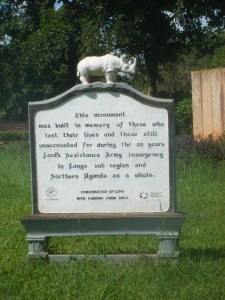
A monument to LRA victims in Lira town.

The LRA grew out of the Alice Lakwena’s Holy Spirit Movement, but incorporated other northern rebel groups in the aftermath of current President Yoweri Museveni’s rise to power. In the ensuing years, the LRA became more and more of a problem for the government, which reacted in two ways. Betty Bigombe was appointed as a government minister to deal with the insurgency in 1988, and she encouraged defections and established a dialog with the LRA. Meanwhile, the Ugandan military (NRA) launched Operation North, which included arbitrary arrests of alleged collaborators and attacks against LRA positions. In 1992, Bigombe set about creating Arrow Groups, village militias to defend against the LRA, but the rebels reacted with brutal attacks against civilians to discourage collaboration with the government.

In 1993, Bigombe decided to reach out to the LRA to begin the process of a peaceful resolution to the conflict. Talks began that November, with the LRA searching for blanket amnesty in return for disarming. During the peace talks, Gulu was incredibly peaceful and NRA leaders began taking part – but relations deteriorated as military leaders asked for surrender while LRA wanted integration.

LRA placed the talks on hold and NRA leaders grew more impatient, and in February of 1994 President Museveni suddenly announced in Gulu that the LRA had seven days to surrender. Attacks resumed almost immediately, and the LRA began to perceive the Acholi civilians as collaborators, leading to the rise of civilian casualties. Soon the LRA began establishing bases in Sudan, where they rearmed and stepped up attacks in northern Uganda, including the Atiak massacre. This was also the beginning of widespread use of abductions both as a tactic and for recruitment.

Civil War Expands: Displacement, Invasion, and Retaliation

The IDP camp in Kitgum, credit K. Burns, USAID.

In response to massacres like the one at Atiak and the high-profile abduction of the Aboke girls, the Ugandan government enacted a dubious plan to address the crisis in Northern Uganda – by corralling civilians into displacement camps.  The camps were ostensibly to protect civilians but in reality had little protection and scarce food, water, and sanitation.

The government of Sudan supported the LRA, in part as retribution for Uganda’s support of the Sudanese Peoples Liberation Army (SPLA), the rebel movement that would later help win independence for South Sudan. With this support, Kony and the LRA unleashed more violence against Ugandan civilians in the north while maintaining bases in southern Sudan, where they also attacked civilians on behalf of the government there. After the 1998 embassy bombings and even more after 9/11, the U.S. pressured Sudan for assistance in counter-terrorism efforts that also led to an agreement allowing the Ugandan military, now the Ugandan People’s Defense Force, to launch an attack across the border into southern Sudan.

The Ugandan military had just withdrawn from the DRC, where soldiers had looted the country’s resources and killed numbers of civilians during the Second Congo War. Many of these returned soldiers were sent to Sudan to take part in Operation Iron Fist. The results were disastrous: the LRA fled the attacks and slipped back into Uganda, carrying out reprisal killings at IDP camps across the region.

In the mid-2000s, the two sides were brought together for infrequent negotiations.  The Ugandan parliament passed an amnesty law that allowed some LRA to return home and a ceasefire zone was established, but talks ended when chief negotiator for the LRA Sam Kolo surrendered to the government. It was also during this time that the ICC investigated the LRA for mass atrocity crimes, eventually issuing indictments for the LRA leadership. Meanwhile, most rebel fighters migrated westward to the Garamba National Forest in northeastern DRC, where they settled as a new set of peace talks began in Juba, Sudan.

Leaving Uganda: The Juba Peace Talks, Operation Lightning Thunder, and the Christmas Massacres

From 2006 to 2008 the Juba Peace Talks [PDF] sputtered forwards with marginal ceasefires and the movement of the LRA to assembly areas for negotiations. While the LRA were gathered in the DRC, where they received food aid from Caritas (with support from several European governments) to keep them from raiding villages for supplies, however there were allegations that they secretly sold some of the food for arms. The two sides agreed to five main agenda items that they worked on when they weren’t threatening to leave the talks:

  1. Cessation of Hostilities included a series of short-term ceasefires, allowing northern Uganda to begin its recovery while negotiations continued.
  2. Comprehensive Solutions, which included issues of the national government’s institutional mistreatment of northerners and the resettlement and rehabilitation of IDPs.
  3. Accountability and Reconciliation was one of the biggest issues that forced the talks to be put on hold several times. Eventually, they agreed on a hybrid system that included a truth-telling mechanism and reparations for victims along with the creation of a human rights branch in the High Court of Uganda and the removal of the LRA from Ugandan terrorist lists. The issue of the ICC was somewhat vague, but both sides seemed willing to accept an end to the conflict in exchange for withdrawing warrants.
  4. Permanent Ceasefire was signed in early 2008,  assigning a battalion of SPLA soldiers as ceasefire monitors once the final peace agreement was signed.
  5. Disarmament, Demobilization, and Reintegration required the Ugandan government to address the ICC issue and allow LRA fighters to reintegrate into the national army. Those not willing to join the army agreed to disarm, and child soldiers would be supported through reintegration and educational programs.

In 2007 there was progress on the issue of accountability and reconciliation, but this progress was tainted by rumors that Vincent Otti, Kony’s second-in-command, had been executed after a power struggle within the LRA. Despite this, the two sides reached agreement on accountability in terms of alternative forms of justice, but the question remained of whether the ICC would drop its warrants in exchange for a peaceful resolution to the conflict. Kony refused to sign the final agreement until the indictments were lifted, and Uganda refused to apply to try war criminals under complementarity until after the LRA disarmed. The talks collapsed in April of 2008, with several failed attempts to reconvene throughout the summer, along with reports of LRA attacks in rural South Sudan and the DRC.

It was against this backdrop that the UPDF launched Operation Lightning Thunder, an attack coordinated with the DRC and South Sudan with intelligence and logistics support from the U.S., in December of 2008. The attack routed the rebels, who anticipated the attack, but failed to lead to the capture of any leaders and freed a minimal number of abductees. In response, the LRA set in motion what has been dubbed the Christmas massacres. In a coordinated attack across several towns and villages in the DRC, the LRA massacred hundreds of civilians and abducted around 100 more.

Since then, the Ugandan force was kicked out of the Congo in early 2009 due to international disputes, and the ill-equipped Congolese military has continued the charge against the LRA there.  The UPDF halved its LRA-hunting force in order to step up its presence in Somalia as a part of the peacekeeping force there, AMISOM, and the forces that remain on Kony’s tracks are ill-equipped for a manhunt.  The LRA, according to the LRA Crisis Tracker, have shifted further west and north to ungoverned spaces in CAR and DRC.

LRA attacks and sightings in 2012, to date. via LRA Crisis Tracker.

More recently, the US sent military advisers to the region in October of last year, and the African Union has nominally stepped in to create a multinational, Ugandan-led force. The hunt for Kony seems to be active in CAR, DRC, and South Sudan with some US advisers based in Uganda while others work in the field (reportedly setting up a base in Obo, CAR).  Civil society groups both locally and in the US have called on the forces to ensure the protection of civilians from retaliatory attacks and have put forth efforts to encourage LRA combatants to disarm and come home. As Paul Ronan points out, however, Uganda’s Amnesty Act is set to expire this year, which could have dire consequences for the effort to convince rebels to return.

The Way Forwards

The multilateral deployment continues its hunt for Kony.  As Patrick Wegner explains, the mission has had some success in reducing the amount of attacks carried out by the LRA in late 2011 (although this could be an LRA tactic since attacks dropped after a meeting between LRA commanders supposedly occured), but has accomplished little so far as capturing Kony and has failed to protect civilians in remote parts of the DRC.

The history I just bulldozed through shows that a military plan is not foolproof. But it also shows why many remain skeptical of a peaceful solution. Historically, the Ugandan government has alternated between negotiations and military incursions, and the LRA have used peaceful time periods to rearm and regroup. When the Juba Peace Talks fell through, the LRA had rearmed and the Ugandan government had given up on waiting for Kony. We are currently seeing lower hostilities committed by the LRA, but they may be regrouping once again.

Ever since the peace talks failed, groups like Resolve have looked at the option of a military apprehension of Kony that can effectively end the LRA. As Resolve recently stated, they are not opposed to a peaceful resolution. Indeed, if the LRA and relevant governments can reach a peaceful and legitimate agreement that addresses grievances of victims and leads to an end to the conflict, it would be a huge step towards pacifying the area and rehabilitating abductees, and it would avoid putting abducted soldiers and innocent civilians in danger. But if disingenuous, negotiations could lead to an impatient military attacking a rearmed rebel group again.

Civil Rights in Mad Men and Beyond

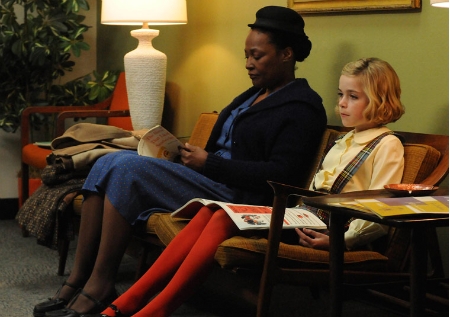
The only black character that has been on Mad Men for more than two episodes is Carla, the Draper housekeeper. That might change this season.

If you didn’t see the season premiere of Mad Men this week, you should know one thing: racism and civil rights have intruded upon Sterling Cooper Draper Pryce. The show has referenced racism a few times, with Paul and Sheila going to the South to register voters, but it has never been a prominent theme like women’s role in the workplace has. It seems, however, that the fifth season could feature race quite a bit, especially if the office hires a person of color. As Tanner Colby points out, most seasons have included a major historical event (Kennedy’s election, the Cuban Missile Crisis, and Kennedy’s assassination), and if this season spans about two years it could include Martin Luther King Jr.’s assassination.

In this first episode of the season, race is treated as a problem that nobody wants to fix.  The opening scene of the premiere features a few executives at Young & Rubicam water bomb a Civil Rights protest going on outside their office,* which gets them in the papers. From there, the partners at SCDP decide to take the opportunity to rub salt on Y&R’s wounds by placing an ad in the paper declaring themselves “an equal-opportunity employer.” The boys at Y&R fire back, sending a resume and an African artifact through the door while a number of black applicants sit in the lobby.

While the premiere spends a lot of time showing how SCDP employees struggle with their home lives (with two new children, two new homes, and a new wife), the issue of race is tossed back and forth between SCDP and Y&R throughout the episode, with each agency trying to stick the other with the Civil Rights problem.

During the time in which Mad Men is set, the Civil Rights movement was often treated in the same way.  Politically, both Democrats and Republicans voted against civil rights reforms in Congress, despite Presidents of both parties putting forth piecemeal plans for reform.  Kennedy denounced the Freedom Riders for provoking violence and criticized SNCC for inciting harassment as well.  It would take James Meredith’s enrollment at the University of Mississippi and Bull Connor’s crackdown in Birmingham to force his hand.

The biggest victories for blacks, the Civil Rights Act and the Voting Rights Act, arguably only came about because Johnson realized that black votes were important. By and large, the rights of America’s blacks were hot potato’d until politicians realized that black votes, not black people, were something to attract and protect.  One of the boys at Y&R shouted for the protesters to get a job, then pranked SCDP into accepting resumes – neither agency actually wanted to address the problem, but in the end one had to. Most politicians during the time didn’t want to deal with the “problem” of civil rights, but were forced to. I’m definitely not an expert on civil rights history, but I think this was a recurring theme until the movement grew enough to demand attention.


* Fun fact: Young & Rubicam was actually the first ad agency to hire a black adman, Roy Eaton, and that was in 1955.