Hate Radio

2/3 of my thesis is about how radio can be used to mitigate violence in the LRA conflict. The programs aren’t perfect, and may even facilitate other kinds of violence through increasing militarization, but the radio programs aim to use the airwaves to encourage rebels to lay down their arms and to warn civilians of impending attack.

When I explain my project to people, one of the most common reactions is to compare it to the role of radio in the Rwandan genocide. There, the killing of 800,000 Tutsi and politically moderate Hutu occurred with RTLM Radio playing in the background. The radio station went down in infamy as inciting the genocide with divisive messages of hate, calling on Rwandans to purge their country of Tutsi, linking Tutsi civilians to the rebel RPF fighters, and publicly naming people who would then be targeted.

Ever since Rwanda, radio and its potential for inciting mass violence has captured the popular imagination. There are fears of radio programs turning peaceful neighbors into killers by engaging in fear-mongering and naming people and places to be attacked. There was even recent news that radio stations in Bentiu, South Sudan had been used to instigate violence.

I watched Sometimes in April last week in one of my classes, a film about the Rwandan genocide that is told through the story of one family. I was surprised at how much the film hits you over the head with the role of RTLM radio in the genocide. One of the main characters, Honoré, works at the radio station, and the film moves between the genocide, during which Honoré issues hate on the radio and also tries to smuggle his brother’s Tutsi wife and children out of Kigali, and after the violence, where Honoré is being held on charges of incitement. In almost every second of every scene in 1994, the radio is playing.

But how much of a role did RTLM actually play?

Scott Straus, author of The Order of Genocide, an in-depth study of why Rwandan men took part in the genocide, has a 2007 article that questions the assumption that radio helped drive the genocide [pdf]. In it, he soundly debunks the theoretical cases for radio’s role in inciting genocide (a. theory that media can influence the public so directly go against established communications research; b. theory that radio caused listeners to go out and kill denies killers agency; c. theories of radio’s role rarely situate it among other theories of violence) and he also takes on empirical studies that say that RTLM was a main driver of violence.

Straus compares a few different data sources and pokes holes in the idea that RTLM turned people into violent killers by broadcasting hateful messages. First, he notes that RTLM’s broadcast range was limited to Kigali and western Rwanda (that’s without considering the country’s hilly topography). He then compares this to the fact that killings occurred in all government-held territories, even those where RTLM did not have an audience. Second, he looks at the actual broadcasts temporally. Admitting that a small fraction of attacks were called for explicitly by RTLM, he finds that, broadly speaking, the increase in killings did not coincide with the increase in inflammatory or extremist broadcasts during the genocide. Lastly, he includes quantitative evidence from broadcast content and qualitative evidence from interviews with perpetrators that show that most of the broadcast content did not actually mobilize killers.

Overall, he finds that the radio had a “second-order” effect in bolstering those who advocated for violence, but that most perpetrators were not convinced by the radio to go out and kill; rather they were recruited in person or were reacting out of fear. He summarizes his findings as such:

The positive evidence of radio media effects is that the radio instigated a limited number of acts of violence, catalyzed some key actors, coordinated elites, and bolstered local messages of violence. Based on these findings, it is plausible to hypothesize that radio had conditional and marginal effects. Radio did not cause the genocide or have direct, massive effects. Rather, radio emboldened hard-liners and reinforced face-to-face mobilization, which helped those who advocated violence assert dominance and carry out the genocide.

I don’t know much about the recent story about radio and violence in South Sudan, but I do know that the country has never effectively addressed ethnic divisions that were so acute in the recent decades. Radio may play a role in inciting violence, but it can only do so when the foundations have already been laid for such violence.

Weekend Reading

This is not uplifting, heartwarming stuff. This is not release, or catharsis. At best, “Portraits of Reconciliation” is terrifyingly willing to place the burden of reconciliation on the bodies of the victims, and then to call it progress when they show, by gestures of intimacy with the perpetrators, that they have gotten over it, moved on. But, for me, everything disturbing about this story gets crystallized in the overwhelmingly gendered narrative these photos tell—all the “perpetrators” are men, and seven of the eight “survivors” are women—while the word “rape” is screamingly absent from the article and the framing.

This omission is glaring, absurd, and obscene. An estimated 250,000 to 500,000 women were raped in the course of the genocide—though who really knows? It could be much higher—and sexual violence against women was as central to the genocidal project as lethal violence against men. “Rape was the rule, and its absence the exception,” as U.N. Special Rapporteur on Rwanda Rene Degni-Segui put it, and it is important to come to terms with that fact: leaving women alive to rape them was as much a part of the genocide as killing them.

Maps and the Way We See Africa

A friend recently showed me a post at HuffPo’s Impact blog titled “8 Maps That Will Change the Way You Look at Africa.” Curated by an intern at The ONE Campaign, the short listicle includes eight maps that, well, don’t change the way anyone has looked at Africa in the past century.

In numerical order, this list allows one to look at Africa as 1) the place where most of the world’s poorest live; 2) the least wealth continent; 3) huge; 4) including a number of the few countries that still have slavery; 5) having an arid North and lush agricultural sub-Saharan region; 6) at high risk for water scarcity, especially in the northern and southern ends of the continent; 7) way behind (but growing!) in internet access; and 8) having little access to electricity.

The list was posted earlier this month, and I’m not the first to comment on it. So, rather than rant too much about how we don’t need to keep talking about Africa as a place of poverty and landscape (and I am glad there wasn’t a map of conflict), I’m going to post some maps that are also worth looking at below the fold. I know that there are others that have given me pause for thought, though I haven’t been able to track them down. Anybody have maps that influenced how they view Africa or parts of Africa?

Continue reading

Weekend Reading

Weekend Reading Has Risen, and It is High.

#433rds: 04/17/14

This is part of a month-ish-long blog/Instagram project. For more, go here.

433-417

The Beinecke Library will temporarily close next year. 50 years old and having never seen a good renovation, the building’s ugly innards need to be examined. I worked there for about a year and a half, deep under this modern stone-walled building. It is beautiful, it is elegant, it is important. It also needs to be gutted and strengthened from the inside out. It doesn’t need a whole reinventing, but it needs to a renovation.

As I whirl from the news of not getting into any PhD programs, I wonder when and where to apply again. How do I reinvent myself? What were my weak points? What were my strong ones? What schools would I be happy at? What schools would I hate? What do I do next? These are, of course, also existential questions that I use to string myself along.

Another thing that needs to be reinvented is the tenure track at Yale. One of the few universities where it’s still virtually impossible to move from tenure-track to tenured, Yale loses its junior faculty at what I assume is a faster pace than most places. At other universities, there aren’t even tenure-track positions to go through before being denied tenure. And yet, in a time rife with denial and rejection, I continue to try to be strong and persevere. I want to teach. I want to write. I want to get there.


“Invisible Children does not claim to be neutral.”

I’m deep into thesis territory. Currently hovering around page 110, madly pounding away at the keyboard. The chapter I’m working on is about two things, primarily: AFRICOM’s involvement in Uganda, and Invisible Children’s involvement in counter-LRA interventions. Yesterday afternoon I had just finished wrapping up a section suggesting that Invisible Children, by involving itself in military strategy, further blurred the distinction* between military humanitarian intervention and humanitarian/development relief (IC does both).

Many NGOs active in war zones collaborate to some extent with militaries, for better or for worse. In the LRA conflict, many used UPDF convoys to deliver goods, and toed the government line when it came to how to direct aid. But Invisible Children’s activities don’t use military support to carry out development aid. They coordinate with the military to help direct counter-LRA initiatives.

Then I happened upon this just-published short article on Invisible Children post-Kony 2012. It’s pretty bare-bones (if you’re interested in the topic, this piece does it more justice), but it includes some discussion of exactly this topic of an NGO’s role in military activity (sans analysis):

Invisible Children keeps a staff of about 80 people on the ground in Africa. They run programs dropping leaflets from airplanes to encourage LRA soldiers to lay down their arms, and setup a high frequency radio network so that remote villages can report LRA activities and movements.

Unlike other NGOs, which usually try to stay neutral in conflict zones to do their work, Invisible Children doesn’t apologize for actively supporting efforts to track down Kony, with help from both the US military and national armies in the region.

“Invisible Children does not claim to be neutral. You know, we are not in this conflict saying we are not going to take sides,” says Sean Poole, the anti-LRA program manager for Invisible Children.

This isn’t revelatory. Invisible Children has long stood behind their “comprehensive approach” that blends peace-oriented come home messaging and Safe Reporting Sites with more offensive maneuvers. But it’s an explicit statement of that fact. They see themselves as not neutral, but on the side of peace.

Agree with that framework or not, it’s a feature of the discourse around the international human rights regime. Because the LRA are guilty of human rights abuses and are indicted by the ICC, efforts to pursue them are legitimized with little regard to their consequences. And regardless of whether the current efforts against the LRA can be characterized as “good” or “bad,” the quote above is representative of human rights discourse and humanitarian intervention overall, from Darfur to Libya to Syria.

*The existence of this distinction itself is also up for debate. To a large extent, humanitarian interventions, armed or not, deploy a mixture of unequal, dehumanizing, and (in)directly violent power relations. Mamdani  [pdf] argues that humanitarian intervention reifies international power structures and depoliticizes those deemed “vulnerable,” and Branch goes into all sorts of detail on how humanitarian interventions (military and non-military) have exacerbated the LRA conflict in particular in his book on the topic.

#433rds: 4/16/14

This is part of a month-ish-long blog/Instagram project. For more, go here.

433 416

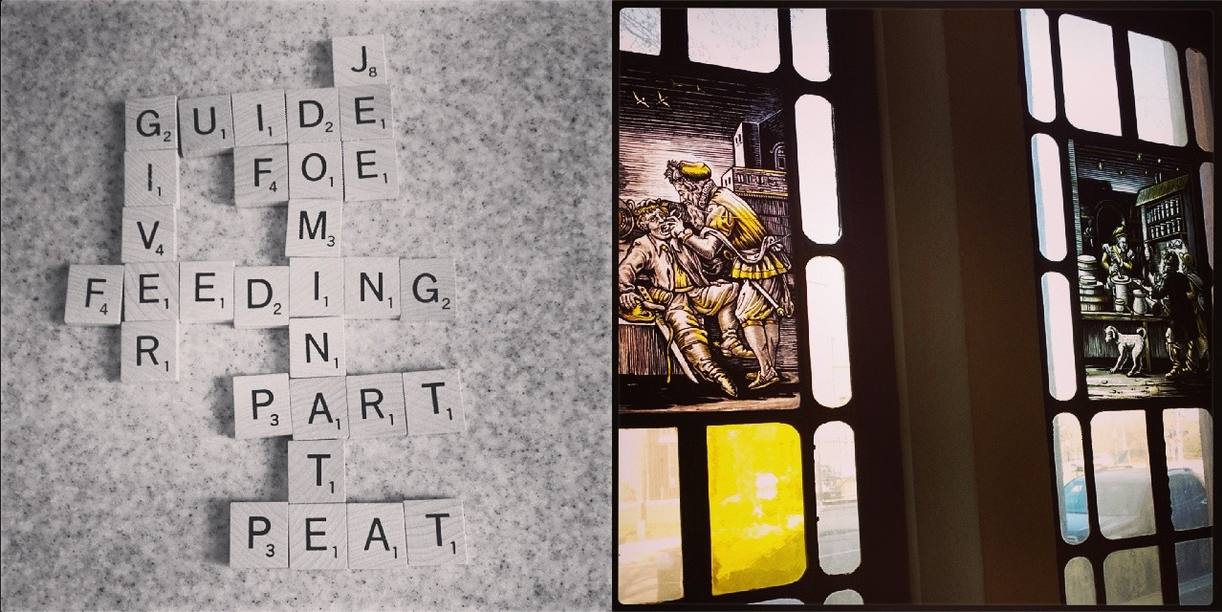
I haven’t left the common room.* The stained glass overhead consists of an old man adorned in gold armor, holding a vessel aloft to an incredibly witch-like woman (off-camera); either a very cruel dentist hard at work or a man force-feeding someone a pair of pliers; and a couple with a dog at what could be a bar or a pharmacy or both. The images that adorn these windows dominate much of the otherwise gray wall space. For how diverse they are, the color palette is decidedly narrow: black and white and yellow dominate the images of farmers, wooly mammoth skeletons, and mermaids.

The images are rarely, if ever, a guide for me. I go where my friends go, I go where the outlets are, I go where I can see through the dust on my laptop screen. But I sit most often under the aforementioned mammoth and volcano, flanked by a forest, a woman, and Old Faithful. For how little these images figure in my everyday, I despise the people sitting under Old Faithful. They are my foes, as much as my coursework is. If I can’t sit under Ice Age fossils, nobody can.

Maybe I just need to chill, to feed myself, grab a drink. I should hit the bar (or pharmacy, as it were). If the Mammoth can’t be my Muse, perhaps the Dentist can be my Guide.

* This is a lie.

#433rds: 4/15/14

This is part of a month-ish-long blog/Instagram project. For more, go here.

433-415

Do.

I am about 3/4ths finished with my workload, but about 47/50ths done with the school year, which means it’s time I just buckle down and do it. Just do. Every tangent must be fought off. Every divergence taken out. Every source footnoted and image captioned. Everything that needs doing needs to be done.

Finding a place to be productive can be a challenge in and of itself. I’ve had productive afternoons in the graduate student common room. There are cozy booths to settle into, and stained glass figures mundane and exotic. The clang of metal appliances and the aroma of coffee from the little café that sits in the middle of the room. And the most ornate ceiling I’ve seen on a campus filled with details. It’s a place to admire, but it’s also a place to do work. Do.

Curiously, it’s not always a place one can go to do work. It closes prematurely in the late evening, even early evening on weekends and during school breaks. While college students here enjoy the pleasures of residential college common rooms and libraries that are open all day, all year, the graduate students are left with beautiful common room with a closing time. All we want is a cove to call our own. A place to do work whenever we want to. We’ve fought for student space before, the struggle has seemed endless, but the end may be near. Cost estimates are coming in, resolutions have been passed, reports published. All that’s left is to take the keys out and leave the door open so we can just do our thing.

Weekend Reading

Weekend reading marches on:

#433rds: 4/10/14

This is part of a month-ish-long blog/Instagram project. For more, go here.

433333

I was sitting on the 3:50 train into New York City yesterday, curled up in my window seat, reading a book for class, jotting down some notes. A group of Yankees fans were lit, openly pregaming in the aisle, and the two undergrad/high school boys in front of me alternated between talking about sex and girlfriends vs. the music they were listening to. It was otherwise quiet.

Somewhere in western Connecticut, the train slowed, the electricity flickered, and only the lights by the doors stayed lit. The Yankees fans exchanged tipsy jokes about being stuck on the train, the youths talked about Brand New. The conductor announced that the pantographs weren’t connecting, and that mechanics were on their way to reattach them. I don’t think many passengers know what a pantograph is; I didn’t.

I immediately wondered if there were any phalanges on the train.