The History of Peace and Conflict with the LRA

As Invisible Children and Resolve continue the push to support the US advisers in their collaborative mission to apprehend Josephy Kony, there continues to be a lot of discussion about the perceived militarism of the campaign.  One of the primary focuses of the Kony 2012 campaign is, of course, to capture Kony. If the multinational effort to apprehend Kony is successful, it will have lasting impacts on peace and security in the region as well as bolster the fragile framework of international justice. If it is unsuccessful, it has the potential to be damning for the people on the ground. The more peaceful the resolution to this conflict, the better. But it’s worth discussing why this is the option that many of us are talking about right now.

Historically, both peaceful negotiations with the LRA and armed operations against the LRA have led to instances of violence against nearby civilians. This is due to the rebels’ horrific tactics but also to inconsistency in the Ugandan government’s stance. The usual pattern is that the LRA would drag out peace talks while they regrouped, and then the Ugandan government would grow tired of peace talks and launch a failed attack, thus driving the now regrouped LRA to lash out at civilians, leading to perhaps another set of negotiations. For example:

The Growing LRA Problem: From Operation North to Peace Talks to Massacres

A monument to LRA victims in Lira town.

The LRA grew out of the Alice Lakwena’s Holy Spirit Movement, but incorporated other northern rebel groups in the aftermath of current President Yoweri Museveni’s rise to power. In the ensuing years, the LRA became more and more of a problem for the government, which reacted in two ways. Betty Bigombe was appointed as a government minister to deal with the insurgency in 1988, and she encouraged defections and established a dialog with the LRA. Meanwhile, the Ugandan military (NRA) launched Operation North, which included arbitrary arrests of alleged collaborators and attacks against LRA positions. In 1992, Bigombe set about creating Arrow Groups, village militias to defend against the LRA, but the rebels reacted with brutal attacks against civilians to discourage collaboration with the government.

In 1993, Bigombe decided to reach out to the LRA to begin the process of a peaceful resolution to the conflict. Talks began that November, with the LRA searching for blanket amnesty in return for disarming. During the peace talks, Gulu was incredibly peaceful and NRA leaders began taking part – but relations deteriorated as military leaders asked for surrender while LRA wanted integration.

LRA placed the talks on hold and NRA leaders grew more impatient, and in February of 1994 President Museveni suddenly announced in Gulu that the LRA had seven days to surrender. Attacks resumed almost immediately, and the LRA began to perceive the Acholi civilians as collaborators, leading to the rise of civilian casualties. Soon the LRA began establishing bases in Sudan, where they rearmed and stepped up attacks in northern Uganda, including the Atiak massacre. This was also the beginning of widespread use of abductions both as a tactic and for recruitment.

Civil War Expands: Displacement, Invasion, and Retaliation

The IDP camp in Kitgum, credit K. Burns, USAID.

In response to massacres like the one at Atiak and the high-profile abduction of the Aboke girls, the Ugandan government enacted a dubious plan to address the crisis in Northern Uganda – by corralling civilians into displacement camps.  The camps were ostensibly to protect civilians but in reality had little protection and scarce food, water, and sanitation.

The government of Sudan supported the LRA, in part as retribution for Uganda’s support of the Sudanese Peoples Liberation Army (SPLA), the rebel movement that would later help win independence for South Sudan. With this support, Kony and the LRA unleashed more violence against Ugandan civilians in the north while maintaining bases in southern Sudan, where they also attacked civilians on behalf of the government there. After the 1998 embassy bombings and even more after 9/11, the U.S. pressured Sudan for assistance in counter-terrorism efforts that also led to an agreement allowing the Ugandan military, now the Ugandan People’s Defense Force, to launch an attack across the border into southern Sudan.

The Ugandan military had just withdrawn from the DRC, where soldiers had looted the country’s resources and killed numbers of civilians during the Second Congo War. Many of these returned soldiers were sent to Sudan to take part in Operation Iron Fist. The results were disastrous: the LRA fled the attacks and slipped back into Uganda, carrying out reprisal killings at IDP camps across the region.

In the mid-2000s, the two sides were brought together for infrequent negotiations.  The Ugandan parliament passed an amnesty law that allowed some LRA to return home and a ceasefire zone was established, but talks ended when chief negotiator for the LRA Sam Kolo surrendered to the government. It was also during this time that the ICC investigated the LRA for mass atrocity crimes, eventually issuing indictments for the LRA leadership. Meanwhile, most rebel fighters migrated westward to the Garamba National Forest in northeastern DRC, where they settled as a new set of peace talks began in Juba, Sudan.

Leaving Uganda: The Juba Peace Talks, Operation Lightning Thunder, and the Christmas Massacres

From 2006 to 2008 the Juba Peace Talks [PDF] sputtered forwards with marginal ceasefires and the movement of the LRA to assembly areas for negotiations. While the LRA were gathered in the DRC, where they received food aid from Caritas (with support from several European governments) to keep them from raiding villages for supplies, however there were allegations that they secretly sold some of the food for arms. The two sides agreed to five main agenda items that they worked on when they weren’t threatening to leave the talks:

  1. Cessation of Hostilities included a series of short-term ceasefires, allowing northern Uganda to begin its recovery while negotiations continued.
  2. Comprehensive Solutions, which included issues of the national government’s institutional mistreatment of northerners and the resettlement and rehabilitation of IDPs.
  3. Accountability and Reconciliation was one of the biggest issues that forced the talks to be put on hold several times. Eventually, they agreed on a hybrid system that included a truth-telling mechanism and reparations for victims along with the creation of a human rights branch in the High Court of Uganda and the removal of the LRA from Ugandan terrorist lists. The issue of the ICC was somewhat vague, but both sides seemed willing to accept an end to the conflict in exchange for withdrawing warrants.
  4. Permanent Ceasefire was signed in early 2008,  assigning a battalion of SPLA soldiers as ceasefire monitors once the final peace agreement was signed.
  5. Disarmament, Demobilization, and Reintegration required the Ugandan government to address the ICC issue and allow LRA fighters to reintegrate into the national army. Those not willing to join the army agreed to disarm, and child soldiers would be supported through reintegration and educational programs.

In 2007 there was progress on the issue of accountability and reconciliation, but this progress was tainted by rumors that Vincent Otti, Kony’s second-in-command, had been executed after a power struggle within the LRA. Despite this, the two sides reached agreement on accountability in terms of alternative forms of justice, but the question remained of whether the ICC would drop its warrants in exchange for a peaceful resolution to the conflict. Kony refused to sign the final agreement until the indictments were lifted, and Uganda refused to apply to try war criminals under complementarity until after the LRA disarmed. The talks collapsed in April of 2008, with several failed attempts to reconvene throughout the summer, along with reports of LRA attacks in rural South Sudan and the DRC.

It was against this backdrop that the UPDF launched Operation Lightning Thunder, an attack coordinated with the DRC and South Sudan with intelligence and logistics support from the U.S., in December of 2008. The attack routed the rebels, who anticipated the attack, but failed to lead to the capture of any leaders and freed a minimal number of abductees. In response, the LRA set in motion what has been dubbed the Christmas massacres. In a coordinated attack across several towns and villages in the DRC, the LRA massacred hundreds of civilians and abducted around 100 more.

Since then, the Ugandan force was kicked out of the Congo in early 2009 due to international disputes, and the ill-equipped Congolese military has continued the charge against the LRA there.  The UPDF halved its LRA-hunting force in order to step up its presence in Somalia as a part of the peacekeeping force there, AMISOM, and the forces that remain on Kony’s tracks are ill-equipped for a manhunt.  The LRA, according to the LRA Crisis Tracker, have shifted further west and north to ungoverned spaces in CAR and DRC.

LRA attacks and sightings in 2012, to date. via LRA Crisis Tracker.

More recently, the US sent military advisers to the region in October of last year, and the African Union has nominally stepped in to create a multinational, Ugandan-led force. The hunt for Kony seems to be active in CAR, DRC, and South Sudan with some US advisers based in Uganda while others work in the field (reportedly setting up a base in Obo, CAR).  Civil society groups both locally and in the US have called on the forces to ensure the protection of civilians from retaliatory attacks and have put forth efforts to encourage LRA combatants to disarm and come home. As Paul Ronan points out, however, Uganda’s Amnesty Act is set to expire this year, which could have dire consequences for the effort to convince rebels to return.

The Way Forwards

The multilateral deployment continues its hunt for Kony.  As Patrick Wegner explains, the mission has had some success in reducing the amount of attacks carried out by the LRA in late 2011 (although this could be an LRA tactic since attacks dropped after a meeting between LRA commanders supposedly occured), but has accomplished little so far as capturing Kony and has failed to protect civilians in remote parts of the DRC.

The history I just bulldozed through shows that a military plan is not foolproof. But it also shows why many remain skeptical of a peaceful solution. Historically, the Ugandan government has alternated between negotiations and military incursions, and the LRA have used peaceful time periods to rearm and regroup. When the Juba Peace Talks fell through, the LRA had rearmed and the Ugandan government had given up on waiting for Kony. We are currently seeing lower hostilities committed by the LRA, but they may be regrouping once again.

Ever since the peace talks failed, groups like Resolve have looked at the option of a military apprehension of Kony that can effectively end the LRA. As Resolve recently stated, they are not opposed to a peaceful resolution. Indeed, if the LRA and relevant governments can reach a peaceful and legitimate agreement that addresses grievances of victims and leads to an end to the conflict, it would be a huge step towards pacifying the area and rehabilitating abductees, and it would avoid putting abducted soldiers and innocent civilians in danger. But if disingenuous, negotiations could lead to an impatient military attacking a rearmed rebel group again.

ICC Neutrality Keeps Not Existing

In December of 2003 the International Criminal Court opened its first situation, the civil war in northern Uganda, at the referral of the Ugandan government. From the beginning, the Court opened itself to criticisms with President Yoweri Museveni of Uganda with Chief Prosecutor Luis Moreno-O’Campo’s joint press release on the referral. Critics challenged that the ICC was being used as a tool by Museveni and that the Court would not approach the situation from a balanced perspective.  Indeed, the ICC has only issued five indictments for LRA leaders to date, despite evidence of egregious human rights abuses by the Ugandan army against civilians in the region.

Since this biased introduction to the world stage, the ICC has tried to navigate between government assistance in access on the ground and the desire for judicial fairness. While there was marginal success in some situations, the ICC has more recently continued its record of only investigating one side of the conflict, most recently in Libya.

Last month, in a piece questioning the “Libyan model” and whether it should be used in Syria, Vijay Prashad outlined some of the missteps concerning biased justice in Libya. The ICC made huge strides in getting American and Chinese support for the UNSC resolution authorizing NATO assistance in the Libyan Civil War, but has since faded into memory by not being proactive to try those it has indicted and by refusing to step forward in investigating rebels or NATO forces.

Prashad also points to two damning reports on the transitional government’s abuses. Amnesty International has outlined the problems of torture and abuse in detention facilities in post-war Libya, along with discrimination against women, foreigners, and black Libyans. This was followed by a report by the Independent Civil Society Fact-Finding Mission to Libya (PDF) which stated that it was concerned by revenge attacks and intimidation against alleged Qaddafi loyalists, including the potentially extrajudicial killing of Muammar Qaddafi, allegations of executions of detained loyalists, instances of abuse and torture in detention facilities, and the possibility of civilian targeting by NATO.

Some of these allegations have existed since before the war was even over, and the ICC has taken virtually no action to investigate the other side of the civil war. The ICC continues its course of using its allies’ assistance to investigate and indict the other side while turning a blind eye to abuses committed by its allies.  The ICC has been able to issue indictments on all sides in Sudan and Kenya, but this record is dwarfed by the overwhelming situations in which the Court benefits from its silence.  From Uganda to Libya, the ICC has yet to prove that it can truly move beyond victor’s justice.

Weekend Reading: #KONY2012 Edition

A tinge of humor before you read fifty articles about atrocities and development.

Earlier this week, I put together a post on Invisible Children’s new campaign and video, Kony 2012.  It’s gotten a huge amount of readership, which this humble blogger is very proud and thankful for.  Since the whole of the internet joined in what turned out to be a huge debate over both the issue of LRA disarmament specifically and Invisible Children as a whole, I began gathering links to anything I thought was worth reading. The list has gotten a bit bigger than I expected, so I’m re-writing everything here in what I hope to be a more digestible format as an early edition of the weekly reading feature.

Reporting

  • “Stop Kony, yes. But don’t stop asking questions,” by Musa Okwonga at The Independent.
  • UN Dispatch has a two-sided post on sensationalist vs. savior.
  • The Wired’s Danger Room gives a quick look of Kony 2012.
  • A blog post at the Washington Post covers the debate.
  • Michael Dreibert gives a succinct history of the conflict.
  • The Guardian has a long live-feed of updates on the debate.
  • NPR asks if the campaign will actually work.
  • The Guardian has an article including an interview with Jacob Acaye, one of the children featured in IC’s original video, as well as criticisms from Victor Ochen, who runs a great youth rehabilitation center in Lira.
  • The Monitor, an independent newspaper in Uganda, has this report that includes support from the UPDF but a criticism from former Gulu Mayor Norbert Mao – who has worked with IC in the past.
  • The New York Times’ Room for Debate features a number of important voices on the Kony 2012 campaign.

Critiques

There are a number of critical takes on both the Kony 2012 campaign and on IC itself as an organization:

Kings of War has a critique on the military side of the campaign.  African Arguements has a piece up by Angelo Izama about the video’s misrepresentations. A guest post at FP by Michael Wilkerson criticizes the video’s apparent inaccuracies; Wilkerson also wrote about it at The Guardian.  Elizabeth Dickinson writes about the moral conflict of the campaign as well as comparisons to the Darfur advocacy campaign.  Global Voices has a collection of Ugandan criticisms of the Kony 2012 campaign. And here’s another look at the backlash of the campaign. Max Fisher at The Atlantic has a good article criticizing the video as well. An FP article explains that the danger of troops being withdrawn might be unfounded. Adam Branch at the Makarere Institute for Social Research thinks IC is a symptom of US actions and doesn’t affect things on the ground. Timothy Burke questions the goal of Kony 2012’s direct action.

TMS Ruge wrote specifically about how the narrative denies agency to Ugandans. Africa is a Country has a post lambasting IC co-founder Jason Russell and Kony 2012’s white savior narrative.  Amanda and Kate from Wronging Rights wrote a piece at The Atlantic – also they made a drinking game.  Teju Cole tweeted a short burst of criticism against American sentimentality. There’s also a fun, satirical interactive map.  This article in the CS Monitor touches on the need to reach out to African groups. Alex de Waal argues that elevating Kony to “make him famous” isn’t the right way forwards. There is also an article on Kony in the real world.

In Defense

Resolve, Invisible Children, and Enough released a letter to President Obama (pdf) that is a blueprint for the way forward.  Invisible Children also released a response to critiques directly responding to many of the critiques. Paul Ronan, Resolve’s Director of Advocacy, posted this from South Sudan, where he has been doing research in the field.  Anneke van Woudenberg wrote a recent piece for Human Rights Watch explaining the need for action. Senator Chris Coons wrote that we should work together to capture Kony. Invisible Children CEO Ben Keesey responds to financial critiques in this new video.

And a critique of the Visible Children blog in defense of Invisible Children was posted on Facebook by an IC staffer working on the Crisis Tracker. Bridgette Bugay offers a response to criticisms at the LSE blog. Sarah Margon, a former staffer for Senator Russ Feingold (who spearheaded the bill that was passed in 2010) has this defense to offer. Jared White, a development worker at IC’s Uganda office, wrote about the benefits of IC’s three track system.  James Pearson criticizes the video, but give his support to the mission of Kony 2012. A former IC roadie wrote a half-defense at Dave Algoso’s blog.

Things to Think About

Daniel Solomon gives some views on the way forward.  Kings of War’s original post on the topic covered the dangers of “crowdsourcing intervention.”  Shanley Knox does some reflecting on interacting in Uganda as a savior versus a partner.    This World We Live In offers a warning against hubris. Dave Algoso touches on the differences between simplification and distortion in advocacy. Think Africa Press has a piece on Uganda’s military and a survivor’s story that’s important to consider. The Washington Post interviewed Glenna Gordon, the photographer who caught the filmmakers posing with soldiers in 2008.

Siena Anstis provides a number of ways to learn more about the crisis. Hayes Brown looks at whether or not the UN could harness the momentum, while Give Well has an argument for concentrating on malaria, which could actually be stopped if more people paid attention. Mafoya Dossoumon argues that we should hold African leaders more accountable, which is a great point. Daniel Solomon also has a piece on seeing advocacy as discursive, and how that changes the approach. Here is a look at the video’s impact on documentaries. And Aaron Bady put together a list on the “Genre of Raising Awareness of Someone Else’s Suffering .

A Week Later: More Links

Catching Joseph Kony

This Monday, Invisible Children released its newest film – the thirty minute Kony 2012. I’ve been involved with IC since early 2007, and my relationship with them is almost always in flux – ranging from being inspired and truly believing in the work to being a critic of the trendy oversimplification. After helping Resolve and the Enough Project gain support for the LRA Disarmament and Northern Uganda Recovery Act in 2010, IC has embarked on a new mission of trying to effectively end the war in 2012, with this video as a part of the broader campaign.  The video is centered on Jason Russell, one of the founders of Invisible Children, explaining Joseph Kony, the war criminal in charge of the LRA, to his son.  The take-away from the video is that the goal of the next two months is to teach people who Kony is, thus leading to more change and ultimately his capture.

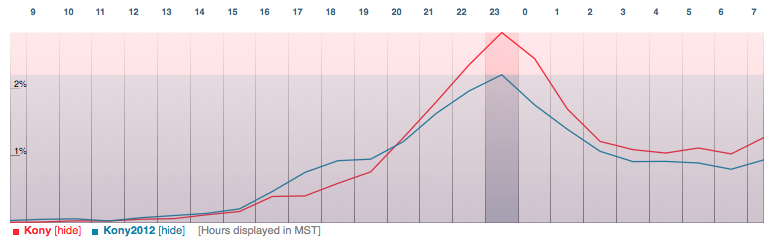
Through most of Monday evening Facebook and Twitter were slowly ramping up in my world. I have met scores of people in my work on the issue, and many of my friends are on the staff at IC, so the hubbub was expected.  By Tuesday afternoon, some staff members were tweeting that, in the first 24 hours, the video had been viewed 800,000 times. Late Tuesday evening, the campaign took up six of the top ten trending topics on Twitter, and “Kony” and “#KONY2012” accounted for 3-4% of all tweets.

The last 24 hours (checked at 7:45am, MST today) of Twitter traffic, from trendistic.

Like many who are aware of the crisis in central-east Africa, I would love to see Joseph Kony brought to justice as soon as possible. Kony is the leader of a highly centralized rebel group comprised of abducted fighters – some of them children. Kony is among the first criminals indicted by the International Criminal Court, and his arrest would go a long ways towards ending the Lord’s Resistance Army as we know it and reinforcing an essential international institution like the Court.

”]As I mentioned, I’ve been a supporter of varying tenacity, and I have disagreed with Invisible Children here and there over the years. I support many of their programs on the ground in the region – granting scholarships for students to attend rebuild schools, teaching displaced people employment skills, and building a radio warning system among them – and am one of the many that first got involved in human rights and activism through their work here in the States. I’ve always felt that there is a huge disconnect between the great work being done in the region and the simplistic, sexy, and purely PR work Stateside, which is a shame. I’m not as much of a critic as others, but I do have a few qualms with the current campaign that’s launching right now.

Invisible Children continues to oversimplify the message of how to get rid of Kony. I understand that advocacy groups need to take really complex problems and boil them down so that it can be disseminated among supporters. As the movement grows, however, the leaders should be better educating their followers.  Being involved for five years, I have yet to see IC expand on its very simplistic history of the war, which is critical to understanding how best to approach ending it.

Something needs to be said about the narrative that IC creates, but I’ll leave that to everyone else.  IC has been running programs in northern Uganda for several years – ineptly at first but more recently they operate like any other aid organization there. Meanwhile, their PR campaigns in the States aim to address the LRA, who left Uganda – which has been in relative peace and experiencing slow recovery – in 2006. The videos blur the lines between the countries, and simplify everything to Kony roaming Africa abducting kids. That’s not to mention that there is no evidence of the 30,000 children figure endlessly repeated by IC and other NGOs, and no discussion of how to define abduction (which is important, since some are forced to help transport supplies before being set free, while others are forced to kill their own family members before being conscripted for life). The story IC creates will drive policy, and it needs to ensure that we have a dialog about the peace-justice debate, the accountability of the Ugandan military, and ways to move forwards without losing momentum.

IC’s campaign for the next two months is heavy on awareness. We supporters are to tell all of our friends and put posters everywhere, and then write messages to 20 cultural leaders (who control public discourse) and 12 political leaders (who are involved with real change). This build up is to April 20th, when we’re supposed to plaster our cities in Kony 2012 posters to “make him famous.” There is footage of “Kony 2012” – to make him as popular as possible – a sort of Public Enemy #1.

When I first got involved with IC, I attended an event that included learning about displacement camps in northern Uganda – an eye-opening experience that really pushed me to start a student organization in college. This year’s big event is to put up posters. This is all in the name of garnering more name recognition for Kony to make him (in)famous, but when you get the most bipartisan congressional support for any Africa-related bill in history and you claim hundreds of thousands of youth support you, you’ve gotten the word out. Claiming that nobody knows about Kony (the video says “99% of people” have never heard of him), is absurd. There is enough attention that we can move from awareness to action now. It’s time to pursue real change – front and center. E-mailing the Chairman of the Senate Foreign Relations Committee should not just be a side-note to hanging up flags and tweeting at Oprah, who is probably sick of IC distracting her from her work in South Africa anyways.

As Daniel Solomon notes (and you should definitely read his post), if people are tweeting at me to watch the video and aren’t reading the ICG report to learn more, then a vital part of the campaign has missed the mark. Mark Kersten also calls out the campaign in a post you should read, and here’s a critique of “crowd-sourced intervention.”

After six years of building a massive youth-led base in America – including raising millions of dollars in record time and directing masses of young people – we have passed the deadline for moving forwards. In the film, IC tells us the Kony 2012 campaign expires at the end of the year – a movement has an expiration date alright, and it’s important to freshen up the whole IC movement.

Update: The list of related links has moved to a new post, as it continues to grow.

Why Uganda? Why Now?

So, I’ve been working on revising a paper about US relations with the ICC for the past week or so, and I find myself revisiting the issue of Obama sending 100 troops to Uganda to help hunt down the LRA.  I went to a professor of mine to talk ICC, and we ended up debating the deployment quite a bit, discussing the reasons for sending troops to Uganda now.

I wrote a pretty jumbled analysis of the decision already, but I concentrated on whether or not it was a good idea and if it would work. I barely scratched the surface of why. But it’s definitely worth asking. The LRA have been committing atrocities pretty much from its inception in the late 1980s. The ICC issued indictments for Joseph Kony & Co. in 2005.  The LRA were driven out of Uganda in 2006, and civilians have been leaving displacement camps for home ever since. Why is the US sending military advisers there now?

It’s definitely true that there is broad grassroots support for this type of action.  Between Invisible Children and Resolve, there are tens of thousands of supporters who have been writing letters and attending local lobbying meetings pressing the issue.  I was among over a thousand people who went to DC in the summer of 2009 after the LRA Disarmament and Northern Uganda Recovery Act was introduced, lobbying for its passage.  Ultimately the bill passed with more support than any Africa-related issue in US history (allegedly).  But that’s only part of the story.  The law passed last May, and the White House’s strategy was released last November. Why did it take nearly a year for (part of) the strategy to be implemented?

Some suspect that this is America’s pushback to Sudan’s power in the region.  The US pushed Sudan to oust Osama bin Laden back in the day, and Bush was a huge supporter of South Sudanese autonomy and later a critic of Khartoum’s actions in Darfur.  Obama has been similarly vocal about both issues.  So, it’s pretty clear that the US has staked out its position against the Sudanese government.  While it’s true that the LRA enjoyed Sudanese material and financial support as well as safe haven in the past, it seems that such a relationship hasn’t existed for years.  Because of this, I don’t think that the deployment of 100 troops in neighboring states is quite the statement to Sudan that others say it is.

One idea that is gaining some traction is that the US is rewarding Uganda for its actions in Somalia.  Uganda has been one of the primary military participants in AMISOM, the multilateral effort to fight al Shabaab. Uganda has also suffered from this engagement at home with the World Cup bombings in 2010 being linked to al Shabaab. The US hasn’t been publicly involved in fighting in Somalia since the debacle almost two decades ago, but it has been a longtime supporter of the mission. Indeed, several members of Congress at the House Foreign Affairs Committee hearing on the deployment in Uganda made mention of Uganda’s work in Somalia.  But I wonder if this really makes sense, but that stems mostly from my skepticism that Museveni cares that much about the LRA since he never really cared in the past unless it helped his image during election season.

One thing that I haven’t heard many say, and I think it’s worth addressing, is the state of US-ICC relations.  The Bush administration was staunchly opposed to the International Criminal Court, and even undertook a campaign of isolating the Court in hopes of destroying it. That is, until Colin Powell called the crisis in Darfur genocide.  That began a slow and gradual detente as the US abstained in the Security Council vote to send the Sudan situation to the ICC and then provided logistical support to the Ugandan military in catching Kony.  The Obama administration has been more involved with the ICC than its predecessor, and even voted in the Security Council to refer the Libyan situation to the ICC.  It seems like assisting in the apprehension of the ICC’s first indicted criminals falls neatly into this trend of easing the tensions between the United States and the International Criminal Court.

It’s Rebel Leader-Hunting Season

On Friday, the press began to run numerous stories about the announcement that President Obama had authorized the deployment of about 100 combat-ready troops to Uganda to take an advising role in order to help capture or kill LRA leaders. Obama wrote a letter to John Boehner about the deployment two days after the first troops had landed in Uganda, placing the statement square on a Friday afternoon. This was a scrolling headline for some, but for me it was all over the internets. Stuff like this happens when you’re Facebook is filled with Invisible Children activists and your Twitter is dotted with development wonks and academics that are experts in the region. Let’s look at what exactly is happening here.

Let’s start with why this is happening. In the letter, (which can be found here) Obama references that the LRA are impacting regional security, the passage last year of the LRA Disarmament and Northern Uganda Recovery Act, and national security interests in the region. The troops are destined for Uganda, but will be going to the DRC, CAR and South Sudan as long as each of those countries agree to host them. The troops will be combat-ready, but will only be serving in an advisory role.

Full disclaimer to the few readers that don’t already know, I volunteered with Resolve to help advocate for passage of the aforementioned bill. I’ve continued to work with them to advocate for more action from the Obama administration on this issue. That said, I’m not sure where exactly I stand on this decision. Over the years, I have had at least a few conversations with fellow activists about the possibility of deploying American forces – advising or combating – to remove LRA leader Joseph Kony. Let’s take a look at some of that, shall we?

Why don’t we send some U.S. troops to just go snipe Kony?

Well, for starters, that’s a really bad idea and it probably wouldn’t work.  First we’ll be needing permission to run the operation (well, I guess we don’t need permission if we decide to just fly in on a stealth helicopter and shoot him in the face, but still. We should). Kony could be in one of a few places: northeastern DRC, southern CAR, South Sudan, or Darfur. The DRC has a history of being used as a training ground for atrocities, place to push a rebel group you don’t like or place to start your own rebel group if you want. It’s not fond of having more armed forces in the area. The DRC has already asked the Ugandan military, currently hunting for Kony, to get out. Twice. And it tried to kick out MONUC despite never really solving the 20-rebel-groups-hide-here problem. Supposedly Kabila is “pleased” with the recent U.S. decision, but I can’t read French and he’s changed his mind after the fact before.

Anyways, if we were to send U.S. troops in to do the job, they would face quite a few setbacks. The terrain is densely forested and rural, and there are very few chances to use surveillance such as cell phones and satellite tracking. Kony has historically established wide networks of soldiers around him so that he knows when trouble is afoot. That’s how he’s survived for 25 years, outlasting the Holy Spirit Movement and the UPDA and evading the UPDF, SPLA, and even Guatemalan special forces (killing 6 when the UN tried to catch him a few years ago). He will know what’s up. Not knowing the terrain or the language puts the forces at a disadvantage against a guy who has literally lived in the bush for twenty years.

That, and the specter of Somalia (despite huge differences between the situations) seem to be why Obama has gone with the advisory route, which still smells a little bit like Vietnam to many, but that is also a vastly different situation. Museveni has already given assurances that the Americans are here to advise, not to fight, simultaneously boasting about how the UPDF don’t need help to fight their wars. And so the US “personnel” have begun to arrive in Kampala, and will pretty soon begin to deploy to the other respective countries in the region.

Except for Sudan. While the LRA are currently scattered across DRC, CAR, South Sudan and Darfur, a year ago reports said that Kony was en route to Darfur. Darfur would be part of Sudan, and thus out of reach to both central African militaries and US advisers. I feel like if anybody asked Omar al Bashir if it was okay to enter Sudan to apprehend a leader indicted for war crimes, he might think you were talking about him since, you know, you could be. If Kony hasn’t made it to Darfur yet, he’s probably thinking about it.

But why send the advisers there now?

The LRA Disarmament and Northern Uganda Recovery Act passed in May of 2010, and the requisite strategy on the LRA was released in November of that year. Since those have been around for a while, some are asking, “why now?” Well, since then, all has been quiet on the LRA front until Resolve mentioned AFRICOM’s nudge-nudge that a deployment could happen soon. ABC News reported that the plans have been in the works for over a year, but that resources were not available until now. Some have speculated that the U.S. is rewarding Uganda for its contributions to Somalia’s fight against al Shabaab.

I don’t quite know if that makes sense. Uganda itself is really not concerned with the LRA anymore. The government is dealing with economic protests and its huge effort with AMISOM fighting al Shabaab. The LRA haven’t been active in northern Uganda for years, and when I was in Uganda last year many people told me they were far more concerned with the upcoming elections and Museveni’s continued rule than with a rebel group in the DRC – especially in central and southern Uganda, where civilians never really faced the threat of the LRA. This deployment is fueled by grassroots efforts, and I think that Uganda will accept it as another way for the UPDF to project power in the region.

One other piece that fits nicely that I haven’t seen reported is that it is yet another nod from the Obama administration to support the ICC. After Bush relaxed the hatred late in his term, Obama has stepped it up with a yes-vote on the Libya resolution and a heavy, heavy presence at the ICC Conference last summer. Assisting in the capture of Kony could show real U.S. support for the ICC without all the supposed worries of actually joining up and ratifying the Rome Statute. It’s an international and human rights win without any of the duke-it-out-with-Jesse-Helms bad press.

Will it work, and if not, what will?

I’ve been pushing for the Obama administration to address the crisis for a long time. The region that the LRA operate in has almost zero infrastructure and is completely ungoverned. This is why there is so much lawlessness in these corners of the DRC, CAR, and South Sudan. The key to protecting civilians and ending these types of insurgencies is to make it difficult to operate there. Whether the advisers go there or not, the thing that needs to happen is more support for infrastructure in the region.

Speaking specifically to the LRA, Kony has got to go. There have been reports about how fractured the LRA are, but they are usually followed by a former abductee mentioning that Kony is communicating with other leaders constantly. The LRA has a highly concentrated command structure, and getting rid of Kony could actually resolve the entire issue.

While training troops and assisting with intelligence to find Kony, we also need to help build up government legitimacy and accountability. Resolve indicated in a recent post that the US personnel will be able to investigate UPDF abuses “and (hopefully) hold them accountable to a higher human rights standard as they interact with civilians across the region.” I have yet to see that reported anywhere else, but if that is true it is a huge step. The Ugandan government’s handling of both the civilian population in northern Uganda and abroad has been abysmal and needs to be addressed. The UPDF itself testified that it had committed 501 human rights abuses in 2005 alone. If a handful of advisers can simultaneously help catch Kony and bring accountability into the UPDF, it will go a long ways.

In summation, the decision has little guarantee of succeeding, but there is little risk for the US. AFRICOM has said that the advisers will not be accompanying on any missions to actually capture Kony, only on training missions. This means American soldiers should not be in any real danger, although that’s really hard to say for sure. If Kony is captured, it will be an easy foreign policy win and a great step for human rights in central Africa. If it doesn’t work, the advisers can quietly return and say they did their job, which was to train the regional forces. There’s a lot to gain and not a lot to lose, so why not try it?

A Year After Kampala

Today is the one year anniversary of the World Cup Bombings in Kampala which claimed over 70 lives. I wanted to put together some sort of post to mark the occasion, even if only to remember the incidents and the lives taken. Last year, I put up a blog post about it at the time, but was pretty bewildered.

For those who don’t recall, one year ago two sites in Kampala were bombed by Somali insurgent group al Shabaab. The attacks hit the Ethiopian Village, a restaurant frequented by Westerners and a place I planned on visiting. I drove by the restaurant a few weeks later and the compound was boarded up – haven’t heard if it ever opened. The attacks also hit the Kyadongo Rugby Club, a field that had been filled with seats and screens to house a viewing party. The attack was in response to Uganda’s involvement in the African Union’s military presence (AMISOM) in fighting for the transitional government in Somalia against al Shabaab.

So, how much have things changed since? In May, some groups reported worries that al Shabaab attacks loomed, but it led to some debate over whether the government had reliable evidence of attacks or if it was exploiting the attacks to dampen contemporary protests over fuel prices. Al Shabaab is still fighting against AMISOM, but there is some speculation that they’ve expanded outside of Somalia. The East African had a report on prospects of expansion due to several conflicts along the Somali-Kenyan border. It seems that al Shabaab is definitely pushing its weight around even though it’s still in the middle of fighting against the transitional government, but the question remains: are another series of bombings on the scale of the World Cup Bombings possible?

The Right to Walk

In case you haven’t heard, protests rocked Uganda this week, leading to lots of arrests, police violence, and several deaths. The Daily Monitor has a decent live feed, but I’ll summarize bits. It all began with the opposition protesting the Museveni government’s economic policies. With fuel prices rising, opposition leader Kizza Besigye explained that “we are just asking people to walk to work two times a week and we want to do so to show solidarity with the already tens of thousands of people who are walking to work every day because they can no longer afford the cost of public transport.”

Apparently, walking to work is illegal.

Specifically, the Assistant Inspector General of Police stated that by announcing a campaign to walk to work in solidarity with others, opposition leaders were in effect leading a procession, which requires a permit and all sorts of other limitations. The police went out in force to oppose such illegal processions.

Riot police kept Besigye from leaving his home town, a Kampala suburb, because they believed his walk would incite violence. Amid the scuffle, Besigye was shot with a rubber bullet and suffered a wound to the hand. In Masaka some 300 youth, presumably boda drivers, fought with police when their march was interrupted. News outlets were ordered not to provide live feed updates about the campaigns and protests, under penalty of losing licenses. In addition, the Daily Monitor’s internet connection was cut. Several opposition MPs were arrested, and a reporter in Masaka was attacked by police.

Masaka’s actions seem to have been started by young boda drivers walking their motorcycles across town in protest, but the protest grew in size and resulted in the army taking over the town. These young kids are bearing the brunt of Museveni’s economic policies, and it’s interesting to see just how the security forces responded to their protests.

Meanwhile, when police arrested opposition figure Norbert Mao, they incited violence. After Mao was arrested, Gulu erupted. Eventually the police called in the army, who showed up in armored cars with guns firing. With the town suffering a blackout, citizens burned tires and threw stones at the army. Three people were killed and Mao has called for a prayer and fast in protest.

Some have been saying that the army was able to restore calm and stability. I’d have to say, restricting the rights of the press and of protesters, even the rights of people to work peacefully to work, is hardly a status quo worth staying in.

What’s Happening in Uganda Tomorrow?

On Friday, Uganda will be holding presidential elections.  Even eight months ago when I was in Uganda it was big news.  So, what’s going on in Uganda?

Yoweri Museveni, President of Uganda for over twenty years and leader of the National Resistance Movement, will be running for re-election yet again.  He is running against a slate of opposition figures, chief among them Kizza Besigye of the Forum for Democratic Change.  But what’s important about this election?

Despite having won every election since seizing power, Museveni’s victory margin has been diminishing.  In the last election he only won with 59% to Besigye’s 37%.  With notable corruption and a diminishing economy in addition to failure to secure the north and west against rebellions, Museveni faces the possibility of winning only a plurality in tomorrow’s election.  According to Ugandan law, if there is no clear majority than the front-runners compete in a run-off election.  If this is the case, it is likely that the less viable opposition figures such as Norbert Mao and others would throw their support behind Besigye, ushering him into the presidency.

That said, Museveni is consolidating control.  In both 2001 and 2006 the Supreme Court of Uganda ruled that the elections were flawed with corruption and vote-rigging, but both upheld the election returns for various reasons.  This election season there have already been rumors that the NRM has been buying votes in certain regions.  There are even cases of Museveni personally handing out envelopes of money to prospective voters and of Parliament receiving funds that slant towards NRM victory.  This in addition to a possible repeat of Museveni’s announcements a couple of years ago that any districts that did not vote for him would risk not receiving national funds for programs.

It looks like Museveni is setting up the elections in his favor.  Regardless, there may be some room for the opposition to sneak a victory.  But, even if that happens, he may not relinquish power.  Besigye has been exiled before and accused of treason, a strong run against the President could result in similar consequences.  With the vote taking place tomorrow, I’ll be keeping my eyes on how things unfold.