A Year After Kampala

Today is the one year anniversary of the World Cup Bombings in Kampala which claimed over 70 lives. I wanted to put together some sort of post to mark the occasion, even if only to remember the incidents and the lives taken. Last year, I put up a blog post about it at the time, but was pretty bewildered.

For those who don’t recall, one year ago two sites in Kampala were bombed by Somali insurgent group al Shabaab. The attacks hit the Ethiopian Village, a restaurant frequented by Westerners and a place I planned on visiting. I drove by the restaurant a few weeks later and the compound was boarded up – haven’t heard if it ever opened. The attacks also hit the Kyadongo Rugby Club, a field that had been filled with seats and screens to house a viewing party. The attack was in response to Uganda’s involvement in the African Union’s military presence (AMISOM) in fighting for the transitional government in Somalia against al Shabaab.

So, how much have things changed since? In May, some groups reported worries that al Shabaab attacks loomed, but it led to some debate over whether the government had reliable evidence of attacks or if it was exploiting the attacks to dampen contemporary protests over fuel prices. Al Shabaab is still fighting against AMISOM, but there is some speculation that they’ve expanded outside of Somalia. The East African had a report on prospects of expansion due to several conflicts along the Somali-Kenyan border. It seems that al Shabaab is definitely pushing its weight around even though it’s still in the middle of fighting against the transitional government, but the question remains: are another series of bombings on the scale of the World Cup Bombings possible?

Remembering December

In early 2008, the Juba Peace Process between the Ugandan government and the Lord’s Resistance Army failed.  In December of that year, a joint offensive by Uganda, the DRC, and South Sudan invaded the LRA’s hiding place, dispersing the rebels.  It was a messy, ill-advised attempt at apprehending rebel leaders and freeing abducted civilians.

On Christmas Eve, the LRA lashed out at the local population, destroying whole villages. In the ensuing month, as reported by a number of news papers and human rights groups, the rebels killed at least 900 people and abducted at least 160 children.  They rounded up villagers who had been celebrating Christmas, tying them up and killing them with clubs, axes, and machetes.  A number of women were raped and whole families burned.  In the following year they would kill over 1500 and abduct over 3000, 700 thought to be children.

In December of 2009, the LRA issued a warning – saying they would celebrate Christmas with the people of the region. On December 14th, to celebrate the one-year anniversary of the military incursion, the rebels lashed out again, attacking a number of villages and towns in eastern DRC.

This is a blog post I’ve been meaning to write for a week or so.  It’s about something that has me worried.  It’s December.  It’s almost the two-year anniversary of the beginning of hostilities and one-year anniversary of the 2009 attacks, as well as the two-year anniversary of the Christmas Massacre.  Who knows what the LRA are planning this year?  Having spent a good four years learning about this conflict, and having met a number of victims in Uganda effected by the LRA, I’m worried for the people of the DRC, CAR, and Sudan.

On this subject, the Obama administration’s LRA Strategy was released almost two weeks ago, and I’ve been reading and reviewing it.  I’ll put up a praise/critique soon, hopefully. After two years of relative peace from 2006-2008, these past two years have been pretty brutal for the people of east-central Africa.  I’d like to see it end.

Remembering

Typed on the 2nd of July at Bourbon Coffee Shop (with the internet down).

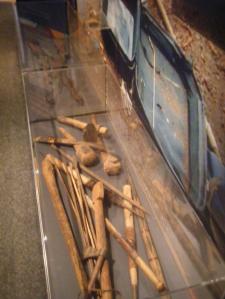
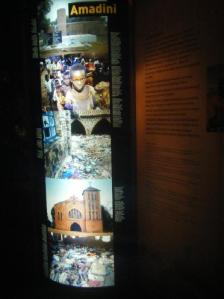
So, today was a day that I had been anticipating for, well for a few years now. I had in mind two goals, two places I wanted to go. First was the Kigali Memorial Center, the city’s memorial of the 1994 genocide and an exhibit about other genocides in history. It was really interesting and really informative, which is what I expected. The exhibits were split into Rwanda before, during, and after the genocide and addressed issues like ethnic divisions and justice after the war. Here are some pictures from the memorial.
But the thing that loomed ahead was the memorial I had wanted to see since I first read about the incident a couple of years ago. The church in Nyamata.  In early April of 1994, when the genocide first began after the President’s plane was shot down, thousands of Tutsis fled to the church in Nyamata.  They were safe for a couple of days before the Interahamwe militia broke down the gates and lobbed grenades at the church before using guns and machetes to kill those inside.  I’ve heard figures of up to 10,000 victims.  It’s something difficult to imagine, and seeing the memorial was something that really struck a chord.

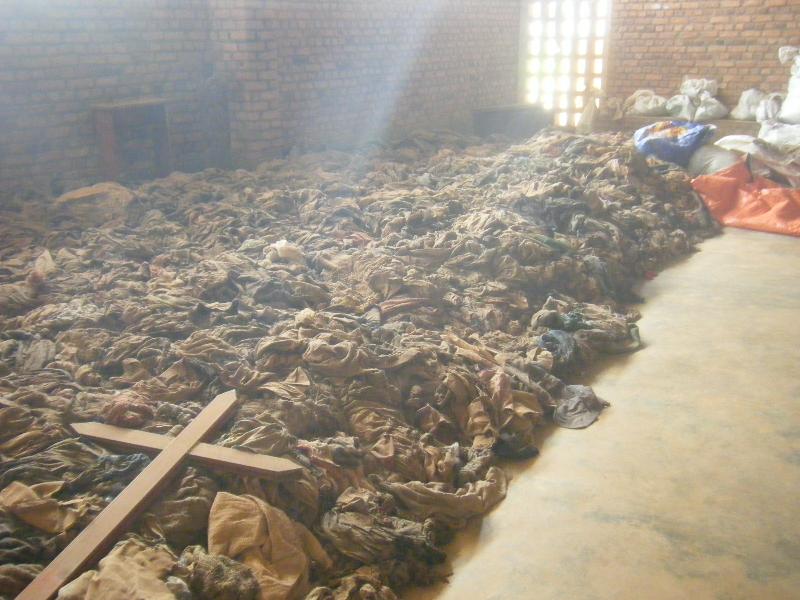
So after a half hour matatu-ride and a short trip on a bicycle, I got to the church. It was a simply brick building with a serene lawn, with everything draped in purple and white flags. I walked in and immediately was taken aback by the pews. Each pew in the church was covered in piles of clothes – the clothes of the victims. The clothes were also scattered all over the floor throughout the church.

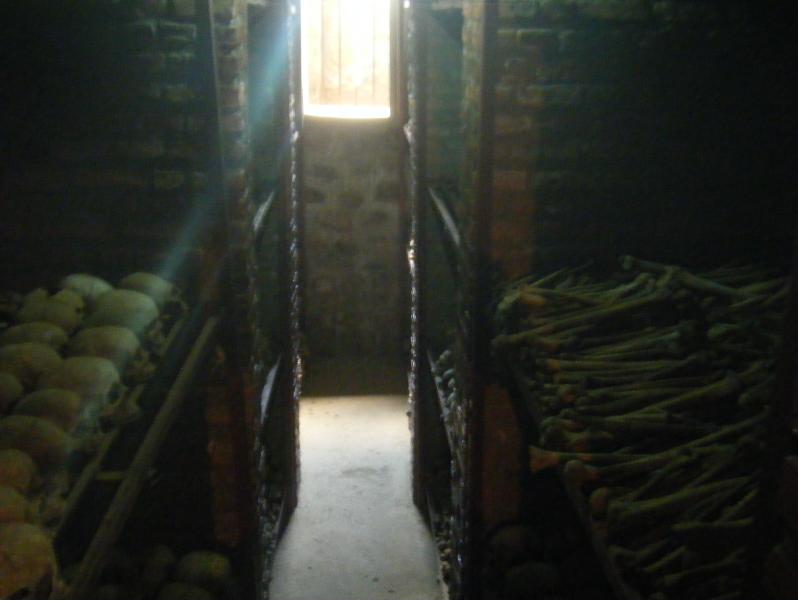
From here I went into the vault immediately under the church. Here there was a three-tier shelf that laid it all out for me. The very bottom was a casket draped in white cloth. Above that was a shelf with row after row of skulls. In the center were some bracelets and identification cards (each of which said “Tutsi” on it). The top tier, just about at eye level, was a pile of bones – femurs to scapulas to ribs, laid bare. I knew the memorial was displayed like this, but I was still a little on the defensive, and when I saw that someone had scribbled a name onto one of the skulls I got weepy. After reflecting for a bit I got out of the church.
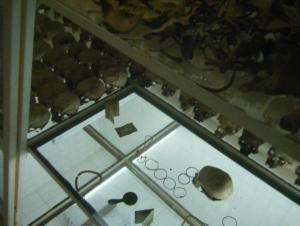
After walking out of the church I faced the most daunting task – the mass grave behind the church. First, there was a grave for an Italian humanitarian worker beside the church – she had warned about the impending genocide and called on people to intervene before she was killed. Behind the church were two large slabs of stone marking the grave. Each one had a staircase that led underground to the tombs. Inside were stacks of caskets (each with the bodies of far more than one victim), shelves lined with hundreds of skulls and bones, and dozens of purple and white flags. I’ll let the pictures speak for themselves, but you at least know what you’ll see.

Needless to say, it’s a powerful statement, seeing these reminders of the genocide.  It is such a different idea of remembrance that we have at home, and it’s such a different way of addressing an issue like this. It definitely brings out emotion, and if you’re like me it just makes you think that the event this church represents isn’t a solitary event. This happened all over the country in 1994, and things like it have happened around the globe in the passed century. Seeing the memorial was something I had to do, and I think it’s something that will stick with me for a long, long time.