Weekend Reading

Weekend Reading wine pairings.

etc.

Watching The West Wing: Teachers and Courts

I am midway through a weeks-long marathon of watching The West Wing. When I was young, my parents watched the show, and I often watched it with them. Most evenings I watched whatever prime time drama my parents were into, and my wife and I recently began to run through the whole show on Netflix. Aaron Sorkin’s tendency to plant teachable moments throughout what is a fairly fast-paced and often context-riddled dialogue – notorious both in The West Wing and The Newsroom – does two things: teach the intricacies of American politics, both complex and simple, to an audience that may not yet know the details of a filibuster or censure or pardon, and allows those who do know feel a sense of being an “insider” as they follow the main characters down familiar hallways.

Coincidentally, Alyssa Rosenberg at The Washington Post is also watching the show this summer, and wrote a smart piece on the personal politics of the show, focusing on the fact that the main characters’ “positions on policy are — at least initially — determined by their personal attachments.” She argues that “it’s an ingenious way to make viewers feel attached to policy debates. But it also lets the Bartlet administration, which was never terribly liberal in the first place, be guided much more by emotion than any particular partisan theory of government.” I suggest reading her article, as it looks at the show’s focus on personal relationships and on its discussion of media and personal lives.

3269112733_e5e917eed9_m

But I have something else I’d like to focus on. In watching the senior staff of the Bartlet administration debate education, drug policy, war, and terrorism, I’m becoming more and more convinced that The West Wing obscures more than it reveals. While the script frequently teaches its audience about the inner workings of the White House and American politics in general, the descriptions and definitions it provides often preclude the viewer from making up her own mind about those very issues. The ideas proposed – recruiting more teachers, supporting international justice, decriminalizing marijuana, selling weapons to repressive regimes, etc. – are introduced not to educate but to show the viewer which one is right (or at least practical, for the latter two realpolitik situations).

The West Wing‘s take on the post-9/11 world is something I’ll have to set aside for another day (that subject will take much, much more time), but here I’m going to outline two specific scenes in seasons 2 and 3. I’m halfway through the show, so it’s very likely that more of these posts are coming. Without further ado, The West Wing, Teach for America, and the International Criminal Court.

Continue reading

Weekend Reading

[I]n a 1996 article in Nature, a seismologist named Kenji Satake and three colleagues, drawing on the work of Atwater and Yamaguchi, matched that orphan [tsunami] to its parent—and thereby filled in the blanks in the Cascadia story with uncanny specificity. At approximately nine o’ clock at night on January 26, 1700, a magnitude-9.0 earthquake struck the Pacific Northwest, causing sudden land subsidence, drowning coastal forests, and, out in the ocean, lifting up a wave half the length of a continent. It took roughly fifteen minutes for the Eastern half of that wave to strike the Northwest coast. It took ten hours for the other half to cross the ocean. It reached Japan on January 27, 1700: by the local calendar, the eighth day of the twelfth month of the twelfth year of Genroku.

Once scientists had reconstructed the 1700 earthquake, certain previously overlooked accounts also came to seem like clues. In 1964, Chief Louis Nookmis, of the Huu-ay-aht First Nation, in British Columbia, told a story, passed down through seven generations, about the eradication of Vancouver Island’s Pachena Bay people. “I think it was at nighttime that the land shook,” Nookmis recalled. According to another tribal history, “They sank at once, were all drowned; not one survived.” A hundred years earlier, Billy Balch, a leader of the Makah tribe, recounted a similar story. Before his own time, he said, all the water had receded from Washington State’s Neah Bay, then suddenly poured back in, inundating the entire region. Those who survived later found canoes hanging from the trees. In a 2005 study, Ruth Ludwin, then a seismologist at the University of Washington, together with nine colleagues, collected and analyzed Native American reports of earthquakes and saltwater floods. Some of those reports contained enough information to estimate a date range for the events they described. On average, the midpoint of that range was 1701.

It does not speak well of European-Americans that such stories counted as evidence for a proposition only after that proposition had been proved.

there were already innumerable levers at our disposal to alter Facebook’s algorithm and its interpretation of us. Like this post, view that profile, visit this third-party site while logged into Facebook, etc. We didn’t know what the exact effects of these would be, and we still don’t know what the exact effects of the new “controls” will have on our News Feeds. You don’t control an algorithm by feeding more information to it; you teach it to control you better.

Facebook has always deferred to users because that deference allows it to gain more information that can be presumed more accurate than what it can merely infer. And it has never wanted to tell us what to find meaningful; it wants only to inscribe Facebook as the best place in which to discover our sense of meaning. The control Facebook’s algorithms impose is not what to think but where to think it.

Weekend Reading

You can read these links anywhere and everywhere.

In a wealthier Michigan county, kids convicted of minor offenses are almost always sentenced to community service, like helping out at the local science center. Doug Mullkoff, a criminal defense attorney in Ann Arbor, told me that prison in such circumstances is “virtually unheard of.” But Jamie is from Detroit, and in January 2012, she was sent to the Women’s Huron Valley Correctional Facility, a prison that holds inmates convicted of crimes like first-degree homicide. From this point onward, her world was largely governed by codes and practices and assumptions designed for adult criminals.

Jamie is 20 now, but her soft brown eyes make her seem younger. When she first came to prison, women old enough to be her mother told her she was cute and promised to take care of her. “They rub on you and stuff, I can’t stand it,” she said. In the seven months before her 18th birthday, prison records show that Jamie was housed with at least three adult cellmates, including one in her 50s who had a history of cocaine possession. Jamie said she was also around adults in the showers and the yard. She had a bunkmate who did drugs she had never been around before, “something you snort.”

In this environment, Jamie found it hard to stay out of trouble. And when trouble came, she didn’t know how to explain herself to the guards. According to Chris Gautz, a spokesman for the Michigan Department of Corrections (MDOC), Jamie “failed in every instance” to meet good-behavior standards that under Michigan law allow certain inmates to have their records scrubbed clean after they serve their sentences. In June 2012, Jamie’s special status was revoked and she was resentenced to up to five years in prison for her original crime.

Chilean capitalists were—then as now—gifted at spotting and exploiting opportunities. Many found that setting up shops in San Francisco was more profitable than searching for gold. Some of the richer Chileans who came to California brought theirpeones with them—dependent workers who claimed sites in their own names but worked them for their patrón (often for very little pay). That didn’t sit well with some American prospectors, nor did the fact that foreigners had claimed some of the best sites.

In December 1849, a group of Iowans decided to target and expel foreigners from sites they wanted to work. Intimidation tactics worked in some cases, but Chilean miners proved generally hard to intimidate. The Iowans claimed that the Chilean “peons” were slaves in a free state, and got a Judge Collier to issue an eviction order: The Chileans had eight days to vacate the site or be forcibly evicted. The Chilenos coolly informed the Iowans that they had never voted for Judge Collier and therefore didn’t recognize his authority. And what started out as a conflict in the mines of the Wild West devolved (or escalated) into a battle over paperwork: Finding a judge of their own, the Chileans asked him to issue a warrant for the Americans’ arrest, petitioned for authorization to personally make the arrests, and obtained it. They invaded the American camp, and managed to legally take more than a dozen extremely surprised Americans prisoner.

Africans existed in many different conditions in the colonies. Some Africans were free; there are even instances of Africans bringing lawsuits against Europeans — then called “Christians” — and winning. There are records of Africans adopting Christian babies. It’s only later that language changes from “free” and “slave” (or “African” and “Christian”) to “white” and “black.” Africans were available for enslavement in ways that other people were not.

For the first time in human history, the color of one’s skin had a political significance. It never had a political significance before. Now there was a reason to assign a political significance to dark skin — it’s an ingenious way to brand someone as a slave. It’s a brand that they can never wash off, that they can never erase, that they can never run away from. There’s no way out. That’s the ingeniousness of using skin color as a mark of degradation, as a mark of slavery.

Memory and Monuments at the U.S. Capitol

One of the things I did during a recent trip to Washington, DC, was visit the U.S. Capitol. I’ve never been in the building, and went on a tour through most of it with some family. One thing I hadn’t ever heard of was the National Statuary Hall Collection, which displays 100 statues – 2 representing each state in the union – in several of the rooms in the building. Originally confined to the Statuary Hall, some statues now stand in the visitor center, rotunda, and other wings and halls of the building. Each of these statues was created and donated by a state, chosen by its legislature to represent it in the Capitol.

Looking through the list of statues is an interesting exercise to do. There are many people of renown and many who are rather obscure even to fans or scholars of American history. For every Samuel Adams, there’s an Edmund Kirby Smith. There’s a bit of diversity in types of figures – mostly politicians but some activists and inventors – but there’s also a sizable list of war heroes responsible for untold misery on the frontier, like Andrew Jackson.

The first thing that caught my eye upon entering the Capitol Visitor’s Center’s Emancipation Hall was that several statues of indigenous leaders flanked the lines for tours. Kamehameha I, resplendent in gold and the heaviest statue in the collection, represents Hawai’i. 17th Century Pueblo leader Po’pay represents New Mexico and is the oldest figure among the collection. Sakakawea, Washakie, and Sarah Winnemucca also stand in Emancipation Hall. (Sequoyah and Will Rogers bring the indigenous to seven percent of the 100 statues in the collection. Impressive and unexpected).

There are six presidents currently in the collection, from Washington to Jackson to Reagan. There are also a number of Vice Presidents, like John C. Calhoun and Hannibal Hamlin, as well as presidential hopefuls from William Jennings Bryan to my own home state’s Barry Goldwater, the newest statue. Of the hundred statues, nine are women, among them several suffragettes and activists.
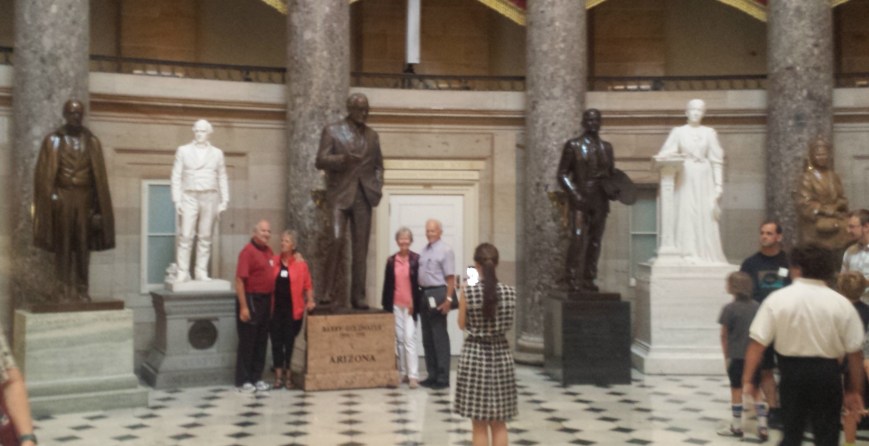
20150629_123332

Some tourists – presumably Arizonans – posing by Barry Goldwater. In the National Statuary Hall.

As any historian might guess, the Civil War era features prominently in the collection, and that’s the demographic that I want to talk about here.

There are two dozen Civil War figures among the hundred statues, and if you add such antebellum big names as Henry Clay and John C. Calhoun, and a couple of lesser known Reconstruction names, the specter of the Civil War makes a huge mark on the National Statuary Hall Collection. What’s interesting – albeit not surprising – is just how many Confederate fighters have monuments in the U.S. Capitol.
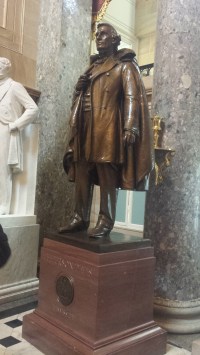
20150629_123820

Jefferson Davis, who worked in this building as a U.S. Senator until he resigned and became the President of the Confederate States of America.

Despite the fact that there were twenty-three Union states and eleven in the Confederacy, there are roughly a dozen statues representing each side in the collection. Included among the secessionists are none other than Jefferson Davis and Alexander Hamilton Stephens, the President and Vice President of the Confederate States of America, represent Mississippi and Georgia, respectively.

Remember that the states choose which two statues represent them in the collection. Alabama, Arkansas, Florida, Georgia, Louisiana, Mississippi, North Carolina, South Carolina, and Virginia all sent a Confederate to Capitol Hill – several of whom had resigned from positions as U.S. Senators and Congressmen to join the Confederacy.

Mississippi is the only one with two Confederates representing it (James Zachariah George, as well as Davis). Alabama had two until former member of the U.S. and C.S.A. Congress Jabez Lamar Monroe Curry was replaced by Helen Keller in 2009 (Confederate general Joseph Wheeler remains). In addition to Confederate Zebulon Vance, North Carolina’s other statue is Charles Brantley Aycock, a Gilded Age/Progressive Era politician who was a champion of white supremacy and famously said, upon being nominated governor, “When we say that the negro is unfit to rule we carry it one step further and convey the correct idea when we declare that he is unfit to vote. To do this we must disfranchise the negro.”

Of the twenty-two statues in the collection from states that once formed the Confederacy, eleven are of men who fought against the United States of America. While half of these statues are secessionists, just a quarter of the statues representing the states which once made up the Union forces are from the same time period. Among them, however, are leaders like Hannibal Hamlin and Free Soilers and founding Republicans who not only fought to preserve the Union but to rid it of slavery.

Frederick Douglass. On the side of the pedestal is a quote regarding emancipation in the West Indies:

Frederick Douglass. On the side of the pedestal is a quote regarding emancipation in the West Indies: “If there is no struggle there is no progress.”

Oh, and it’s worth mentioning that the 100 statues in the collection feature zero black people. Rosa Parks and Frederick Douglass both have statues in the Capitol – both installed way back in 2013, and there are busts of Martin Luther King, Jr., and Sojourner Truth in the building, but no state has chosen to represent itself with a black person in the collection. But 11% of the collection once fought the United States in the name of slavery. Go figure.

What do we do with a collection of statues that memorializes so many men who once tried to leave the union? I’m not necessarily for getting rid of monuments completely. While I’m all for taking down the Confederate flag, less a historical artifact and more a symbol of white supremacy and hate, it’s less clear what should be done when Robert E. Lee is literally put on a pedestal in the same room as Samuel Adams or Roger Sherman.

When it comes to monuments in general, I find myself agreeing with Ta-Nehisi Coates, who tweeted that “the fact that white supremacists were lionized for so long is also history.” And indeed, many of the statues in the collection were first donated in the early 20th Century, just decades after Reconstruction was cut short and in the midst of the White Supremacist Democrats’ Solid South era.

But the statues continue to stand, shoulder to shoulder with historical figures who struggled for things like liberty and rights and not white supremacy and slavery. What’s more, while the U.S. Capitol is part-museum, there is only brief discussion over who the actual figures are and why they are there. The tour guide when I went (who was awesome despite her relatively recent employment there) explained statues correlating to states where her guests were from, and briefly referred to Davis and Stephens’ statues in the light of recent debate over Confederate flags and other paraphernalia.

But, just as Colin McEnroe says about the name of Yale’s (John C.) Calhoun College, “It’s not called Calhoun College So Let’s Talk About That.  It’s called Calhoun College, and it’s an easy feat to spend four years at Yale without ever having one those “teachable moments” about the background of the name… For three of my four years [at Yale], my roommate was an African-American man, Ken Jennings. He tells me the Calhoun name was a topic of discussion, if not a towering issue at the time. He’s not surprised I never noticed. ‘A lot of this kind of thing is below the radar if you’re not of African descent.'”

The fact of the matter is, the dozen rebels standing in the Capitol weren’t even put there by the Capitol. They were sent by Southern Democrat state legislatures in the early 1900s – that is to say, White supremacist state legislatures – and they were sent to memorialize great men of their states. This was no history lesson on racism. We can make it one by changing the plaque to signify these men’s real actions. To cite another Coates tweet, this time regarding what we should do with monuments like Stone Mountain: “Keep it. Put a big-ass inscription near it saying ‘These Men Fought For An Empire Of Slavery.'” Or, better yet, these state legislators can commission a new statue to represent them in the Capitol, and move these old ones into a museum or state park – with proper and honest signage. After a century of these Confederates standing on pedestals, I think it’s time for something new.