Catching Joseph Kony

This Monday, Invisible Children released its newest film – the thirty minute Kony 2012. I’ve been involved with IC since early 2007, and my relationship with them is almost always in flux – ranging from being inspired and truly believing in the work to being a critic of the trendy oversimplification. After helping Resolve and the Enough Project gain support for the LRA Disarmament and Northern Uganda Recovery Act in 2010, IC has embarked on a new mission of trying to effectively end the war in 2012, with this video as a part of the broader campaign.  The video is centered on Jason Russell, one of the founders of Invisible Children, explaining Joseph Kony, the war criminal in charge of the LRA, to his son.  The take-away from the video is that the goal of the next two months is to teach people who Kony is, thus leading to more change and ultimately his capture.

Through most of Monday evening Facebook and Twitter were slowly ramping up in my world. I have met scores of people in my work on the issue, and many of my friends are on the staff at IC, so the hubbub was expected.  By Tuesday afternoon, some staff members were tweeting that, in the first 24 hours, the video had been viewed 800,000 times. Late Tuesday evening, the campaign took up six of the top ten trending topics on Twitter, and “Kony” and “#KONY2012” accounted for 3-4% of all tweets.
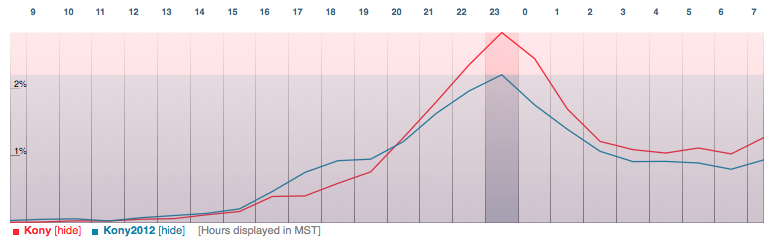
The last 24 hours (checked at 7:45am, MST today) of Twitter traffic, from trendistic.

Like many who are aware of the crisis in central-east Africa, I would love to see Joseph Kony brought to justice as soon as possible. Kony is the leader of a highly centralized rebel group comprised of abducted fighters – some of them children. Kony is among the first criminals indicted by the International Criminal Court, and his arrest would go a long ways towards ending the Lord’s Resistance Army as we know it and reinforcing an essential international institution like the Court.

”]As I mentioned, I’ve been a supporter of varying tenacity, and I have disagreed with Invisible Children here and there over the years. I support many of their programs on the ground in the region – granting scholarships for students to attend rebuild schools, teaching displaced people employment skills, and building a radio warning system among them – and am one of the many that first got involved in human rights and activism through their work here in the States. I’ve always felt that there is a huge disconnect between the great work being done in the region and the simplistic, sexy, and purely PR work Stateside, which is a shame. I’m not as much of a critic as others, but I do have a few qualms with the current campaign that’s launching right now.

Invisible Children continues to oversimplify the message of how to get rid of Kony. I understand that advocacy groups need to take really complex problems and boil them down so that it can be disseminated among supporters. As the movement grows, however, the leaders should be better educating their followers.  Being involved for five years, I have yet to see IC expand on its very simplistic history of the war, which is critical to understanding how best to approach ending it.

Something needs to be said about the narrative that IC creates, but I’ll leave that to everyone else.  IC has been running programs in northern Uganda for several years – ineptly at first but more recently they operate like any other aid organization there. Meanwhile, their PR campaigns in the States aim to address the LRA, who left Uganda – which has been in relative peace and experiencing slow recovery – in 2006. The videos blur the lines between the countries, and simplify everything to Kony roaming Africa abducting kids. That’s not to mention that there is no evidence of the 30,000 children figure endlessly repeated by IC and other NGOs, and no discussion of how to define abduction (which is important, since some are forced to help transport supplies before being set free, while others are forced to kill their own family members before being conscripted for life). The story IC creates will drive policy, and it needs to ensure that we have a dialog about the peace-justice debate, the accountability of the Ugandan military, and ways to move forwards without losing momentum.

IC’s campaign for the next two months is heavy on awareness. We supporters are to tell all of our friends and put posters everywhere, and then write messages to 20 cultural leaders (who control public discourse) and 12 political leaders (who are involved with real change). This build up is to April 20th, when we’re supposed to plaster our cities in Kony 2012 posters to “make him famous.” There is footage of “Kony 2012” – to make him as popular as possible – a sort of Public Enemy #1.

When I first got involved with IC, I attended an event that included learning about displacement camps in northern Uganda – an eye-opening experience that really pushed me to start a student organization in college. This year’s big event is to put up posters. This is all in the name of garnering more name recognition for Kony to make him (in)famous, but when you get the most bipartisan congressional support for any Africa-related bill in history and you claim hundreds of thousands of youth support you, you’ve gotten the word out. Claiming that nobody knows about Kony (the video says “99% of people” have never heard of him), is absurd. There is enough attention that we can move from awareness to action now. It’s time to pursue real change – front and center. E-mailing the Chairman of the Senate Foreign Relations Committee should not just be a side-note to hanging up flags and tweeting at Oprah, who is probably sick of IC distracting her from her work in South Africa anyways.

As Daniel Solomon notes (and you should definitely read his post), if people are tweeting at me to watch the video and aren’t reading the ICG report to learn more, then a vital part of the campaign has missed the mark. Mark Kersten also calls out the campaign in a post you should read, and here’s a critique of “crowd-sourced intervention.”

After six years of building a massive youth-led base in America – including raising millions of dollars in record time and directing masses of young people – we have passed the deadline for moving forwards. In the film, IC tells us the Kony 2012 campaign expires at the end of the year – a movement has an expiration date alright, and it’s important to freshen up the whole IC movement.

Update: The list of related links has moved to a new post, as it continues to grow.
Using Maps to Track the LRA

You might be aware that I have a love-hate relationship with trendy activism/development. I’ve always been interested in development, but I’ve been slowly opening my eyes a little more to what actually works and what kinda works and what is actually detrimental. My first foray into what we’ll call “sexy development” was Invisible Children, as most of you know. It’s a pretty sizable tag over on the right, and I was a founding member of the Schools for Schools club at ASU. My relationship with IC has been a close one – it means a lot to me and I care about the crisis in central Africa a lot. To me, IC was the amazing development group that was doing things I had never heard of.

As I grew academically and otherwise, I learned more about what’s happening on the ground in places like Uganda. I realized that lending circles have been going on everywhere for years. I figured out the economics of why in-kind donations are detrimental. I stared the conflict mineral movement in the eye and realized what it’s really done in the DRC. Finally, I realized that IC here and IC in Gulu are very different. Here, it’s the trendy commercial non-profit with the big vans and the MTV-esque movies that started small and grew huge raising money to help people. In Uganda, IC was the small group of naive kids that tried to pioneer forth and finally did what everybody else was doing.

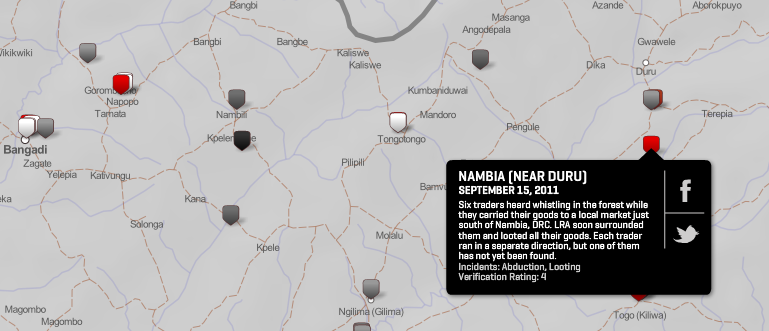
But something happened recently that I thought set IC apart from some of the other trendy activists, and that’s the LRA Crisis Tracker. Invisible Children and Resolve have been working for almost a year to set up radio towers throughout the DRC to establish warning systems and to better track LRA activity. Crisis mapping has become a pretty big field recently, and its use in this region has the potential to be of tremendous help. The information on the mapping tool comes from a variety of sources, including human rights NGOs and journalist reports, and is being updated constantly to give an accurate account of LRA activity and displacement migration. If you’re interested in the LRA or crisis-mapping you should check out the site and peruse the methodology book.

Screen cap of northeastern DRC from today.

Deafening Silence

Tonight, thousands of activists are going silent. I’m (kind of) one of them. Why? Here’s a little background:

In 1986, a civil war started in Uganda. Over the next twenty-five years, the rebel group Lord’s Resistance Army would resort to kidnapping and conscripting children to fight against the government. The crisis caused by the LRA would eventually be called the “most neglected humanitarian crisis” in the world and the “second most dangerous place” (to Iraq) to live. Fast forward to January of 2007, when I first got involved with a growing non-profit called Invisible Children.

In the past five years, I’ve gotten more and more involved not just with IC but with human rights in general. I’ve been to a handful of national events and conferences, a dozen lobby meetings, and scores of film screenings. Invisible Children has become something of a PR machine for ending the war. And starting at 7:00 tonight supporters went silent in solidarity with those victims who go unheard. Tomorrow night we’ll be breaking that silence, and hopefully moving towards ending the war.

I’ll post a recap of tomorrow evening’s events later. All I know is I’ll be a part of a team that will be ushering activists, hosting a concert, and organizing a letter-writing campaign – in silence.

Tweeting the Revolution (or at least the Rescue)

The internet has been pretty a-buzz over Malcolm Gladwell’s recent article in the New Yorker.  It’s called “Small Change: Why the revolution will not be tweeted” and it’s generated a lot of backlash.  Gladwell’s main argument is that modern social networking – through Facebook and Twitter – won’t translate into revolutionary social activism.  He points primarily to the differences between strong ties and weak ties and what type of actions each tie generates.  His primary focus is the sit-ins in Greensboro in 1960 and he contrasts that to a recent online campaign to get people to register as bone marrow donors.

So far, I’ve only read a few responses.  Angus Johnston provides a critique that follows the 1960s activism theme by contrasting SNCC with SDS and showing the strength of weak ties in organizing.  Patrick St. John did a pretty good job of showing how effective decentralized non-hierarchical networks can be. There’s also a good article at Wired that provides some great evidence as to why weak ties are useful for organizing.

I just wanted to provide a short contemporary example that hasn’t been added to the deluge of responses.  For years I’ve grown a number of weak ties with friends across the country for an idea that few others share: that a war in a far off place can end with our help.  It was called The Rescue. In April of 2009, we tweeted and facebooked our way to tens of thousands of people attending events simultaneously in 100 cities.  Some of my friends whom I convinced to initially show up were weak-tie friends.  And when the Phoenix event closed up shop and people caravaned to Albuquerque (then Wichita, then Chicago) the weak ties kept me updated as to what was going on.  Peruse the #therescue hashtag.  Watch “Together We Are Free,” the film about how The Rescue played out over six days and brought 500 people to Chicago.  Most of the Rescue Riders started off as weak ties and grew stronger.

Now, spending a week living on parks, vans, and church gyms is one thing.  Changing the world can be a bit different, I know.  But the attention that peaked with the Rescue carried into something huge.  A year-long local lobbying effort led by young people started off with the biggest Africa-related lobbying initiative in Washington history and culminated with the most widely co-sponsored Africa-related bill in modern legislative history.  And since the LRA Disarmament and Northern Uganda Recovery Act passed, we are anxiously awaiting the Obama administration’s response.

As one of the ones who abducted himself, I say that weak ties have power.

From Promise to Peace

A few months ago, President Barack Obama signed into law the LRA Disarmament and Northern Uganda Recovery Act.  It was a piece of legislation that I had spent almost a year pushing for through local lobbying and organizing.  I think most of you can remember my excitement when the House finally passed the bill. In total, I attended seven or eight lobby meetings and made dozens of phone calls before it was finally passed.

Three months later, it looks like I’m back at it.  Included in the law was a mandate that, in 180 days, the Obama administration draft a strategy of how the United States would assist in apprehending the LRA leader Joseph Kony.  Upon signing the bill into law, the President stated that the U.S. was dedicated to this mission.  Soon after, Secretary of State Clinton said much the same thing.  Since then, not a word – and there’s only 70 days left.

Resolve Uganda is about to launch a campaign to keep pressure on the Obama administration from putting together a piecemeal strategy.  If this law is going to do anything, it needs to be a comprehensive plan.  Last week I met with the District Director at Rep. Harry Mitchell’s office and urged my representative in the House to state that he would read and review the strategy.  I’m trying to muster some support for an end-of-month meeting at the office of my former representative, Jeff Flake.  Hopefully, we can keep the pressure on or else this year of lobbying will have amounted to little.

Without Objection

Yesterday evening, the United States House passed the Lord’s Resistance Army Disarmament and Northern Uganda Recovery Act of 2009.  I was at home watching C-SPAN and was elated to hear it pass.  A number of representatives made statements on the floor about the atrocities carried out by the LRA, including all of the original co-sponsors and both the chairman and ranking Republican of the Foreign Affairs Committee.  In theses statements, several representatives mentioned the work of advocates and activists.  And boy it’s been a long haul for a lot of the people I know.  Invisible Children made a sweet video breaking down everything I’ve written here, so feel free to get some visuals. In April of 2009, nearly 100,000 activists took to the streets in 100 cities around the world for a campaign that ended six days later in Chicago.  In May, Senators Russ Feingold (D-WI) and Sam Brownback (R-KA) introduced the bill, and a piece of partner legislation was introduced in the House by a trio of representatives.  A month later, 1700 activists descended on Washington, DC for two days – the most for any lobbying initiative.  The months since have been dotted by district meetings all over the country, and slowly the support trickled in.  In addition to lobby meetings, over 250,000 signatures were gathered for the Citizen’s Arrest Warrant for Joseph Kony and were hand-delivered to the State Department.  When Senator Tom Coburn tried to block the bill from passing in the Senate, a grassroots campaign led to activists sleeping outside of his office for 262 hours until he removed his hold (and the bill passed with unanimous consent). The bill gained the support of 65 Senators and 201 Representatives, the most of any policy bill in this session and the most for any Africa-related bill in either chamber in modern American history.  And on Wednesday it passed the House by voice vote and without objection. If you want to know more about what this means (and doesn’t mean), my friends at Resolve Uganda put together a break-down Q & A and John Prendergast wrote an article for Huffington Post about the bill as well.  The main thing you should know is that it will soon become law for the US to help apprehend Joseph Kony.

UPDATE (5/14) – Kim and I totally saw an Invisible Children ad on TV last night.  Totally weird, totally cool.  If you get Halogen.tv you should check out all of the IC films they’re showing. :D

UPDATE (5/15) – A couple more links for everyone! Senators Russ Feingold, Sam Brownback, and Jim Inhofe, together with Representatives Jim McGovern and Ed Royce issued a joint statement celebrating the passage of the bill that you can read here.  And, props to Resolve Uganda are in order.  The organization called for supporters to ask for statements from their representatives.  Their goal was five (only about 10 have made statements on this issue in the past ten years) and by the time the bill came to a vote fifteen statements had been made.  You can see a full transcript of the statements on Resolve’s website.

Victory.

Big news for my friends in Oklahoma and across the country, as well as for us here in Arizona.

On March 9th, 41 days after he put a hold on the bill and 262 hours after activists began camping outside of his district office, Senator Tom Coburn from Oklahoma released his hold on the bill.  Just a few hours later, it passed the Senate with unanimous consent.  The compromise they reached was pretty simple – changed some language to make it more direct that the $40M would be offset and not add to the deficit.  Coburn sticks to his principle, we stick to ours.  So, so excited to see this go through the upper house.  Now we just need to turn to the House of Representatives, where we only have 162 co-sponsors so far.

Speaking of which, here’s the personal victory.  In June my friends met with Representative Harry Mitchell’s staff in DC.  I’ve met with his staff twice here in Tempe.  After all of this, my friend Kristi met him at a fundraiser and mentioned the bill – he said he had never heard of it.  Demoralized, I sent a few follow-up e-mails to his staff and voila!  He co-sponsored yesterday!  I’m such a happy camper right now.  Nationally, we passed the bill in the Senate and my friends in Oklahoma managed to do the unthinkable.  Locally, a few good friends and myself put this obscure African bill on the desk of our representative and convinced him to put his name on it.  It’s a good day for activism.

I want to leave you with a little evidence of how commited people are.  The circles are the homes of people who ended up in Oklahoma City for 262 hours in the rain.

The Hold Out came from all over! (Picture by Rachel Bryan)

“It pierces your heart”

Tuesday night, the ASU campus hosted the Invisible Children roadies. I met up with them and helped set up in the Memorial Union, and we just kinda hung out for a while. I met the new roadies and the two Ugandans with them, and I also got to catch up with some familiar faces.

I talked to Richard, a Ugandan from IC’s Mentor Program, a bit before the screening and he seemed like a really interesting fellow.  Easy to talk to.  Then I greeted some familiar faces before starting the film.  I’ve probably seen this movie over twenty times. The crane shot still just floors me. And Jacob crying is still one of the most  heart-wrenching things to behold.  If you haven’t seen this film, I feel that you need to.

After the screening, a former night-commuter from the film spoke to us a little. After he spoke, his mentor spoke for a while. Richard is very well-versed.  He reminds me of my maternal grandparents with all the proverbs and deep thinking. Hell, he invented proverbs as he spoke – comparing people to light bulbs and turning life into a highway.  And while I didn’t record the Q & A, I got most of their addresses beforehand.  I hope you enjoy:


105 Hours

Today was a big day for me! I both narrowed and broadened my choices for the rest of my stay at ASU, and hopefully the semesters will play out the way I want. May have opened a new window for the internship. And the Legacy tour came to ASU! Expect at least one, maybe two posts about March 2nd to come soon. In the mean time, I want to pay a little bit more homage to the Oklahoma Hold-Out: 105 hours as I type. In the early 90s, they held a short press conference that I tried to listen to while in class. I’ll be youtube-ing it to catch what I missed. At hour 100, John Prendergast – the former Director of African Affairs for the National Security Council under President Clinton and co-founder of The Enough Project – issued a video statement in solidarity with the Hold Out. Until my future posts, I leave you with the letter that the activists are handing out to passersby in the Sooner State:

“Dear Oklahomans,

Staying outside Senator Coburn’s office for 24 hours a day – especially when overnight temperatures dip below freezing – no doubt sounds a bit extreme, because it is! But please allow us to explain why we have chosen to be here instead of at our jobs or in school. It is for a worthy cause.

Right now, in central Africa, a terror group called the Lord’s Resistance Army (LRA) is stealing children from their homes and families and forcing them to become child soldiers. They are attacking vulnerable communities, burning down churches, and maiming their victims. In the last year, this group has abducted and killed thousands of innocent people.

With leadership from our government, this violence is preventable. There is currently a bill in Congress – called the LRA Disarmament and Northern Uganda Recovery Act (S.1067) – that seeks to spur such leadership. It has more bipartisan support than any legislation focused on Africa in America’s history (62 Senate cosponsors!), and Senator Inhofe of Oklahoma is one of its biggest champions.

But Senator Coburn is blocking the passage of this bill because it authorizes funding to help the victims of this violence without an “offset” that clarifies where the funds will come from. Let us be clear: this bill does not directly expand our budget or deficit, and Senator Coburn knows that. He also knows that attaching an offset to it would result in the bill’s likely death. So he has decided to block the passage of this bill – supported by 99 other Senators – to make a purely symbolic point, even as the LRA continues its campaign of violence and terror.

All we want is to see Senator Coburn engage personally in finding a compromise that upholds his own principles and still addresses this urgent crisis. Because we feel so strongly about stopping this senseless violence, we are not going home until such a compromise is reached.

You can help us by writing or calling Senator Coburn to request that he allow this bill to pass, and by visiting http://www.coburnsayyes.com where you can find more information or make a tax-deductible donation to support this cause.

Thank you!

-Us”

The Oklahoma Hold-Out

As of right now, the hold-out in Oklahoma City has been going on for more than 24 hours. They’re holed up near the Chase Building, where Senator Coburn’s office is, and they’re committed. I have friends from Austin and San Diego that are there, and I heard supporters from Chicago and Los Angeles have also converged on the Sooner State. As I mentioned in my last post why there are there, they are asking Senator Tom Coburn to remove his hold on the Bill. On the same day as the rally at the OKC Capitol, Senator Russ Feingold called on Coburn to work with the original co-sponsors.

I not only admire this strong commitment to peace in the region, I share and support it. If it were up to me I’d probably be hunkered down with them right now. Supporters are flocking from across the country to one city. Supporters who can’t make it are sending food and blankets to keep them going. They even brought the Live Feed. It’s like a mini-Rescue, when 100,000 people in 100 cities supported each other for 6 days until Oprah addressed 500 of the faithful in Chicago. I’m really excited to see how it all plays out.

But I’m really worried for this bill and whether or not this campaign will work. You see, Senator Tom Coburn is a unique individual. Like a counterpart in the House, my former Representative Jeff Flake, he has one platform. The single thing he stands for more than anything else is not just fiscal responsibility, but fiscal restriction. Senator Coburn drafted a list of requirements for bills, and if a proposed bill does not meet these requirements, he refuses to allow it to pass. He has done this time and time again, placing holds on numerous bills. He even carried a little cheat sheet with a run down of each bill because he has holds on so many.

When approached about this Bill in particular, he stood his ground. I admire a man of his principle, but I’m worried that we;re reaching a stalemate. When a constituent asked about the bill (about 4:00 in), the Senator said he would support an offset to the State Department. This compromise was offered, and he still refused. I asked some sources, and they’re fairly certain that compromise wasn’t plausible even when Coburn said this. Numerous other compromises have been pitched, all to be rejected. The bill doesn’t even appropriate extra funds for this – it just authorizes spending and Congress will figure out where the money comes from later.

The problem is, Coburn won’t back down on this issue. Another problem is that we won’t give up on this bill. It means too much to the thousands of activists across the country. It means even more to innocent civilians in four east-central African countries. It means even more to those child soldiers and sex slaves in the LRA. So, we’ll keep pushing. My hope is that Oklahoma’s junior senator will cave under constituent support. But I’m prepared to go the long route and revisit my own representatives in Congress, because the only way to get around this hold is a floor vote – but we need wide support for that. So, I’m hopeful that this campaign will end soon with the removal of Coburn’s hold. But I’m gearing up to meet with important people all across the state. E-mails and phone calls will be going out soon!