Students Aren’t Irresponsible – The Minimum Tuition Bill Is

Amid my short bout of confusion this afternoon over the status of the minimum tuition bill, HB 2675, I contacted the original sponsor, Representative John Kavanagh, asking if the bill had been withdrawn, and received a simple answer that the bill has not been withdrawn and will be discussed in the Appropriations Committee this week (see my update on today’s prior post). In addition, Kavanagh also sent me talking points as to why the bill should be passed, which I have decided to post in its entirety for you:

  • Currently about 48% of students at our state universities pay no tuition at all. Only 5% are academic or athletic scholars. The rest are being given unearned tuition subsidies from the universities.
  • HB2675 requires students, other than academic and athletic scholars, to pay $2,000 of their approximately $9,000 yearly tuition – a mere 20%. They may use their own money, university work-study program money or outside scholarships, grants, gifts or loans, excluding Pell grants, to pay this $2,000.
  • HB2675 still allows the universities to give these students up to $7,000 per year in unearned tuition subsidies, about 80% of their tuition.
  • The $18 million that this frees up will be kept by the universities and may be spent for other purposes, such as tuition rate reductions or improving academics.
  • Even if some students have to take out loans to pay the minimum $2,000 tuition per year and an extra $1,500 per year for fees and books, that still would only amount to a four-year debt of $14,000, which is less than the cost of a Chevy Sonic. Our state university degrees are worth far more than the cost of a Chevy Sonic. In addition, based upon an inspection of university parking lots, students have no trouble getting car loans for greater amounts and paying them off.
  • These unearned tuition subsidizes, which pay the full tuition of non-academic and non-athletic scholars, cause several unintended negative consequences:
    • The free tuition often makes it cheaper for students to attend universities rather than community colleges, which lures some less academically prepared students to universities, when they would be better served going to smaller, more teaching-focused community colleges for a year to two before going to impersonal university with greater distractions. As a result, some of these students fail or drop out, lowering the completion rates of our state universities, which lowers their national ratings and devalues the worth and prestige of their past, present and future degrees.
    • When students pay nothing towards their tuition, some take their studies less seriously and then fail to graduate. This lowers the completion rates of the universities, their national ratings and the value of their degrees.
    •  Taxpayers who generally do not have university degrees wind up paying the tuition of those who will statistically earn one-half to a full million dollars more in salary over their lifetimes. This is unfair.
    • Currently, nearly half of all in-state undergraduates pay no tuition due to this unearned subsidy, which extends this aid well beyond the poor.

Kavanagh repeatedly refers to need-based full-ride scholarships as “unearned tuition subsidies,” arguing that completing the admissions process and qualifying for funding based on financial necessity is not enough to warrant being awarded the funds to pay for education. Again, we are seeing a division being made between the academic and athletic scholarship recipients, who “earn” (and by extension, deserve) their scholarships, and those who apparently receive unwarranted scholarships. And he covers for it by saying that he’s only making them pay a mere 20%, a mere $2,000 a year. But that’s precisely why people receive these types of scholarships – because otherwise they wouldn’t be able to afford the education for which they are striving. To call this anything other than a war on the lower class is to admit that you’re not paying attention.

But it’s not enough to force the poor to pay for tuition that they can’t afford. Why not add a dose of condescending humor? Kavanagh decides to compare the overall cost of tuition to a cheap car, assumes that value equals dollars rendered and nothing else, and then says this:

…based upon an inspection of university parking lots, students have no trouble getting car loans for greater amounts and paying them off.

What kind of assholey argument is that? Kavanagh is ignoring that transportation – like education – is often a necessity, while simultaneously ignoring that a large number of students rely solely on public transportation to reach campus. He ignores that students sometimes need cars to get to jobs to help pay for rent, books, and other costs – things that a full-ride scholarship still doesn’t cover. He’s ignoring that, without a scholarship to cover tuition costs, paying for things like cars – or even parking on campus – is difficult for many. He’s also ignoring that students are individuals worth more respect than his little jab at fiscal responsibility conveys.

The fact that Kavanagh thinks that students – especially poor ones – are irresponsible and unable to make good decisions is continually reinforced with every bullet point. It goes beyond “students who get scholarships waste money on cars.” Students who can’t afford higher education don’t deserve a chance to get it. Students who successfully get admitted to research universities aren’t committed or prepared enough to finish college. Students who don’t pay for their education don’t value it and as a result won’t try hard. Those who want to pursue higher education, but can’t afford it, don’t deserve the help of the community that would benefit from their work.

That this type of legislation can be seen as anything but an attack on the poor is absurd. And yet it’s only when the marginalized (or in the case of Occupy, the newly marginalized) try to stand up that it’s called class warfare. This is just one of many instances in which the legislature is trying to put more pressure on those that have little and are striving for more. It’s a shame that this type of legislation is even seeing the light of day in a time when more and more people are being squeezed by the recession and are fighting to attain a higher education. Students aren’t irresponsible for aiming to get an education. However, it is irresponsible for the government to try to walk away from its obligation to provide an education to residents that are a part of the community, help fund the institution, and want to be educated.
HB 2675 Might Be Gone (with updates)

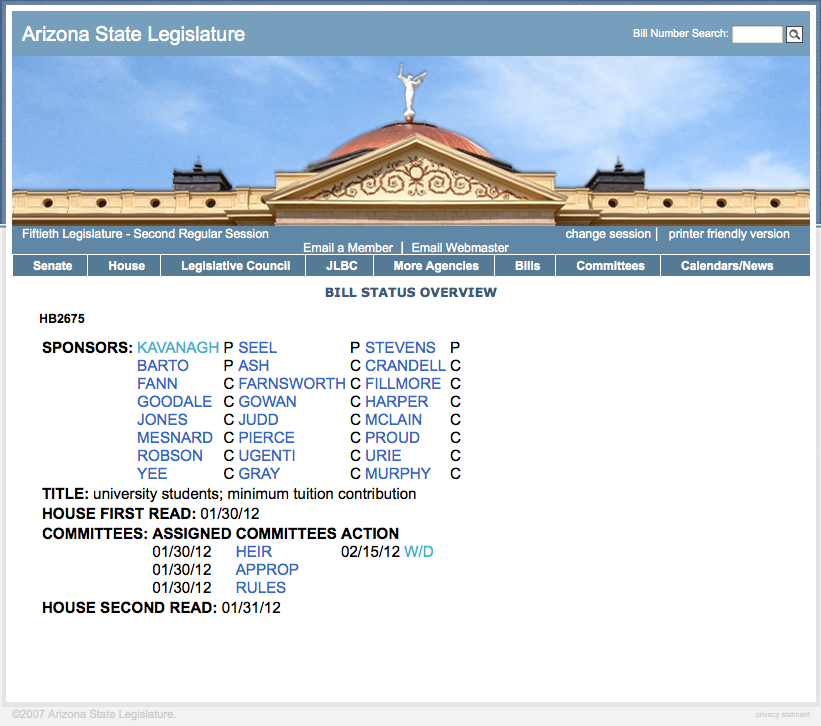
A few moments ago, I was on the Arizona state legislature’s website to check up on a current nemesis, the minimum tuition bill that would get rid of need-based full-ride scholarships. While on the site, I found the bill and checked its status – nothing had changed. I checked the overview and its most recent action was listed as “2/15/12 W/D,” which indicates (to my knowledge) that the bill was withdrawn.

Most recent action lists the bill as withdrawn. (Screen captured at 11:40 today)

Having not heard much, I perused local newspapers and asked the internet about it, so far to no avail. I called the original sponsor of the bill, but got no answer. For a while, the state legislature’s website was rerouting me to this bill, a bill from the previous legislative session regarding food stamps. Manually finding my way back to the current session, the bill still says it was withdrawn last week. I’ll update more on this as the day moves continues.

12:45 Update: It appears that the bill has been withdrawn from the Committee on Higher Education, Innovation and Reform, although I have not found out why. The Appropriations Committee, of which Rep. John Kavanagh is the chairman, is still scheduled to discuss the bill tomorrow morning. Including Kavanagh, six sponsors of the bill are on the 13-member committee. The HEIR Committee had no sponsors among its membership.

9:40 Update: Earlier this afternoon I e-mailed the original sponsor of the bill to ask about its status. He responded with a long list of reasons to support the bill, which I just finished criticizing here.

Feb. 23 Update: The House Appropriations Committee voted yesterday to pass the bill after a very intense testimony from students and other stakeholders. It’s a sad move towards a potential equivalent to a $2,000 tuition increase for the poorest students in the state. An amendment was passed exempting students living on campus, but an exemption for veterans was not passed.

Mar. 1 Update: The bill was withdrawn by Rep. Kavanagh yesterday!

A New Burden for Arizona Students

Recently, State Representative John Kavanagh introduced a bill, HB 2675 [pdf], that would establish a minimum tuition that has to be paid by the student. The bill will force students to “pay $2,000 unless they have a full-ride scholarship based on athletics or academics” – effectively getting rid of needs-based full-ride assistance. The bill, if passed, would even restrict students’ ability to pay with other awards: it says that any other awards from a source affiliated with the university cannot be used to pay for tuition. This would include things like this fellowship that I won in my junior year, or countless other awards offered by the university, colleges, centers, and even the university’s foundation, forcing students to either work or take out loans to pay for their education.

The bill has 24 sponsors right now, and the body is comprised of sixty members. It’s not unrealistic to believe that this bill could become law very soon. It was introduced in the House by John Kavanagh, who you might know as the representative who was a staunch supporter of controversial SB1070 and was a big supporter of contracting with private prisons, in addition to the mastermind behind charging people $25 to visit their family members in prison. Not coincidentally, he is also an active member of ALEC and he received donations from prison privatization lobbyists. It looks like he’s now set his sights on higher education.

According to the linked article, Kavanagh thinks that $8,000 in loans isn’t much since those who choose to go to college will make more than those who don’t. Not only does that ignore the fact that many students who get full-ride scholarships still take out loans for cost of living, an $8,000 loan turns into almost $12,000 due to interest. Kavanagh also defends the fact that merit-based full-ride scholarships remain intact by saying that they contribute to the school. Because if you don’t get recognized  for your intellect of your athleticism in the form of cash, you must not bring anything to the table. He also argues that tax payers shouldn’t pay for higher education because then students don’t take classes as seriously and because it encourages enrollment of students who aren’t actually ready for college. He actually said that.

It’s important to note that the state constitution says that education must be as nearly free as possible. Instead, Kavanagh thinks it’s appropriate to throw a $2000 tuition increase at the most vulnerable students. The response in Arizona’s universities will be interesting. The universities in Arizona have been hit pretty hard over the years, including massive cuts in state funding over the last three years. Just during my time at ASU tuition has skyrocketed while class sizes get bigger. By law, each university will have to host a public hearing about the law since it constitutes a tuition increase for some students. It will be interesting to see if the student community can mobilize itself enough to speak up about this bill.

Academics at War

In my junior year at ASU I was awarded a fellowship to work with a professor on a research project. His research project was particularly interesting because of the framework: he was researching counter-insurgent discourse in Southeast Asia, West Africa and Western Europe. His research was diverse, but boiled down to trying to figure out who was on “our side” in contested regions, and how to connect with them. It was one of a small group of projects that comprised The Minverva Initiative, a program funded by the Department of Defense to help better understand the conflicts in which the United States is involved.

A couple years removed from this, I’m wondering if I would still choose the same fellowship (we each chose from a list of potential projects on which we would work, I ended up landing on this one, researching the background of the rebellion in southern Thailand). The Minerva Project, being fully funded by the DoD through the Office for Naval Research, uses academics to assist the military in its work around the world. There’s a lot to be said about the pros and cons of such a relationship, and I find myself wavering a bit in whether or not academics should really be so involved in the military’s operations. One – well, four – points made by the Network of Concerned Anthropologists was this:

The US university system is already highly militarized, that is, many universities take in a large proportion of their research funding from military sources.  This is problematic for four reasons:

  1. The fields so supported are distorted by focus on issues of utility to warmaking.  Whole fields of study hypertrophy and others shrink or are never developed as researchers are drawn from one field into the other, Pentagon-desired ones.  Nuclear and other weapons research related areas grow, at the expense of environmental research, for example.  Moreover, theory, methodology, and research goals in such fields as physics, computer science, and engineering after decades of military funding now operate on assumptions that knowledge about force is paramount.
  2. These research foci begin to structure what gets taught to students and what research projects students themselves see as the best options for their own work. A brain drain from other research directions occurs.
  3. The dependence on single sources of funding with their own agenda tends to reduce intellectual autonomy in ways that go beyond the selection of subject matter for research.
  4. The University becomes an instrument rather than a critic of war-making, and spaces for critical discussion of militarism within the university shrink.

And if you find this program a little too cozy of a relationship, you’ll shiver at the thought of Human Terrain Mapping. A couple of years ago the Army unveiled a new program called Human Terrain Systems which dwarfs the involvement of academia that programs like Minerva created.

HTS Researcher in Afghanistan, via army.mil

The program, as described by the Army, places small Human Terrain Teams (HTTs) with Army and USMC combat teams on the ground in conflict zones. HTTs conduct research on the ground to help create “human terrain” maps that influence combat decisions, including “planning, preparation, execution and assessment of operations.” The teams are a mixture of military and civilian, including social scientists, researchers and analysts. Some have argued that HTS is “weaponizing” disciplines such as anthropology, and the debate has continued over the last couple of years. It’s hard to argue against the fact that universities are being funded more and more by the military, and that this does alter how universities operate – whether you think it’s good or bad.

A Campaign Deferred

In April of this year I met with a number of like-minded individuals at Arizona State University.  By like-minded, I mean people who are concerned about social justice and human rights.  We had a vision of linking our student organizations – interests like women’s rights and fair trade, LGBTQ equality and anti-genocide came together.  Our primary goal was to establish something ASU didn’t have, but that we thought it needed: a Committee for Socially Responsible Investing.’

A number of universities have these committees.  They’ve manifested themselves in different structures and with different goals.  One early and prominent campaign was the campaign to cripple the South African regime through divestment (which started in the US with the Sullivan Principles and in universities with Stanford).  Recently there has been a push to divest from companies like PetroChina that do business with Sudan, a frequent human rights abuser.  Currently a number of universities have begun the controversial but justified effort to sever ties with the aggressive and abusive Israeli government.  Yet ASU does not have a committee to oversee what money is spent on.  There is definitely no one looking over the Fulton Foundation’s investments.

So we established the ASU Coalition for Human Rights.  And we drafted a proposal.  And we began meeting with Vice President for University Student Initiatives Dr. James Rund.  We began making progress.  I was among four students in a meeting with Dr. Rund at the end of September.  We spent the better part of an hour debating the need for a committee and the trend of social responsibility that ASU is missing.  We began debating the structure of such a committee – who would serve on it? how would the Coalition be involved? would the committee’s decisions be binding? It was at this point that I turned to Dr. Rund and asked, bluntly: “So, are you saying that you support the creation of a committee, but want to debate the structure of it?”  To which he casually responded, “I’d say yes, yes I am.” We later adjourned the meeting and agreed to speak with Student Government’s Council of Presidents on the issue and come back to Dr. Rund.

Last week, a number of my like-minded peers met with Dr. Rund.  Just weeks after telling me that, yes, yes he supported the idea of creating a committee, we were told that the committee was a bad idea.  We were challenged not only on the structure of the committee, but on the structure of the Coalition itself (we had recently voted down an application from a political student organization on the grounds of the Coalition being apolitical and purely human rights-oriented) and even on the premise of the necessity of such a committee.  We were told that, if there is a question of ASU’s investments, feel free to bring it up with ASU’s leadership.

A lot of our success has been curbed, but we’re not stopping.  ASU has not yet made an official proclamation to have sweatshop-free merchandise (although ASU did cut its contract with Russell Athletic over labor disputes, which deserves some applause).  ASU has not taken a stance in making sure its electronics are audited to be conflict mineral-free.  The Fulton Foundation’s finances have not been made public, so I personally have no idea if my tuition dollars are indirectly supporting genocide in Darfur now or election-disruption in South Sudan in January.  Who knows where that money goes?

I still have hopes that my university will take a step forward.  I have hopes that our organization will be able to keep the pressure on until a permanent Committee for Socially Responsible Investing is established at Arizona State University.  Let’s keep this going.

Why SAFRA is Important

As I type this, I am watching the Health Care debate in the House.  Today, the House will be voting on budget reconciliation.  To most, this is a healthcare vote.  For quite a while, the Student Aid and Fiscal Responsibility Act was considered for budget reconciliation.  Instead of leaving it in the dust for healthcare reform, it has been attached for reconciliation and may (probably will) pass today.  Now, my opinion on the health care reform bill is a little iffy. I like parts and I dislike parts.  But I’m all for SAFRA and here is why:

SAFRA would increase the number of Pell grants and amount of Pell grants to students.  Especially with the current crisis in higher education, Pell grants just don’t cut it.  They need to be greater in size and in distribution.  SAFRA does this.  It also caps interest rates on Stafford loans, something that hasn’t yet become an issue but will in coming years.

In addition to this type of assistance to students, there is also good news for our budget.  By dropping subsidies for loan companies, SAFRA could save tens of billions of dollars.  This will be done by cutting out a very costly middleman in favor of direct loans.  In my opinion, there aren’t a lot of negatives for this piece of legislation.  It will help students in a time when higher education is being hit from all sides.  SAFRA is a step in the right direction.