
Here’s your second dose of weekend reading on this blogfront.
A study accidentally links ship activity to whale’s stress levels in post-9/11 silence.
Louis C.K. talks about raising girls in the 21st century.
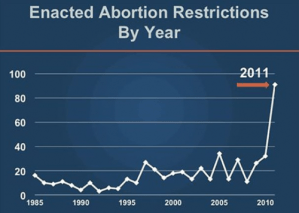
Is there really a culture war truce on things like abortion legislation? This graph says no.
And a look at the war on women and abortion in Africa.
And another look at religious freedom and contraception:
You can force people to pay taxes that pay for guns, but you can’t actually force them to shoot the guns, personally. You have to let them be stretcher-bearers instead, or something of the sort. Only in this case the objection is to one particular form of stretcher-bearing, as it were. But it’s really hard to take this too seriously. It’s not as though anyone is suggesting we force Catholic employers to hand out birth control pills personally, much less that we force them to force employees to take the pill or anything like that. Forcing employers to pay someone else – an insurance company – potentially to pay for someone else – a doctor – to tell someone else – a pharmacist – to give something to someone that the employer wouldn’t ever ask for, for themselves, hardly seems analogous to asking a pious Quaker to shoot a man.
And the editors at The New Inquiry have this to add:
Increasingly, what we are seeing from the right when it comes to women’s issues is not conservatism but radicalism: a bid to roll back the gains and freedoms that feminism has managed to earn for women. During the various imbroglios over Planned Parenthood, for instance, why weren’t more conservatives making a principled case against abortion while also conceding—and applauding—the important role that the organization has played in allowing women to take control of their health and their lives? We are adamantly pro-choice; yet we could certainly respect a principled abortion opponent who took this position. Unfortunately, this is not what we have heard from most conservatives. Instead, we have seen a rush to demonize Planned Parenthood wholesale, oblivious to the crucial work it does for women.
Write like a Mad Man, advice from an advertising executive.
A spooky memo: a contingency speech for Nixon to give if Neil Armstrong and Buzz Aldrin got stranded on the moon.
Alan Moore on V for Vendetta, Anonymous and Occupy.
A couple of weeks ago, caring about privacy at internet cafes was terrorist activity. Nowadays it’s buying coffee with cash.
How do states act once they get nuclear weapons?
Changing from a soldier in Iraq to working on Wall Street to protesting at Occupy Wall Street.
How to spot bad history.
Oprah meets a Hasidic family that has no idea – and doesn’t really care – who she is.
We should probably take a look at a White History Month, to learn both the good and the bad.
Grappling with your ancestor’s past – The Reader and South Africa.
To celebrate Valentine’s Day, three large student groups broke up with major banks due to things like predatory lending and supporting anti-union politicians.
The gay marriage debate is dividing the house, Lincoln style:
For years now the Supreme Court has been doing its damnedest to pass the hot potato on gay marriage. Different states have passed different laws regarding it and different federal courts have issued conflicting decisions. Because the Full Faith and Credit Clause of the Constitution requires things like marriage licenses issued in one state to be recognized as valid by others, it simply is untenable for this patchwork, confusing approach to continue. Now that one federal district court has ruled California’s Prop 8 unconstitutional we have reached the decision point. Gay marriage bans cannot be unconstitutional in one state or one federal court district but constitutional in others.
We have kicked the can down the road for too long already. It is time to decide whether we will become all one thing or all the other. Is this legal or is it not? Will all states recognize legal gay marriages or will none? The Supreme Court appears to be painted into a corner. An appeal of this decision is a certainty and it is unimaginable that the Court would be so derelict in its responsibilities that it would not accept the case. My confidence in the current Court to make the correct decision here is shaky, but regardless we need this issue to come to a head. The status quo is untenable and it is time for the Supreme Court to do its job.
Is there conservative art? Sure, conservatives just don’t embrace art.
And an interesting look at the power of femmes fatales.
The idea of duck-and-cover predates the Cold War.
Noam Chomsky on Vietnam, China, and America’s Decline:
By 1970, U.S. share of world wealth had dropped to about 25%, roughly where it remains, still colossal but far below the end of World War II. By then, the industrial world was “tripolar”: US-based North America, German-based Europe, and East Asia, already the most dynamic industrial region, at the time Japan-based, but by now including the former Japanese colonies Taiwan and South Korea, and more recently China.
At about that time, American decline entered a new phase: conscious self-inflicted decline. From the 1970s, there has been a significant change in the U.S. economy, as planners, private and state, shifted it toward financialization and the offshoring of production, driven in part by the declining rate of profit in domestic manufacturing. These decisions initiated a vicious cycle in which wealth became highly concentrated (dramatically so in the top 0.1% of the population), yielding concentration of political power, hence legislation to carry the cycle further: taxation and other fiscal policies, deregulation, changes in the rules of corporate governance allowing huge gains for executives, and so on.
Meanwhile, for the majority, real wages largely stagnated, and people were able to get by only by sharply increased workloads (far beyond Europe), unsustainable debt, and repeated bubbles since the Reagan years, creating paper wealth that inevitably disappeared when they burst (and the perpetrators were bailed out by the taxpayer). In parallel, the political system has been increasingly shredded as both parties are driven deeper into corporate pockets with the escalating cost of elections, the Republicans to the level of farce, the Democrats (now largely the former “moderate Republicans”) not far behind.
Another discussion on the use of adjuncts in universities, and whether or not to give them tenure.
The U.S. News College Rankings: The Root of all Evil.
Sean Penn should give his Malibu home back to Mexico.
Do online matchmakers really work?
“The Justice Department was not following the law.” Congress has been oblivious to DOJ’s wiretapping.
The impact and influence of Occupy’s refusal to negotiate with the city or obey free speech limiting ordinances has been copious and it has inspired exactly the communities it has been said to alienate. When SEIU workers came to city hall to protest their lay offs at the hands of a city pinching pennies while blowing millions on police wildings, they didn’t do it by waiting patiently in line at the podium. They didn’t nervously hope to be taken seriously while the council members’ squandered their time by fidgeting with Iphones and Blackberries like adolescents; they invaded and occupied with well over a hundred members, stacking the council chambers from floor to balcony. They hooted, hollered, heckled and berated the entire time. They were far more like occupiers than the polite city union that gave the city everything it wanted in contract negotiations last year.
Perhaps even more importantly, the prototypically vulnerable population that is always brought up as the one community Occupy will never win over—Latinos—have approached Occupy for help in labor fights. Not just once—for the licorice strike—but twice now. Pacific Steel workers in Berkeley, fired in a ‘soft raid’ after a battle with their union, headed by none other than the city’s biggest hypocrite, Ignacio de la Fuente, recently asked for solidarity in a march they’re having to bring attention to their plight. These are workers with families who’ve logged decades at their jobs and have families that they’ve raised solely in this country.
One of the Pac Steel workers I spoke to the night that they initially approached the Labor Solidarity Committee, told me he had worked for the company for over twenty years, had raised a family here, had his whole life in the US. If any group of people has something to risk by associating with Occupy Oakland, its people like this. The Pacific Steel workers could have gone to Occupy Berkeley; but they didn’t. They came to Occupy Oakland.
The Good, the Bad, and the Ugly: a follow-up on playful thinking history class experiment.
What the Sumerians can teach us about data.
Laurie Penny on being rootless and ruthless.
Against TED – asking for something newer and better than TED Talks.
Washington’s drone war on Yemen, and how it’s not really working:
For years, the elite Joint Special Operations Command and the CIA had teams deployed inside Yemen that supported Yemeni forces and conducted unilateral operations, consisting mostly of cruise missile and drone attacks. Some of the unilateral strikes have killed their intended targets, such as the CIA attack on Awlaki. But others have killed civilians—at times, a lot of civilians. And many of these have been in Abyan and its neighboring province of Shebwa, both of which have recently seen a substantial rise of AQAP activity. President Obama’s first known authorization of a missile strike on Yemen, on December 17, 2009, killed more than forty Bedouins, many of them women and children, in the remote village of al Majala in Abyan. Another US strike, in May 2010, killed an important tribal leader and the deputy governor of Marib province, Jabir Shabwani, sparking mass anger at the United States and Saleh’s government. “I think these airstrikes were based on false intelligence from the regime, because that is the nature of the contractor,” Qahtan charges. “The contractor wants to create more work in return for earning more money.”
The October drone strike that killed Awlaki’s 16-year-old son, Abdulrahman, a US citizen, and his teenage cousin shocked and enraged Yemenis of all political stripes. “I firmly believe that the [military] operations implemented by the US performed a great service for Al Qaeda, because those operations gave Al Qaeda unprecedented local sympathy,” says Jamal, the Yemeni journalist. The strikes “have recruited thousands.” Yemeni tribesmen, he says, share one common goal with Al Qaeda, “which is revenge against the Americans, because those who were killed are the sons of the tribesmen, and the tribesmen never, ever give up on revenge.” Even senior officials of the Saleh regime recognize the damage the strikes have caused. “People certainly resent these [US] interventions,” Qirbi, the foreign minister and a close Saleh ally, concedes.
Such resentments mingle easily with the political and religious message of Al Qaeda and with the growing radicalization of the religious landscape, particularly in impoverished areas neglected by the Yemeni government, like Abyan. “Of course, when people are in that kind of circumstance then they need to hold on to some kind of ideological banner, so they start talking about the Caliphate and all that stuff,” says Iryani.


 Scott Ross
