Weekend Reading

The biggest source of lead in the postwar era, it turns out, wasn’t paint. It was leaded gasoline. And if you chart the rise and fall of atmospheric lead caused by the rise and fall of leaded gasoline consumption, you get a pretty simple upside-down U: Lead emissions from tailpipes rose steadily from the early ’40s through the early ’70s, nearly quadrupling over that period. Then, as unleaded gasoline began to replace leaded gasoline, emissions plummeted.

Intriguingly, violent crime rates followed the same upside-down U pattern. The only thing different was the time period: Crime rates rose dramatically in the ’60s through the ’80s, and then began dropping steadily starting in the early ’90s. The two curves looked eerily identical, but were offset by about 20 years.

So Nevin dove in further, digging up detailed data on lead emissions and crime rates to see if the similarity of the curves was as good as it seemed. It turned out to be even better: In a 2000 paper (PDF) he concluded that if you add a lag time of 23 years, lead emissions from automobiles explain 90 percent of the variation in violent crime in America. Toddlers who ingested high levels of lead in the ’40s and ’50s really were more likely to become violent criminals in the ’60s, ’70s, and ’80s.

Within 24 hours, 5.2 million people had read the Reddit interview. It was the most-trafficked post in Reddit’s history. Just before signing off, Obama mentioned GottaRegister.com, the campaign’s official voter registration site, and 30,000 people registered to vote from that link. “And he didn’t even hyperlink the fucking thing, so they, like, actually copy-and-pasted it, and opened up a new tab, and put it in,” said a senior official. On Election Day, 82,670 Redditors would connect again with the campaign, giving “upvotes” to a message posted by Obama in the afternoon, with tens of thousands more likely seeing the post. A massive hit—and strategically successful. The Reddit chat occurred in the middle of the Republican National Convention, and the Democrats, through a guerilla-like tactic, had seized control of the Internet for the day. They’d do it again that week, too.

The next night, Clint Eastwood opened up for Mitt Romney at the RNC. He talked to an empty chair. Elizabeth Jarvis-Shean ran into Jim Messina’s office: You’ve got to see this. Stop. What. You. Are. Doing. Two other Obama digital staffers—Jessi Langsen and Alex Wall—who were watching the feed came up to Goff and Joe Rospars within minutes. Another staffer had found a picture of the president pointing at a chair and asked, “Can we post this picture of the president?”

Weekend Reading

New year, new reading.

The Wendlenders chose explicitly non-violent forms of resistance, but the West German authorities attacked, undeterred by moral force or persuasion. A year later, when the government restarted construction of a nuclear power plant at Brokdorf near the North Sea, perhaps they expected the same peaceful acquiescence. What they found instead was quite different.

Opposition groups called a large protest and nearly a hundred thousand came; many attempted to storm the building site and occupy it. As the police tried to drive protesters away with clubs and water cannons, they were attacked with stones and Molotov cocktails, mostly hurled by youths in black ski masks and motorcycle helmets. By the end of the day, protestors had breached all but the last inner fence of the construction site and destroyed a water canon truck with petrol bombs. The authorities were stunned by the protesters’ ferocity, and the fight at Brokdorf revealed a new radical force in the cracks of West German society.

Already activists for wages for internships have begun to follow a similar scheme, gathering interns for shared experiences and culling examples of particularly egregious work. Intern Labor Rights, an outpost of the Arts and Labor Occupy group, describes as part of its outreach how internships “devalue the fundamental dignity of work” and how “unpaid internships produce a culture of self-denigration in the workforce.” Such efforts still operate on a small scale, but they point to a growing sense among interns of their rights and worth. A small ripple of lawsuits early in 2012—after the Department of Labor issued guidelines that suggested it would crack down on the practice—has prompted a number of employers to pay their interns.

Weekend Reading

Here it is, folks! The last weekend reading of the year!

In lean production, however, the goal isn’t to continuously develop workers’ skills or even improve the quality of their products. What’s continuously improved is the production process itself, and the metric for measuring improvement is efficiency.

Of course, as labor educator Charley Richardson has pointed out, efficiency is not an absolute concept, but is socially defined. Richardson notes, “Coffee breaks, production limits and staffing levels are all designed to improve the production process from a worker perspective and are all inefficiencies from a management perspective.” In a lean workplace, continuous improvement means the elimination of whatever makes the work process humane and tolerable in order to increase production numbers.

Ultimately, both the worker and the product are of minimal importance. Perfecting the labor process by maximizing efficiency, regardless of the collateral damage to worker or product, is the goal. In lean schools, teaching, learning, and student growth become secondary.

Silicon Valley’s countercultural vibe has long masked its Wall Street-style labor discipline: a heavy emphasis on smartness, flexibility, and willingness to work more grueling hours than the guy next to you. Facebook COO Sheryl Sandberg has even confessed to “sneaking” out of the office to have dinner with her family so as not to run afoul of overwrought office cultures. So intense is the work expectation that the biography of late Apple CEO Steve Jobs has become a sort of Bible for the aspiringly sleep-deprived…

…this is an impressive absorption of female biology into a reinforcement of the work ethic. Everyone knows that men can work all the time by ignoring their families. But women give birth. They’re natural nurturers. What if they can perform both roles and somehow center motherhood and CEOship? She becomes a superworker, “balancing” two loads too heavy to be borne in any proportion. Women insist that they can “do it all” so as not to appear disadvantaged in comparison to their male colleagues; this scrabbling not to be left behind merely legitimizes the insane work ethic. Women’s desire to break the glass ceiling right under Jobs’s feet — Mayer has referred to him as one of her heroes on Twitter — reinforces the importance of a brutal, dehumanizing schedule. Women can do that too. Only more.

Weekend Reading

And your regularly scheduled reading:

Gun manufacturers have successfully managed to shift virtually all blame for lax gun laws in America onto their lobbyists and their customers. It’s no coincidence that companies like Sig Sauer, Freedom Group and Glock (which also made one of the weapons used in the killings) are privately held. They strive for minimum transparency, and they have achieved it. The NRA, bless its heart, is a front—a perfect little whipping boy designed to weather all of your abuse so that Ron Cohen can drive to and from his office without a reporter shoving a microphone in front of his stupid fucking face. They have taken phrases like “Gun control” and “the Second Amendment” and crafted them into permanent, bulletproof diversions. They’ve done such a good job of shielding themselves that Sig Sauer doesn’t even feel compelled to issue a public statement when one of its weapons is used in a mass tragedy. They don’t have to express their regrets or spew some bullshit about being dedicated to making sure guns are used safely. Higher profile companies have to send out public apologies when they send out a bad tweet. Big Gun does nothing and doesn’t have to. Isn’t that remarkable?

The working class as it existed in Old Left political discourse was a sociologicalcategory, and it often referred to a specific type of wage labor: the industrial proletariat, employed in large-scale factory work. Such workers were thought to be the leading edge of socialist politics not merely because they were exploited by capital, but because they occupied a specific environment that tended to forge a collective identity and to facilitate disruptive mass action: factories in which workers were employed for a long period of time, and where they were massed together each day performing similar, routinized work.

The working class in this specific sociological sense has lost its political centrality both because of structural changes in the economy, and due to the transformation of political consciousness on the Left. Capitalism has increasingly replaced industrial workers with machines, and as a result the economy is more-and-more dominated by culture industry and service employment that is not conducive to fostering solidarity in the way the old factory model was. At the same time, the work of national liberation and feminist movements has forced an acknowledgment that the older conception of the working class implied the centrality of a particular white, male labor aristocracy, rendering invisible both unpaid labor in the household and the role of white supremacy in excluding non-whites from the most privileged sectors of the economy. However much the Old Left liked to portray the “working class” as a universal identity that subsumed particular interests — and as much as contemporary left nostalgics like Walter Benn Michaels might still like to portray it that way—the working class in its sociological sense was always a form of identity politics.

FDR leveled the workplace playing field some with the Wagner Act, for the first time making union security (closed shop) a reality. Labor union power and membership soared, as did wages and benefits; America suddenly had Social Security and unemployment insurance, child labor laws, a minimum wage, five day/40 hour work week, and within a few years, a powerful middle class.

To big business plutocrats, the New Deal labor laws represented a sort of political Holocaust that they never forgot or forgave. They lost their full spectrum political dominance over their workers and over the political and judicial direction of the country, and all that essentially because FDR brought to an end America’s “open shop” culture and empowered unions with “closed shop” union security.

But business vowed that one day it would have its revenge. And that revenge would be “right to work” laws.

Reading on Guns

In response to Newtown:

Posts Worth Re-Visiting:

Weekend Reading

Click on some links:

Earlier this year, Iowa and Utah became the latest states to approve “Ag Gag laws” that criminalize undercover investigations of animal abuse on factory farms. When activists enter a Concentrated Animal Feeding Operation under false pretenses (usually by getting hired) for the purpose of secretly videotaping the daily gratuitous atrocities committed against pigs, cows, chickens and other livestock, their conduct in states with Ag Gag laws is criminal. The FBI has recommended they be prosecuted as terrorists.

Who knows how much this cost. But be reassured, Californians, it’s not your tax dollars at work, here, and that’s kind of the point. Your opinions matter only the shrinking percentage of the university’s budget that the state actually pays for, down from $16k per student in the 1990’s to less than $7k today, and still falling. The state needs that money for building new prisons, for keeping property taxes low, and for not charging vehicle registration fees. But that’s why the state isn’t trying to impress its citizens, isn’t it? It’s appealing to the tech industry, signaling its desire to hook up for the night with all the subtlety and finesse of a 17 year old at a frat party. It even makes a certain kind of sense: instead of serving the public good by educating students, the university’s fiscal strategy is now a matter of attracting donations and customers, so image and advertisement are the important things. Enter the magic of design.

So we’re living in a period of uneasy truce: people around the world are sharing their voices on the internet like never before in history, but they’re doing so under private censorship regimes equally unique in time. There is more speech than ever under more potentially unchecked control than ever. It is “a double-edged sword,” says Electronic Frontier Foundation attorney Trevor Timm, with large corporations both enabling and controlling the ability for average people to reach a much larger audience than previously possible. “The top decision maker at YouTube has more censorship power than any Supreme Court justice,” he says. “We have to develop policies that better protect free speech from not only government interference but also corporate censorship.”

Weekend Reading

Let’s read. First. a list of writings on Lincoln:

When Lincoln sets about abolishing slavery–out of the goodness of his heart, essentially–his first adversaries turn out to be the radical abolitionists, in whose number the movie is careful not to place the great emancipator. Before anything can happen, in other words, the first order of business is to steamroll men of principle like Thaddeus Stevens and James Ashley into doing what Lincoln wants them to do. Stevens is too wildly idealistic and unrealistic to be allowed to speak his mind; he isn’t quite a caricature—if only because Tommie Lee Jones brings too much gravitas to the part—but he’s the uncle everyone is embarrassed of, even if they love him too much to say so. He’s not a leader, he’s a liability, one whose shining heroic moment will be when he keeps silent about what he really believes. And James Ashley is portrayed as too cowardly and weak to even bring the amendment to a vote (while casting David Costabile for the part speaks volumes for what kind of a role they think it is). The two radical abolitionists in the film, in other words, cannot be trusted to take charge of a radical project like the abolition of slaves. A radical and revolutionary change must be placed in the hands of a compromising moderate.

The number of Purdue administrators has jumped 54 percent in the past decade—almost eight times the growth rate of tenured and tenure-track faculty. “We’re here to deliver a high-quality education at as low a price as possible,” says Robinson. “Why is it that we can’t find any money for more faculty, but there seems to be an almost unlimited budget for administrators?”

Purdue is among the U.S. colleges layering up at the top at a time when budgets are tight, students are amassing record debt, and tuition is skyrocketing. U.S. Department of Education data show that Purdue is typical: At universities nationwide, employment of administrators jumped 60 percent from 1993 to 2009, 10 times the growth rate for tenured faculty. “Administrative bloat is clearly contributing to the overall cost of higher education,” says Jay Greene, an education professor at the University of Arkansas. In a 2010 study, Greene found that from 1993 to 2007, spending on administration rose almost twice as fast as funding for research and teaching at 198 leading U.S. universities.

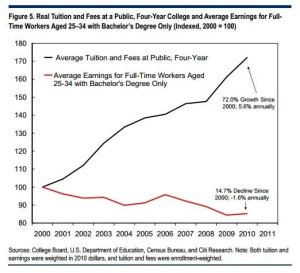
Tuition versus Earnings for Workers with a BA

The friends we mobilize to support our projects appear to us as a community, but to Kickstarter they are raw material to be converted into commodity—a conversion we must also embrace. Members of our networks become investors, not so much in our projects, but in Kickstarter itself. Every fundraising campaign that is launched reaches into our intersecting communities. Newer and newer layers of people are extracted to invest in Kickstarter. Like any other for-profit entity, its goal is to make money. Our projects that facilitate the funding are a side effect, a cost of doing business—the business of drilling our relationships for all they are worth. This is the logic we are allowing to dictate the whos, hows, and whats of cultural funding in our society.

Clearly, Kickstarter extracts value from our communities—10 percent of the capital raised and an unknown amount of networked and social value—but it does something less obvious as well. It converts support and community building into a shopping experience. By building a commodity-based rewards system into the platform, Kickstarter naturalizes the idea that supporting a friend is similar to any other online purchasing experience. You charge your credit card and something cool shows up in the mail in the future.

Weekend Reading

Rounding out the Thanksgiving weekend, it’s always a good idea to enjoy some reading:

The conventional wisdom going into the election was that President Obama and the Democrats would have to galvanize the youth vote if they wanted a repeat of 2008. With nearly 20 percent of families, and 40 percent of young families, owing a slice of the education debt, the issue affects a large and growing constituency. And because existing student loan policy is so anti-student and pro-bank, Democrats could have proposed a number of commonsense, deficit-neutral reforms, even reforms that would have saved the government money. The stars were aligned for a major push.

Remarkably, it didn’t happen. Instead we saw dithering, half-measures, and compromises meant to reassure voters that politicians were aware of their suffering and that something was going to be done. The moves that were implemented did not address the core problem: the amount of money debtors will have to pay. For example, President Obama claimed credit for delaying a doubling of interest rates on federal loans from 3.4 to 6.8 percent, while, at the same time, ending interest grace periods for graduate and undergraduate students. The first measure is temporary and is expected to cost the government $6 billion; the second is permanent and will cost debtors an estimated $20 billion in the next decade alone. Despite his campaign rhetoric, President Obama has overseen an unparalleled growth of student debt, with around a third of the outstanding total accruing under his watch.

Part of the municipal debt story can be traced to New York City’s 1975 fiscal crisis, when the city almost defaulted on its debt. New York was able to avoid bankruptcy at the last moment by issuing guaranteed bonds backed by public pension funds. As a result, the Emergency Financial Control Board, the municipal body that controlled the city’s bank accounts, was in the position of rewriting the social contract, exerting control over labor at every level. Union leadership agreed to the deal because they feared a bankruptcy filing would void labor contracts. Only after the city had disciplined the unions did the federal government move in with rescue loans.

New York City had been debt-financed since the 1960s. But the fiscal crisis of 1975 inaugurated a new funding paradigm for distressed municipalities: taxpayer-backed debt is issued to service the debt already on the books. American municipalities are now increasingly financed not with public money, but with private loans, and the pace of this shift has accelerated since 2008.

Austin had adopted its at-large election system, in which there are no geographic districts or wards, in 1953. As long as the City Council was elected at large, campaigns had to be run citywide, and funded not by private donors but by the white business community, which in the ’50s and ’60s had no interest in giving minorities a seat at the table.

The Voting Rights Act threatened to undo all that, and so the gentlemen’s agreement was devised as an end run around the law—a way to provide minority representation while maintaining control of city governance, keeping a paternalistic and frankly racist system in place. Since its institution, white business interests—not the city’s black and Hispanic communities—have selected acceptable minority candidates and backed their campaigns.

Weekend Reading

Read some links!

Conservatives have spent the last thirty years constitutionalizing their political-economic vision. Rather than respond in kind, liberals have insisted that the Constitution is largely silent on what William Forbath has called “the rights and wrongs of economic life.” This attempt to declare our nation’s highest law a neutral zone when it comes to political economy has failed, as conservatives have successfully associated our fundamental legal documents with an absolutist defense of private property and the restraint of government power over the so-called private sphere. Their legal analysis does political work, branding government regulation not just unwise but illegitimate: the Constitution means economic freedom and economic freedom means freedom from government coercion.

There is a counterhistory that liberals might have used, and still might use, to disrupt this chain of libertarian associations: the tradition of Forbath’s “distributive Constitution.” Proponents of this constitutional vision, from Madison to FDR, have denied that “economic freedom” simply means private freedom from public power, a definition that affirms the status quo, no matter how unjust. They have argued instead that the freedom promised by our Constitution guarantees material well-being and the real autonomy that comes with it, an autonomy threatened as much by the market as by the police on whom the market depends.

To act like detransition is something that can ONLY indicate a lack of not “really wanting it” or not “really being trans” is to demonstrate an enormously privileged mindset. One of the most basic kinds of privileged-bias: assuming things are as easy or difficult for everyone as they were for you.

Anyway… that idea of transition, and transness, as inherently linear is just as protected for its superficially “validating” qualities as the essentialism of “gender identity”, “male/female brains” and “men’s and women’s clothes”. It, again, allows us to feel our identified gender is every bit as valid and secure as our cis peers, while remaining on more or less the same kind of conceptual ground as the cis-centric view of gender. We can feel ourselves valid and secure without having to dive into the scary, uncharted waters of granting ourselves that validity, unconditionally, and on our own terms. We can continue feeling there’s some kind of external, quasi-objective standard by which we know ourselves to be “really” women… “deep down”.

Teenage pregnancy has been on a steady decline since the late 1950s, but nothing brings America into more of a panic than the thought of “unwed teen mothers.” These women, often poor with little access to education, are tracked like plague victims. One can’t find statistics without falling into a discussion of disease. “Teen pregnancy—a preventable epidemic,” “U.S. teen pregnancy and syphilis rates rose sharply during George Bush’s presidency” read the reports.

There’s no biological reason to think of teenage pregnancy, in particular, as a form of sickness. Everyone knows that pregnancy is an organic result of sexual intercourse, whether it happens at 15 or at 35. The language indicates fear of a social disease: the threat of reproduction occurring outside the condoned sphere of the family.

In the nineties, talk of gay marriage sounded kooky and futuristic, like  something out of a left-wing version of “The Jetsons.” In the elections of 2004,  when measures against gay marriage passed in eleven states, the campaign  appeared to have backfired. Over time, though, the concerted emphasis on  marriage and the military generated increasingly potent political imagery:  elderly gay men pleading for recognition of their decades-long relationships,  lesbian ex-officers testifying with military terseness. The ennobling effect  that Sullivan had predicted came to pass. I felt it in 2005, when my partner,  Jonathan Lisecki, and I spontaneously got married during a trip to Toronto. When  you get married, your relationship is taken more seriously by those around you;  when you are also gay, the sense of public affirmation goes strikingly deep.  Friends reacted as if we had done something vaguely heroic. I realized, as with  coming out, that personal gestures ripple outward into politics.

However long it takes for a real victory to be certified—no matter what  happens on Election Day, it will be too early to unfurl a “Mission Accomplished” banner—the once ragtag march of lovers has acquired an air of inevitability.  Edith Eyde’s prophecy is almost fulfilled: gays are more or less regular folk.  All the same, many who came out during the Stonewall era are wondering what will  be lost as the community sheds its pariah status. They are baffled by the  latter-day cult of marriage and the military—emblems of Eisenhower’s America  that the Stonewall generation joyfully rejected. The gay world is confronting a  question with which Jews, African-Americans, and other marginalized groups have  long been familiar: the price of assimilation.

Some Debate on Strike Debt’s Rolling Jubilee:

Weekend Reading

As we recover from the election’s end, let’s try to do some reading:

Yale-NUS is unfolding with the ethical and civic compromises that were so easy to foresee. But there is more to it than that. Yale-NUS is being conceived as the realization of a dream that has been harder, but not impossible, to implement in New Haven. That is the idea of a new, smooth and seamless, singular liberal-arts curriculum: centrally controlled, departmentless, and monolingual. (“Avoid[ing] the language barrier” was one thing that attracted Yale to Singapore, where the language of instruction is English.) Departments, in this view, are “silos,” presumed to “hobble” knowledge; they are supposedly stuck in a fractious condition of specificity.

What is proposed instead is something centrally conceived and regulated—more than a mere convenience in an authoritarian state. Yet on the intellectual front, this new model of the liberal arts disingenuously waves the flags of “difference” and “interdisciplinarity,” as if they were novel concepts. (“Many nations live by different traditions and norms,” the Yale-NUS Prospectus helpfully tells us.)

The surprise is that that model has already made inroads in New Haven, with the rise of homogenized, nondepartmental programs and majors with bland titles like “Humanities” or “Global Studies”—and excrescences like the Jackson Institute for Global Affairs. The partial erosion of departments in New Haven has led, logically, to their complete absence at Frankenyale in Singapore. If the promised “feedback loop” between Singapore and New Haven succeeds, the two institutions in tandem will produce a new generation of conformist, dissent-averse managers and executives, particularly well suited for the new global boardroom and tea at Davos.

In 2002, on a Friday, Larry Page began to end the book as we know it. Using the 20 percent of his time that Google then allotted to its engineers for personal projects, Page and Vice-President Marissa Mayer developed a machine for turning books into data. The original was a crude plywood affair with simple clamps, a metronome, a scanner, and a blade for cutting the books into sheets. The process took 40 minutes. The first refinement Page developed was a means of digitizing books without cutting off their spines — a gesture of tender-hearted sentimentality towards print. The great disbinding was to be metaphorical rather than literal. A team of Page-supervised engineers developed an infrared camera that took into account the curvature of pages around the spine. They resurrected a long dormant piece of Optical Character Recognition software from Hewlett-Packard and released it to the open-source community for improvements. They then crowd-sourced textual correction at a minimal cost through a brilliant program called reCAPTCHA, which employs an anti-bot service to get users to read and type in words the Optical Character Recognition software can’t recognize. (A miracle of cleverness: everyone who has entered a security identification has also, without knowing it, aided the perfection of the world’s texts.) Soon after, the world’s five largest libraries signed on as partners. And, more or less just like that, literature became data.

And because I couldn’t not put in some links about the election: