MLK Meals

In my senior year of high school, my government class was taught by a teacher that was very involved in local government. On a day near Martin Luther King, Jr. Day (still not sure why it wasn’t on the actual day) the Town of Gilbert had a MLK commemorative breakfast downtown, and she wanted some students to represent our school by attending. Myself and a few friends went, and while we grabbed breakfast we all muttered how uncomfortable we all felt. All of us were white. Breakfast included grits and fried chicken. Snickers about racism prevailed.

Gilbert is about 3% black, and over 80% white. In my earlier years I don’t even remember if there were black kids in my classes, and I remember only a token few from my high school years (Apparently, there are about 150 out of 2700 total students). So, when Gilbert tries to do MLK Day, it comes off as kind of weird. In retrospect, I’m glad that the event happened, and I’m glad it brought quite a few people out to remember Dr. King. There were a few speakers about equality, and some students from Best Buddies at my school did a performance. And there was grits.

This week, the cafeteria at UC Davis honored Dr. King by serving a menu that looked pretty reminiscent of my experience. And I think this sums it up nicely:

On the one hand, the cafeteria is making an effort to mark MLK day and, to be fair, the food choices are traditional “soul food” familiar to (especially Southern) Black populations and the South more generally.  On the other hand, preparing foods associated with Black people is about the shallowest possible way to celebrate such an important man.

The conundrum — do we or don’t we, as a cafeteria, acknowledge Martin Luther King day and, if so how? — is a familiar one.  Can one do so without reproducing stereotypes and appearing on blogs like these?  Or should we just pretend the day doesn’t exist?

The truth is, in a context of ongoing racial inequality in which stereotypes continue to harm, organizations such as these are stuck between a rock and a hard place.  That’s how racism has such staying power: it makes it such that all choices resonate with its ugliness.

I Went to David Brooks’ Class So You Don’t Have To

When it was first announced that NYT columnist David Brooks would be teaching a class at Yale on humility, a lot of people were quick to point out how ironic it was. When the syllabus was first posted this week, Twitter just about exploded as people pulled quotes like “We will pay special attention to those who attended elite prep schools and universities” from the syllabus (keep in mind, it’s a course on humility, at Yale, taught by David Brooks). The syllabus includes readings by or about famous-but-humble minds like Martin Luther King, Jr., Dorothy Day, Moses, Augustine, and none other than David Brooks.

So I decided to go to the first class yesterday with no intention of actually staying. While it wasn’t that excitingly terrible or good, I did end up making a few observations, and of course there were a few points of “you can’t make this stuff up.” Like when we were trying to cram into the room and he needed to get past dozens of students to get to his seat, and he raised his hands and (I kid you not) said “I feel like Bono!” Or when he was explaining office hours (which are Monday nights at either a cafe or a bar) and said that meeting with students individually was exciting “certainly for them but also for me.” I storified some other observations which I’m restating here:

  • Brooks acknowledged that parts of the syllabus smack of rich or powerful white men, but the first day still begins with Dwight Eisenhower and George Marshall.
  • Of the ~55 students that attended the first day, I counted 8 women and about 10 non-white males. Only 20 will be admitted, so it will be interesting to see how that turns out.
  • After reading 10 definitions of humility, Brooks literally said “God had Ten Commandments, so I figured I’d stop there.”
  • I learned that Brooks has met Obama, Bush, Clinton, Biden, and McCain. On day one of a class on humility.

CFP Roundup

As school comes back in session for most, there are a handful of calls for papers that I wanted to draw your attention to.

A conference on Theory and Practice: The Limits of Ethics for Guiding Action will be hosted at the University of Toronto in March. While the conference is centered on ethics, philosophy, and justice, proposals are welcome in any disciplines. Submissions are due on January 18th.

Cornell Law School’s Inter-University Graduate Conference [pdf] is accepting submissions, which will be due January 18th.

American University’s Washington College of Law has a student writing competition on International Humanitarian Law. All law students are eligilble, and the deadline in January 31st.

The Sudan Studies Association will be convening its annual meeting in May in Philadelphia, and they are accepting submissions for papers, panels, roundtables, and thematic conversations. The theme for the conference is Greater Sudan: Cross Roads to the Future. Submissions are due on March 1st.

The Yale Journal of International Affairs (where I am an assistant editor) has issued a call for papers for its spring/summer issue. The journal aims to bridge academia and policy on a variety of topics, and will be accepting submissions for short articles and op-eds. Deadline is March 1st.

UPDATE: A commenter has alerted me that The Fletcher Forum of World Affairs is taking submissions for the print journal from scholars, practitioners, and PhD candidates until Feb 15. They also accept submissions for their website.

As usual, if you know of any conferences or journals that are looking for submissions, let me know!

Book Recommendations – South African Edition

So, my online presence has been a bit quiet. Weekend readings and occasional tweets are still outgoing, but not much else. My first semester of grad school has come and gone, and the last few weeks have been spent polishing off two term papers, preparing proposals for my thesis, studying for a language final, and moving Henry James books around at the library. Now that all of that’s done, I wanted to recommend some of the many books I still have stacked on my windowsill.

For a South African history course, I wrote a term paper looking at how anti-Apartheid activists used their own trials as platforms to criticize the government. I concentrated on Nelson Mandela’s trials (when caught in hiding and then in the Rivonia Trial) and Steve Biko’s testimony in the Black Consciousness Trial, but found other examples too. I spent some time looking at court records on microfilm – like an old school historian – but these are a few of the more helpful books on the subject of trials during apartheid:

  • Donald Woods’ Biko is a great book for all things Steve Biko. A journalist and friend of Biko’s, Woods includes lengthy excerpts from Biko’s five-days-long testimony in the Black Consciousness trial which I’ve come to rely on. An alternative to this is Millard Arnold’s complete transcript of the trial, although it’s hard to find.
  • Michael Lobban’s White Man’s Justice, while not specifically addressing my topic, is a really good resource on how the apartheid state used trials to legitimate oppression.
  • Joel Joffe’s The State vs. Nelson Mandela: The Trial That Changed South Africa is a good account of the Rivonia Trial, on which Joffe served as an assistant counsel to the defense. His writing style isn’t the best, and he jumps back and forth from trial transcripts to his own narration without much notice, which can be frustrating if you’re doing research.
  • Mary Benson edited a collection of speeches given by activists in The Sun Will Rise: Statements from the Dock by Southern African Political Prisoners, which includes several statements I used in my paper in addition to other really interesting excerpts.

Another term paper I did was on the symbol of land and territory as a founding myth for South Africa. It was for my first ever sociology course, and I chose to look at South African history and the founding myth that Afrikaners had crafted. I used a lot of articles (by du Toit on the role of Calvinism, Templin on the Great Trek, and Marschall on monuments), but these books came in handy as well:

but nonetheless I’ve found these texts to be really helpful:

  • T. Dunbar Moodie’s The Rise of Afrikanerdom utilizes the sociological concept of a civil religion, and in this book he paints a clear picture of the role of the Boers’ Calvinist religion in their nationalism throughout the early twentieth century.
  • Leonard Thompson’s The Political Mythology of Apartheid examines the concept pretty thoroughly, looking at the history of the Great Trek and its place at the center of Afrikaner nationalism. It does a good job of looking at how this came about and when.
  • Another helpful text is Donald Harman Akenson’s God’s Peoples: Covenant and Land in South Africa, Israel, and Ulster. It compares the prominence of a covenant with God in the narratives of the Afrikaners in South Africa, the Zionists in Israel, and the Protestants in Northern Ireland. It doesn’t say much that Moodie and Thompson don’t already explain, but it’s a great comparative look.
  • The Frightened Land: Land, Landscape and Politics in South Africa in the Twentieth Century by Jennifer Beningfield was a great resource. Required reading for the history course mentioned above, it’s a really innovative look at how apartheid changed the actual landscape of South Africa. For this paper, the chapter on the Voortrekker Monument was essential – the whole book is well-worth a read.

And those are my recommended readings on South Africa. Hopefully someone finds these recommendations helpful. With the end of the semester, you should see more of me over the winter reprieve from school. While I might be done with these papers, I’d love any additions – feel free to comment if you know of other resources on these topics.

Living Cheaply

The campaign this year is asking students to think specifically about whether they’re “living cheap enough,” Ainsworth said, and encouraging them to forgo immediate gratification for the payoff of graduating with minimal debt.

“I understand that it’s poverty wages,” he said of many students’ budgets, “but [they] have to understand what [they] do now, [they’ll] pay for later.”

That’s A. Jerald Ainsworth, dean of the Graduate School at the University of Tennessee at Chattanooga, quoted today over at Inside Higher Ed, on making sure poor people are acting poor enough. The article gets moderately better later on, when discussing other options such as limiting fees or raising loan limits, and makes a less than passing reference to maybe providing more assistantships to graduate students, but that quote is a kicker.

Graduate students work a lot, and are paid very little. Ainsworth even acknowledges that we’re talking about poverty wages. But his solution isn’t to provide more support, instead it’s making sure students continue to be poor, but do it better. But we all know that living cheap takes its toll on those doing the living, and when the very same people are doing the researching and the teaching, it’s students and work that are dragged down too. And if you put impoverished grad students alongside impoverished adjuncts, you’re talking about a bulk of the work being done on most campuses being a casualty to a lack of support or even adequate pay.

Living cheaply means pretty much everything is more time-consuming and life-draining. It’s difficult to teach at your best when you had to wait half an hour for the bus before sitting in the bus for another half hour to get to class on time, all the while lugging your bag full of assignments you had to grade while sitting at the laundromat. And since living cheaply means cooking instead of eating out, you might have to make that return trip for lunch. And keep in mind that amidst all of this, you’re trying to do top-quality research in order to move forwards, all the while trying to excel at living cheaply.

I’m curious how cheaply these people expect graduate students to live. I’m lucky enough that I have a manageable, rather than unbearable, amount of debt thanks to help from my parents with tuition and my wife working all of the time. Meanwhile I walk a couple of miles a day and frequently devise plans to get free food. I suppose that Ainsworth’s campaign might tell me to assess my utilities and turn the heat down a little, but they could make the required hospitalization insurance cheaper or provide more teaching positions or provide better notification of scholarships. And these are mostly PhD students we’re talking about. In some ways, they have it far better in that they receive tuition stipends and are first in line for teaching fellowships. Often times, MA students are self-financed and (if they’re lucky) get the leftover teaching assignments. Only one in my cohort of eleven are teaching this semester, and only some of us received funding for tuition.

Rather than teaching graduate students to be better at being poor, maybe provide a little more support for them?

CFP Roundup

Now that I’m a graduate student, I’m in the constant search for conferences and calls for papers related to things I’m interested in. I know at least some readers are in the same boat, so I’m going to start linking to relevant info whenever I run across it. If you know of anything related to the broad, broad topics I look at, feel free to send them to me and I’ll post them here. Without further ado, some items of interest:

This spring, The Midwest Interdisciplinary Graduate Conference will be centered around the topic of “Failure.” The conference will be on February 15 and 16 in Milwaukee, and the deadline for submissions is Dec. 10.

Politique Africaine‘s October 2013 issue will be centered on the mining boom in Africa. Abstracts are due by December 15. More info at the African Politics Conference Group.

The Center for 21st Century Studies at UW-Milwaukee also has a Call for Papers for its May 2-4 conference, “The Dark Side of the Digital.” The conference is looking for “critical, historical, and theoretical papers and creative presentations that shed light on some of the dangerous but overlooked consequences of the 21st-century transformation from mechanical reproduction to digital remediation. Deadline is Jan. 4.

The third Theorizing the Web conference will be in New York City on March 2nd. It’s a conference looking for “critical and theoretical explorations of digital technologies.” Deadline is January 6.

The Institute for Global Law and Policy at Harvard Law School is hosting a conference on New Directions in Global Thought on June 3 and 4 in Cambridge.

Update: The Department of Religion at Montreal’s Concordia University is hosting its Annual Graduate Interdisciplinary Conference, with a call for paper whose deadline has been extended to Dec. 15. They are accepting calls for the conference’s theme, “Brave New World: Traditions and Transitions” as well as the special section on “Order and Chaos: The More Things Change.”

Connecticut Colleges Respond to Sandy

Saturday and Sunday, virtually all of the schools in Connecticut announced closures for parts of this week.  Preschools, primary, secondary, and post-secondary schools across the state will be closed at least today, if not tomorrow or later. Even the University of Hartford, an hour north of the coast, will be closed through Wednesday. Across the state, bus systems closed last night, soon after New York’s MTA system was closed, and highways will be closing in a matter of hours.

Along the coast, universities and campuses in Stamford, Bridgeport, and New Haven are shuttered ahead of what promises to be a mighty hurricane. In New Haven, we’ve been watching the news pretty regularly to see how things go, and I’ve been keeping my e-mail open to see if Yale would close. By Saturday evening, all of the colleges in New Haven (University of New Haven, Southern Connecticut State University, Albertus Magnus College, and nearby Quinnipiac University, Sacred Heart University, and University of Bridgeport) had announced at least Monday and Tuesday closures. All of the colleges except Yale.

Yale waited until late afternoon Sunday to announce Monday’s closure, and they have yet to announce plans for Tuesday. The university seems to have begrudgingly cancelled classes yesterday afternoon, and I don’t see how it will remain open tomorrow, when the storm is at its worst. It’s a bizarre way to handle what is predicted to be a surge twice that of Irene.

Next Time, I’m Bringing an Air Horn.

I love graduation ceremonies. Most people think they’re totally boring, and they do drag on, but I love them. Something about a community all celebrating a sort of mutual achievement makes me happy. My family all lives pretty close, so I’ve been to cousins’ high school and college graduations, along with friends’ and in-laws’. Plus, I spent two spring semesters working at a high school – once as a student teacher and once as a long-term substitute, so I elected to go to those ones as well. I’m not a very vocal person, but I also clap and give a small “whoo” to the family/friend/student who is moving on.

Last month, while I clapped for my students, one student got probably the best, proudest cheer from the crowd. One of my students from when I student taught U.S. History was a refugee who had spent years in transit before resettling in Arizona. His family gave their first American high school graduate a solid minute of screaming and instrument-banging that rang out across the field. It was freaking awesome. The teachers reading names paused and let the family cheer before moving on, and there were plenty of other loud and lengthy celebrations as students walked across the stage. This was just one of the moments that made me smile.

Which makes things like this all the more infuriatingly messed up:

A South Carolina mom was arrested on Saturday for cheering at her daughter’s high school graduation.

Shannon Cooper got up and yelled “yay, my baby made it” when she saw her daughter walk across the stage Saturday night, but just moments later, she was handcuffed, escorted out through the auditorium in front of her daughter and jailed for several hours.

“Are ya’ll serious? Are ya’ll for real? I mean, that’s what I’m thinking in my mind. I didn’t say anything. I was just like OK, I can’t fight the law,” Cooper told WPDE. “I can’t argue with the police, but I’m like are you serious? I didn’t do any more than the others did. Which I feel like no one should have went to jail.”

Teaching Students Racism

Last week my wife told me about an insane case in which a Texas high school had an annual tradition of teaching students about Nazism in the stupidest way possible – by having half of the students be Nazis, and half of them Jews. From the article:

The students playing Jews wear red ribbons. “[Red ribbon students] must do everything school faculty or other students tell them to, including picking up other students’ trash, being taken outside and sprayed with water hoses, bear-crawling across the hot track, carrying other students’ books, and even carrying other students,” says the suit, filed in federal court by Andrew Yara, 19. “Engaging in this exercise was compulsory, with it constituting 60 percent of a major test grade for students in their World History Class, and any student who did not do everything they were told were receive a failing grade.”

This is some insane shit. Giving one group of high school students unrestricted power over another group of high school students is ludicrous, and all it does – besides exacerbating bullying and other problems – is teach students to be assholes.

When I first heard about this, my mind went straight to Jane Elliott’s work in Riceville, Iowa in 1968. You might know her as the third grade teacher that split up her students based on eye color and treated them differently. She began by explaining to her students that blue-eyed people were smarter, cleaner, punctual, and more determined than brown-eyed students, and therefore deserved snacks, extra recess, and sitting up front in class. She noted the sudden divide between students as bullying occurred on the playground and grades rose and fell for the two groups. The next day, she reversed the roles and the third graders immediately swapped places, with grades and attitudes rising and falling according to eye color. The result was a particularly telling example of how prejudice can affect people, with a side of controversial treatment of children.

Elliott’s exercise isn’t without criticisms, and rightly so. It’s worth noting that treating children in such a way can lead to some sorts of trauma through emotional abuse (on which I’m no expert). Telling a third grader, “of course your homework is late, you have blue eyes” will probably have some sort of effect. As this paper (pdf) shows, while most of her students remember the two day experiment as beneficial and life-changing, albeit humiliating at the time, some are hesitant when thinking about whether or not to put their children through the same lesson. Whether you agree with her tactics, the strategy is clear: show all students what it’s like to be mistreated, and they will learn what it feels like to be judged based on their appearance, then they should spend the rest of their lives trying not to be racist.

Compared to Elliott’s exercise, the Perryton High School exercise goes farther in demoralizing students and submitting them to abuse, and I’m curious as to what sort of post-exercise lesson the students undergo. Giving students two days to treat peers as slaves is very different from a supervised two tier classroom setting, and Red Ribbon Days seem to not really do much teaching. News articles don’t point to any positives of the lesson whatsoever; there’s little supervision, some actions cause bodily harm (which has led to the current uproar, after a lawsuit was filed when a student was forced to carry another student almost double his weight), students don’t share both experiences, and the actual lesson doesn’t even address the core curriculum of teaching the Holocaust. It’s controversial and it’s dangerous. It’s also bad teaching.

Catching Joseph Kony

This Monday, Invisible Children released its newest film – the thirty minute Kony 2012. I’ve been involved with IC since early 2007, and my relationship with them is almost always in flux – ranging from being inspired and truly believing in the work to being a critic of the trendy oversimplification. After helping Resolve and the Enough Project gain support for the LRA Disarmament and Northern Uganda Recovery Act in 2010, IC has embarked on a new mission of trying to effectively end the war in 2012, with this video as a part of the broader campaign.  The video is centered on Jason Russell, one of the founders of Invisible Children, explaining Joseph Kony, the war criminal in charge of the LRA, to his son.  The take-away from the video is that the goal of the next two months is to teach people who Kony is, thus leading to more change and ultimately his capture.

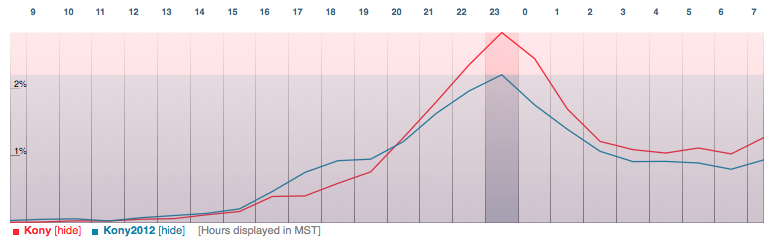
Through most of Monday evening Facebook and Twitter were slowly ramping up in my world. I have met scores of people in my work on the issue, and many of my friends are on the staff at IC, so the hubbub was expected.  By Tuesday afternoon, some staff members were tweeting that, in the first 24 hours, the video had been viewed 800,000 times. Late Tuesday evening, the campaign took up six of the top ten trending topics on Twitter, and “Kony” and “#KONY2012” accounted for 3-4% of all tweets.
The last 24 hours (checked at 7:45am, MST today) of Twitter traffic, from trendistic.

Like many who are aware of the crisis in central-east Africa, I would love to see Joseph Kony brought to justice as soon as possible. Kony is the leader of a highly centralized rebel group comprised of abducted fighters – some of them children. Kony is among the first criminals indicted by the International Criminal Court, and his arrest would go a long ways towards ending the Lord’s Resistance Army as we know it and reinforcing an essential international institution like the Court.

”]As I mentioned, I’ve been a supporter of varying tenacity, and I have disagreed with Invisible Children here and there over the years. I support many of their programs on the ground in the region – granting scholarships for students to attend rebuild schools, teaching displaced people employment skills, and building a radio warning system among them – and am one of the many that first got involved in human rights and activism through their work here in the States. I’ve always felt that there is a huge disconnect between the great work being done in the region and the simplistic, sexy, and purely PR work Stateside, which is a shame. I’m not as much of a critic as others, but I do have a few qualms with the current campaign that’s launching right now.

Invisible Children continues to oversimplify the message of how to get rid of Kony. I understand that advocacy groups need to take really complex problems and boil them down so that it can be disseminated among supporters. As the movement grows, however, the leaders should be better educating their followers.  Being involved for five years, I have yet to see IC expand on its very simplistic history of the war, which is critical to understanding how best to approach ending it.

Something needs to be said about the narrative that IC creates, but I’ll leave that to everyone else.  IC has been running programs in northern Uganda for several years – ineptly at first but more recently they operate like any other aid organization there. Meanwhile, their PR campaigns in the States aim to address the LRA, who left Uganda – which has been in relative peace and experiencing slow recovery – in 2006. The videos blur the lines between the countries, and simplify everything to Kony roaming Africa abducting kids. That’s not to mention that there is no evidence of the 30,000 children figure endlessly repeated by IC and other NGOs, and no discussion of how to define abduction (which is important, since some are forced to help transport supplies before being set free, while others are forced to kill their own family members before being conscripted for life). The story IC creates will drive policy, and it needs to ensure that we have a dialog about the peace-justice debate, the accountability of the Ugandan military, and ways to move forwards without losing momentum.

IC’s campaign for the next two months is heavy on awareness. We supporters are to tell all of our friends and put posters everywhere, and then write messages to 20 cultural leaders (who control public discourse) and 12 political leaders (who are involved with real change). This build up is to April 20th, when we’re supposed to plaster our cities in Kony 2012 posters to “make him famous.” There is footage of “Kony 2012” – to make him as popular as possible – a sort of Public Enemy #1.

When I first got involved with IC, I attended an event that included learning about displacement camps in northern Uganda – an eye-opening experience that really pushed me to start a student organization in college. This year’s big event is to put up posters. This is all in the name of garnering more name recognition for Kony to make him (in)famous, but when you get the most bipartisan congressional support for any Africa-related bill in history and you claim hundreds of thousands of youth support you, you’ve gotten the word out. Claiming that nobody knows about Kony (the video says “99% of people” have never heard of him), is absurd. There is enough attention that we can move from awareness to action now. It’s time to pursue real change – front and center. E-mailing the Chairman of the Senate Foreign Relations Committee should not just be a side-note to hanging up flags and tweeting at Oprah, who is probably sick of IC distracting her from her work in South Africa anyways.

As Daniel Solomon notes (and you should definitely read his post), if people are tweeting at me to watch the video and aren’t reading the ICG report to learn more, then a vital part of the campaign has missed the mark. Mark Kersten also calls out the campaign in a post you should read, and here’s a critique of “crowd-sourced intervention.”

After six years of building a massive youth-led base in America – including raising millions of dollars in record time and directing masses of young people – we have passed the deadline for moving forwards. In the film, IC tells us the Kony 2012 campaign expires at the end of the year – a movement has an expiration date alright, and it’s important to freshen up the whole IC movement.

Update: The list of related links has moved to a new post, as it continues to grow.