A New Burden for Arizona Students

Recently, State Representative John Kavanagh introduced a bill, HB 2675 [pdf], that would establish a minimum tuition that has to be paid by the student. The bill will force students to “pay $2,000 unless they have a full-ride scholarship based on athletics or academics” – effectively getting rid of needs-based full-ride assistance. The bill, if passed, would even restrict students’ ability to pay with other awards: it says that any other awards from a source affiliated with the university cannot be used to pay for tuition. This would include things like this fellowship that I won in my junior year, or countless other awards offered by the university, colleges, centers, and even the university’s foundation, forcing students to either work or take out loans to pay for their education.

The bill has 24 sponsors right now, and the body is comprised of sixty members. It’s not unrealistic to believe that this bill could become law very soon. It was introduced in the House by John Kavanagh, who you might know as the representative who was a staunch supporter of controversial SB1070 and was a big supporter of contracting with private prisons, in addition to the mastermind behind charging people $25 to visit their family members in prison. Not coincidentally, he is also an active member of ALEC and he received donations from prison privatization lobbyists. It looks like he’s now set his sights on higher education.

According to the linked article, Kavanagh thinks that $8,000 in loans isn’t much since those who choose to go to college will make more than those who don’t. Not only does that ignore the fact that many students who get full-ride scholarships still take out loans for cost of living, an $8,000 loan turns into almost $12,000 due to interest. Kavanagh also defends the fact that merit-based full-ride scholarships remain intact by saying that they contribute to the school. Because if you don’t get recognized  for your intellect of your athleticism in the form of cash, you must not bring anything to the table. He also argues that tax payers shouldn’t pay for higher education because then students don’t take classes as seriously and because it encourages enrollment of students who aren’t actually ready for college. He actually said that.

It’s important to note that the state constitution says that education must be as nearly free as possible. Instead, Kavanagh thinks it’s appropriate to throw a $2000 tuition increase at the most vulnerable students. The response in Arizona’s universities will be interesting. The universities in Arizona have been hit pretty hard over the years, including massive cuts in state funding over the last three years. Just during my time at ASU tuition has skyrocketed while class sizes get bigger. By law, each university will have to host a public hearing about the law since it constitutes a tuition increase for some students. It will be interesting to see if the student community can mobilize itself enough to speak up about this bill.

Links from the Internet Blackout

If you were near the internet yesterday, you probably noticed that things were a little different. As a part of a protest against the Stop Online Piracy Act and the Protect IP Act, websites like Wikipedia and reddit went completely dark while many, like Google, drew attention on their pages to the legislation. Throughout the day, several former sponsors of the legislation backed down in both the House and the Senate. If you haven’t already, here are some links to learn about the piracy/censorship laws on the table. This was supposed to be posted yesterday morning, but my computer was being slow and I was busy. Probably SOPA’s fault. If you haven’t read these already, take a look:

Wikipedia takes action, the Electronic Frontier Foundation asks you to do two things, and Mashable breaks it down. Google also had this spiffy infographic.

Angus Johnston found two quotes on SOPA, Someone on Twitter found that the author of SOPA might be stealing content. Joe Sestak says the corporate lobby’s argument doesn’t make sense. Gimodo has photos of some of the website’s blacked out cover pages. And how SOPA/PIPA will affect women and artists.

Why I Will Never Vote to Drug-Test Welfare Recipients

Wednesday night I sat at home aghast at a lot of things. I was watching the Republican Presidential debate, for one thing, but I was simultaneously reading reports (both links are videos) about police violent cracking down on protesters at Berkeley and also hearing about Joe Paterno’s defenders at Penn State rioting and giddily flipping over a news van. But one thing that caught me off guard was one of the polls on Facebook’s questions app.

A number of my friends had voted “yes” on the question, “Do you support drug testing to get approval to be on Welfare?” Now, I’m a vehement no, but I know that A. a lot of my friends are pretty conservative, and B. there’s a strong (and incorrect) stereotype about the people who need welfare and how many are addicts who should just pick themselves up and work harder. But I didn’t vote, initially, because I’ve never answered a question before. Then my wife decided to take a gander, and reported back to me.

So, I voted, because that’s a lot. And at the time of this posting (Thursday night at 7:30), it was 2.2 million for, 108,000 against. I thought I would move on, but this morning I was still a little irked about it, so I threw this piece together. I naively hope that it changes some minds, but at the very least I’m putting my opinion out there, which is practically what the internet is for these days, right?

The Mythical Relation Between Drugs and the Poor

Apparently everybody thinks that the poor do drugs all of the time. I’ve heard, time and again, that the poor wouldn’t be so poor if they kicked the habit and got jobs. If they just picked themselves up, they’d be fine and dandy. Before we assume that this is true, we should acknowledge something else that is true: mental disorders, physical disability, trauma-related disorders, and depression are all things that can lead to substance abuse – and are also found in low-income communities. Now, do they use drugs at a higher rate than the rest of us? Michigan was the first state to implement drug testing for welfare recipients in the 90s, and it found that 10% of recipients were drug users. And a subsequent survey found that 9% of all Michigan residents, on welfare or not, were drug users. Regarding a similar law passed in Florida in the late 90s, some researchers have already said that such assumptions about the poor are “unwarranted.” In fact, another study showed that only 5% of those applying for assistance failed a drug test.

Some studies have definitely shown that those on welfare are more likely to use drugs or be dependent on them, but they are quick to qualify that if they stopped using drugs they would still be living in poverty because of illness, poor education, and unemployment.  And let’s take a second to note that addiction isn’t easy to break, and often one needs support in order to successfully kick a strangling habit like substance abuse. In 1996, over 200,000 people qualified for SSI because of disabilities related to drug addiction and alcoholism. That category has since been eliminated, and those people no longer have that support. Often, drugs are used as escapism, and being stranded without support will only lead to more abuse and less treatment and recovery. This is not the way to actually help people help themselves, nor is it the way to build a healthier society.

Oh, and it’s Unconstitutional

No authority can search you (or your property) without reasonable suspicion. That’s the law, and it includes taking urine samples. And applying for welfare is not reasonable cause, because – as we’ve discussed – there’s no reason to suspect that the poor are more likely to be on drugs. And that’s where the glorious Fourth Amendment comes into play. The wise authors of our Bill of Rights stated that “the right of the people to be secure in their persons, houses, papers, and effects, against unreasonable searches and seizures, shall not be violated.”  Which is why the Supreme Court decided in Chandler v. Miller that Georgia could not drug test elected officials, and why state efforts to drug test welfare recipients in the late 90s also faltered. This is also why Florida’s current drug-test-for-welfare program is on hold. Because it’s unconstitutional.

The Race Issue

In America, you can’t talk about “the poor” without talking about racial minorities. Most of our communities of color are disadvantaged, and many residents in these areas need assistance like welfare. Many are also targeted for drug use. Which is where policy regarding the poor is also policy on race. The National Poverty Center lists the 2010 poverty numbers with 27.4% of blacks and 26.6% of Hispanics living in poverty while less than 10% of whites (and 12% of Asians) did. So, we know the poor are predominantly minorities. Which is what makes it interesting that a study from The Sentencing Project (PDF) found that race had virtually no effect on the levels of drug abuse, stating that the disparate numbers were actually the result of law enforcement policy, saying that:

Police agencies have frequently targeted drug law violations in low-income communities of color for enforcement operations, while substance abuse in communities with substantial resources is more likely to be addressed as a family or public health problem.

And yet, The Drug Policy Alliance found that, in New York, young white people are more likely to use marijuana, but that black people were arrested at seven times the rate of whites and Latinos (PDF). The narrative continues to argue that the poor and the colored are the ones using drugs, when it’s really that poor minorities are just the ones being arrested for it. The stereotype affects the mentality of the law enforcement, who in turn reinforce the stereotype with disparate statistics every time they choose to arrest and jail minorities and only confiscate the white offender’s drugs, maybe with a warning.

An Unnecessary Hurdle

Last week I was talking with one of my clients in Glendale. He has lived in the U.S. over a year and is a permanent resident. Unable to get a job, he had run out of money a long time ago and relied on his roommate to pay rent. With his roommate moving, he applied for public housing. Lo and behold, to qualify for public housing in Glendale you have to work within city limits for five years. Because the type of people who can work for five years are the ones most likely to need public housing. And this is just a minor example of how we continue to place hurdles in the way of the poor, essentially keeping them that way forever.

Barbara Ehrenreich detailed how we have criminalized poverty ten years after writing her book on how the poor struggle to get by. She explains that food stamps have increased by huge numbers during the recession, but welfare has barely moved because it is so difficult to actually qualify. You can’t qualify for disability without medical documentation, which costs hundreds of dollars for those without health insurance.  Plus, the bullshit welfare system that we have now, ever since Clinton “reformed” welfare, provides supplemental income – which means you have to get a job first, then the government will help, which deals a huge blow to those who can’t find jobs. Ehrenreich explains how one couple down on their luck had to apply for 40 jobs per week while attending daily “job readiness” classes just to get assistance, which is a tall order for anyone having trouble paying for gas, a bus ticket, or a baby sitter. And that’s just to qualify for welfare.

If you find yourself worse off, you face constant harassment at the hands of useless laws like loitering, jaywalking, and the like. Ehrenreich also tells an anecdote of police raiding a homeless shelter to arrest the homeless (while in a shelter) for prior offenses like sleeping on the sidewalk. Las Vegas has even made it illegal to give food to the needy unless you’re a certified organization. When I was in high school I volunteered at a food bank where the poor had to bring proof of residence in order to receive meals – apparently the homeless weren’t allowed food (I didn’t volunteered there again). When you’re not poor, it’s easy to not realized just how many obstacles are on the path to assistance for those who really need it.

Spending Money on the Right Things

People continually argue that, it’s not a war on the poor and it’s not racism, it’s just about fiscal responsibility. We just want to make sure our tax dollars don’t go towards buying illegal things like drugs. So we put the poor through all of these steps in order to make sure that welfare money goes towards what it’s meant to. But, I say, why stop there? Other people receive public funds as well, and we don’t check them.

We should drug test all of the seniors on Social Security. I mean, they’re frail and dying, they’ve got to be on something. Have you seen Little Miss Sunshine? And while we’re at it, I know some friends in college who smoked weed and they were on state-funded scholarships. In a time when it’s harder to afford college, shouldn’t drug users have to fund their own addiction while we give scholarships to the ones who earned it? And we should definitely drug test anyone who wants a driver’s license. When I was teaching last semester, I got the impression that at least a few high school students do drugs, and yet they’re still allowed to drive. I don’t get it. It’s illegal to drive under the influence, but we don’t preemptively check. It’s like we’re just telling them it’s okay to do drugs.

But while we’re talking about watching our dollars, how much does it cost to administer drug tests, process results, and print out new forms and all of that? I mean, Florida’s currently-on-hold law stated that the state would reimburse applicants once they passed, which led to lots of additional costs when only 2% of applicants failed to pass the drug tests (no reliable data on how many chose not to get tested, for obvious reasons). Everyone knows that bureaucracy costs money, but they’re okay adding to it as long as it affects the poor. I mean, this isn’t to improve the welfare system at all, so much as it is about keeping them marginalized.

A Day at the Executive Mansion

This post is the political and analytic post about the DC trip. For the general trip run-down, click here.

Friday was the big day, and in the morning I took a stroll down F St. to the White House gate, and started meeting all sorts of great fellow advocates. Once we all got together, we went through security and headed into the Eisenhower Executive Office Building, one of two office buildings that flank the White House on the premise. We filed in and took our seats in a small auditorium, and listened to the following and surprisingly long list of speakers.

  • Gayle Smith (Director of the NSC) and co-founder of the Enough Project,  talked about America’s transition from a unilateral actor to a multilateral actor in development and international affairs, and emphasized the importance of security, economics, and values in humanitarian aid. She talked a lot about long-term solutions and referenced some advancements in the aid sector.
  • Erin Mazursky (Youth Advisor, USAID), formerly of STAND fame, talked about the link between youth advocacy and conflicts, emphasizing the importance of the younger generation to be involved. Herself a product of that, it was great to hear her talk about her work for USAID in helping youth around the world, and she said that many in the development sector see advocacy as “the wind in our sails,” which is always uplifting to hear.
  • Andrew Sweet (from the Office of Conflict Management and Mitigation at USAID), who used to be at the Enough Project, talked a lot about OCMM’s work in producing alert lists of countries at risk of falling into conflict. He also made several references to conflict assessment and contributions to local reconciliation efforts to prevent conflicts in post-conflict zones. In response to some questions, he also referenced that the U.S. was going beyond MDGs in a lot of developing countries, with other goals such as legitimate political systems, justice, and security.
  • Brooke Anderson (Chief of Staff of National Security Council) took a lot of questions and tried very hard to understand where all of us advocates were coming from. In the course of answering questions, she referenced the importance of crisis mapping and that problems in the DRC needed to be addressed, but our group did not get any LRA questions in really.
  • Esther Brimmer (Assistant Secretary for International Organizations at the State Department) talked primarily about the UN, saying that the U.S. needed to not just support peacekeeping mandates but also to ensure they had viable plans. She referenced the UN’s role in Côte d’Ivoire and the Human Rights Council. She dodged a question about the LRA, probably because it wasn’t really in her job description. However, she did say that witness protection was a priority, which it definitely needs to be. When asked how to face opponents to UN funds, she reiterated the importance of sharing the burden of peacekeeping around the world.

Originally, myself and two others were supposed to meet with Jon Carson, the director of OPE, to express a little bit of urgency about the President’s LRA Strategy. That got cancelled at the last minute, and I ended up joining everyone for a self-guided tour through the East Wing! From there we split up for lunch before reconvening, and then the following people spoke:

  • Mark Doms (Chief Economist, Department of Commerce) gave a prolonged talk about the current recession, replete with pretty graphs and humorous interludes. Talking points included European debt problems, international uncertainties in the global market, and dependence on foreign fuel.

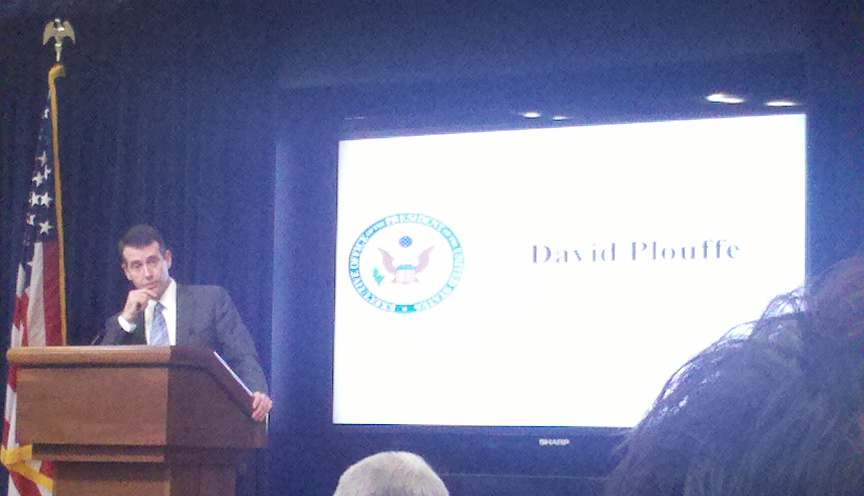
    Plouffe taking questions

  • David Plouffe (Senior Advisor to the President), also former campaign manager for the Big O, talked a lot about how to move forwards, shifting between calling himself a progressive but also mentioning the importance of balancing budgets. He took questions for a long time, and when asked what President Obama wanted his foreign policy legacy to be, he speculated that it would be ending the war in Iraq, giving AfPak the attention it needed, reestablishing the U.S. leadership role, and non-proliferation (a la START). In short, a “cleaner and safer planet.”
  • Alexia Kelley (Director, Center for Faith-Based and Neighborhood Partnerships) talked about her office’s work across the country and ways to partner with the government in communities. It’s also worth noting that during this segment I slipped out to use the restroom and upon my return I passed the First Dog, Bo. It was pretty legit.
  • Brad Cooper (Director, Joining Forces) talked about the launch of his program, which is a support system for military families and is definitely going to be getting bigger.
  • Anne Filipic (Deputy Director, OPE) emphasized the importance of taking our experiences home and spreading the word about the White House’s outreach programs. OPE is holding all sorts of round tables and focus groups across the country to get a better idea of what exactly people are wanting to see from the presidency, which is a pretty great effort. She also referenced ways to connect with the White House via technology.

    Carson taking questions

  • Jon Carson (Director, OPE) didn’t meet with me privately, but instead came to talk to everyone, which was pretty cool. Referencing the small size of OPE, he called on individuals to act as conduits for making sure people in the communities’ voices were heard. When asked about the LRA by one of our own, he said that building networks was an imperative, and called on involving diaspora groups (which I have always been on the fence about, given a majority of them’s contempt for Museveni). When we challenged him to get a strategy going, though, he seemed to take to heart that advocates like us really want to see the Executive Branch give a little and get some skin in the game. He later referenced that, when it came to cuts in the budget, community activism was the key to keeping money where it was needed the most.

As the White House event closed up, one of my fellow advocates – a child psychologist in Kentucky that works in Uganda rehabilitating former child soldiers through art – presented Jon Carson with letters and a drawing made my children addressed to President Obama. Carson assured her that he would pass them along, which is great news.

In the aftermath of the event, we congregated outside the White House and a few of us did interviews with Ricky from Discover the Journey, who was filming a short segment on Resolve’s work at the White House. I did my little part, and also hung out with some great people by the gate.

And that was my day at the White House. It was a pretty neat experience, and it was great to be surrounded by such a great group of advocates. Not all of the speakers were great, but the briefing overall was wonderful. Thanks go to Resolve for the invite and to Citizens for Global Solutions were setting up the briefing in the first place and for hosting a neat workshop the following day at their offices.

Drug War Turns 40

So, last week was the fortieth anniversary of the infamous War on Drugs. The internet was abuzz with people talking about all sorts of aspects of how much of a failure it’s been. Instead of giving anything anecdotal or analytical, I figured I’d just share one of the most effective infographics I’ve seen on it, via Colorlines:

“Dr. No” Got the Message

Roughly a year ago, when local lobbying was at its height for the LRA Disarmament and Northern Uganda Recovery Act, the bill’s co-sponsors tried to pass it by unanimous consent.  With more co-sponsors than any Africa-related legislation in modern American history, it was a good idea.  And then Tom Coburn stepped in.  Known for blocking everything that costs more than a penny for Congress, Coburn had decided that the LRA bill would be one of his many stands.  He he blocked a bill with bipartisan support from the country at large, including his state’s senior senator , and thousands of his constituents.  Needless to say, grassroots organizing got a move on.  Quite a few of my friends, from across the country, held a vigil in front of his Oklahoma City office 24/7 until he took the hold off.  All told, the vigil lasted eleven days before a deal was reached, and the bill passed the Senate the next day.

Dr. Coburn was in the news again this past week for being one of the more vocal opponents to the 9/11 health bill.  The bill would have compensated a number of first responders who were suffering from health problems related to 9/11 and the rescue efforts that followed in the rubble.  After Jon Stewart hosted a number of first responders on his show to call out opponents, the general populace started getting up in arms about it (including Rudy Guiliani and Mike Huckabee).  After all the uproar, Coburn finally decided to give in (after bringing down some costs, obviously).

I’m all for being careful with money and watching where the government spends money, but Coburn has gone to the extreme. He also blocked aid to Haiti after the earthquake there, among other hot topic blocks.  It seems like he always needs a level of shame before he’ll back down.  I hope he gets smarter about where he chooses to put his foot down in the future. It’d make government work a little better, which – according to Coburn – has been his intention all along.

Voting

Tomorrow will probably be the biggest election day I have seen.  Definitely the most important in my short voting life.  Last week I mailed in my ballot – complete with 11 Democrats, 3 Republicans, and 1 Libertarian and with 6 “no” votes and 4 “yes” votes in propositions.  Now, I’m sitting back and waiting for the ridiculous attack ads to fade out for what I’d like to be 18 to 20 months but in reality is probably maybe a year.  I’m also going to be sitting down and slowly watching a lot of people I like probably not return to office and a lot of people I don’t like get in.  This afternoon Kentucky will close its polls and the projections and numbers will begin to fly.

Even two years ago I knew that 2010 would be a loss for the Democratic Party.  In modern American history the new President’s party has only gained seats in the following midterm elections twice: in 1934 and 2002.  Even though we are in a recession and still fighting in two wars (who are we kidding, Operation Iraqi Freedom?) I don’t think gaining seats was ever really on the table for the Dems this year.  Not that I’m 100% happy with how they’ve been acting either.

The Democrats, with their supermajority in both houses of Congress, didn’t pull off nearly as much as I would’ve liked to see in the past two years.  I might be guaranteed health care, the SEC might be drafting a report on conflict minerals legislation, and Pell Grants might have been expanded.  But the DREAM Act hasn’t been passed and “Don’t Ask Don’t Tell” is still very much in effect. I don’t have a public option for my health insurance and Race to the Top is no better than No Child Left Behind.  Clean energy legislation never showed up and we just released the moratorium on offshore drilling.  Now, I didn’t expect to see all of these things – but a couple would have been nice.

In Arizona, Democrats seem to be on the run.  Personally, I don’t think it’ll be the near complete rout that some are predicting.  Currently, my governor doesn’t know how to debate or answer questions. And the last county attorney to get elected is off his rocker.  So I think some people, even if they’re not happy with Democrats in Washington, might still keep a few shades of blue in Phoenix.  Point is, I hope my least favorite political party doesn’t sweep my state.  If xenophobic obstructionist birthers get too much power I’ll be a bit worried.

Regardless of what you think, I’d like to make one request: go vote! Whether you want to stand beside me or try to counter my vote – get those ballots in!

Arizona Votes

Arizona is the product of the progressive era.  As a result of the bipartisan wave of people asking for a more democratic democracy, Arizona’s constitution has all sorts of “by the people” parts to it.  The initiative, referendum, and recall are all pretty basic parts of Arizona’s law.  The initiative is the ability of people to petition for amendments and the referendum is the ability for legislators to bring up proposals that voters must approve.  As for recall, Arizona was actually denied statehood until the territory took the ability to vote to recall judges out of the constitution – but in the state’s first election it was reinstated.

Every election we have a plethora of propositions brought up by initiative or by referendum.  I know last election I talked a bit about the fun ones (like the idea of counting every missing vote as a no-vote for finance-related propositions) and the bad ones (defining marriage as the union of a man and a woman).  This year we’ve got the expected “hands off our healthcare” proposition.  But we also have an effort to make the right to hunt part of our constitution – right up there with speech and bearing arms; there’s also putting an end to affirmative action and stopping early childhood development and health programs.  I’m not usually a fan of most propositions, and this election cycle isn’t any different, it seems.

I’m not sure if other states are like Arizona.  I know most don’t have the ability to vote appointed judges out of office.  I’m assuming most people in other states don’t vote every four years for the office of State Mine Inspector (I have heard there are up to 120,000 abandoned mines in Arizona).  Do you all have the option to vote for school boards?  How about justices of the peace? What’s weird about your state’s political process?

Why SAFRA is Important

As I type this, I am watching the Health Care debate in the House.  Today, the House will be voting on budget reconciliation.  To most, this is a healthcare vote.  For quite a while, the Student Aid and Fiscal Responsibility Act was considered for budget reconciliation.  Instead of leaving it in the dust for healthcare reform, it has been attached for reconciliation and may (probably will) pass today.  Now, my opinion on the health care reform bill is a little iffy. I like parts and I dislike parts.  But I’m all for SAFRA and here is why:

SAFRA would increase the number of Pell grants and amount of Pell grants to students.  Especially with the current crisis in higher education, Pell grants just don’t cut it.  They need to be greater in size and in distribution.  SAFRA does this.  It also caps interest rates on Stafford loans, something that hasn’t yet become an issue but will in coming years.

In addition to this type of assistance to students, there is also good news for our budget.  By dropping subsidies for loan companies, SAFRA could save tens of billions of dollars.  This will be done by cutting out a very costly middleman in favor of direct loans.  In my opinion, there aren’t a lot of negatives for this piece of legislation.  It will help students in a time when higher education is being hit from all sides.  SAFRA is a step in the right direction.