Why I Will Never Vote to Drug-Test Welfare Recipients

Wednesday night I sat at home aghast at a lot of things. I was watching the Republican Presidential debate, for one thing, but I was simultaneously reading reports (both links are videos) about police violent cracking down on protesters at Berkeley and also hearing about Joe Paterno’s defenders at Penn State rioting and giddily flipping over a news van. But one thing that caught me off guard was one of the polls on Facebook’s questions app.

A number of my friends had voted “yes” on the question, “Do you support drug testing to get approval to be on Welfare?” Now, I’m a vehement no, but I know that A. a lot of my friends are pretty conservative, and B. there’s a strong (and incorrect) stereotype about the people who need welfare and how many are addicts who should just pick themselves up and work harder. But I didn’t vote, initially, because I’ve never answered a question before. Then my wife decided to take a gander, and reported back to me.

So, I voted, because that’s a lot. And at the time of this posting (Thursday night at 7:30), it was 2.2 million for, 108,000 against. I thought I would move on, but this morning I was still a little irked about it, so I threw this piece together. I naively hope that it changes some minds, but at the very least I’m putting my opinion out there, which is practically what the internet is for these days, right?

The Mythical Relation Between Drugs and the Poor

Apparently everybody thinks that the poor do drugs all of the time. I’ve heard, time and again, that the poor wouldn’t be so poor if they kicked the habit and got jobs. If they just picked themselves up, they’d be fine and dandy. Before we assume that this is true, we should acknowledge something else that is true: mental disorders, physical disability, trauma-related disorders, and depression are all things that can lead to substance abuse – and are also found in low-income communities. Now, do they use drugs at a higher rate than the rest of us? Michigan was the first state to implement drug testing for welfare recipients in the 90s, and it found that 10% of recipients were drug users. And a subsequent survey found that 9% of all Michigan residents, on welfare or not, were drug users. Regarding a similar law passed in Florida in the late 90s, some researchers have already said that such assumptions about the poor are “unwarranted.” In fact, another study showed that only 5% of those applying for assistance failed a drug test.

Some studies have definitely shown that those on welfare are more likely to use drugs or be dependent on them, but they are quick to qualify that if they stopped using drugs they would still be living in poverty because of illness, poor education, and unemployment.  And let’s take a second to note that addiction isn’t easy to break, and often one needs support in order to successfully kick a strangling habit like substance abuse. In 1996, over 200,000 people qualified for SSI because of disabilities related to drug addiction and alcoholism. That category has since been eliminated, and those people no longer have that support. Often, drugs are used as escapism, and being stranded without support will only lead to more abuse and less treatment and recovery. This is not the way to actually help people help themselves, nor is it the way to build a healthier society.

Oh, and it’s Unconstitutional

No authority can search you (or your property) without reasonable suspicion. That’s the law, and it includes taking urine samples. And applying for welfare is not reasonable cause, because – as we’ve discussed – there’s no reason to suspect that the poor are more likely to be on drugs. And that’s where the glorious Fourth Amendment comes into play. The wise authors of our Bill of Rights stated that “the right of the people to be secure in their persons, houses, papers, and effects, against unreasonable searches and seizures, shall not be violated.”  Which is why the Supreme Court decided in Chandler v. Miller that Georgia could not drug test elected officials, and why state efforts to drug test welfare recipients in the late 90s also faltered. This is also why Florida’s current drug-test-for-welfare program is on hold. Because it’s unconstitutional.

The Race Issue

In America, you can’t talk about “the poor” without talking about racial minorities. Most of our communities of color are disadvantaged, and many residents in these areas need assistance like welfare. Many are also targeted for drug use. Which is where policy regarding the poor is also policy on race. The National Poverty Center lists the 2010 poverty numbers with 27.4% of blacks and 26.6% of Hispanics living in poverty while less than 10% of whites (and 12% of Asians) did. So, we know the poor are predominantly minorities. Which is what makes it interesting that a study from The Sentencing Project (PDF) found that race had virtually no effect on the levels of drug abuse, stating that the disparate numbers were actually the result of law enforcement policy, saying that:

Police agencies have frequently targeted drug law violations in low-income communities of color for enforcement operations, while substance abuse in communities with substantial resources is more likely to be addressed as a family or public health problem.

And yet, The Drug Policy Alliance found that, in New York, young white people are more likely to use marijuana, but that black people were arrested at seven times the rate of whites and Latinos (PDF). The narrative continues to argue that the poor and the colored are the ones using drugs, when it’s really that poor minorities are just the ones being arrested for it. The stereotype affects the mentality of the law enforcement, who in turn reinforce the stereotype with disparate statistics every time they choose to arrest and jail minorities and only confiscate the white offender’s drugs, maybe with a warning.

An Unnecessary Hurdle

Last week I was talking with one of my clients in Glendale. He has lived in the U.S. over a year and is a permanent resident. Unable to get a job, he had run out of money a long time ago and relied on his roommate to pay rent. With his roommate moving, he applied for public housing. Lo and behold, to qualify for public housing in Glendale you have to work within city limits for five years. Because the type of people who can work for five years are the ones most likely to need public housing. And this is just a minor example of how we continue to place hurdles in the way of the poor, essentially keeping them that way forever.

Barbara Ehrenreich detailed how we have criminalized poverty ten years after writing her book on how the poor struggle to get by. She explains that food stamps have increased by huge numbers during the recession, but welfare has barely moved because it is so difficult to actually qualify. You can’t qualify for disability without medical documentation, which costs hundreds of dollars for those without health insurance.  Plus, the bullshit welfare system that we have now, ever since Clinton “reformed” welfare, provides supplemental income – which means you have to get a job first, then the government will help, which deals a huge blow to those who can’t find jobs. Ehrenreich explains how one couple down on their luck had to apply for 40 jobs per week while attending daily “job readiness” classes just to get assistance, which is a tall order for anyone having trouble paying for gas, a bus ticket, or a baby sitter. And that’s just to qualify for welfare.

If you find yourself worse off, you face constant harassment at the hands of useless laws like loitering, jaywalking, and the like. Ehrenreich also tells an anecdote of police raiding a homeless shelter to arrest the homeless (while in a shelter) for prior offenses like sleeping on the sidewalk. Las Vegas has even made it illegal to give food to the needy unless you’re a certified organization. When I was in high school I volunteered at a food bank where the poor had to bring proof of residence in order to receive meals – apparently the homeless weren’t allowed food (I didn’t volunteered there again). When you’re not poor, it’s easy to not realized just how many obstacles are on the path to assistance for those who really need it.

Spending Money on the Right Things

People continually argue that, it’s not a war on the poor and it’s not racism, it’s just about fiscal responsibility. We just want to make sure our tax dollars don’t go towards buying illegal things like drugs. So we put the poor through all of these steps in order to make sure that welfare money goes towards what it’s meant to. But, I say, why stop there? Other people receive public funds as well, and we don’t check them.

We should drug test all of the seniors on Social Security. I mean, they’re frail and dying, they’ve got to be on something. Have you seen Little Miss Sunshine? And while we’re at it, I know some friends in college who smoked weed and they were on state-funded scholarships. In a time when it’s harder to afford college, shouldn’t drug users have to fund their own addiction while we give scholarships to the ones who earned it? And we should definitely drug test anyone who wants a driver’s license. When I was teaching last semester, I got the impression that at least a few high school students do drugs, and yet they’re still allowed to drive. I don’t get it. It’s illegal to drive under the influence, but we don’t preemptively check. It’s like we’re just telling them it’s okay to do drugs.

But while we’re talking about watching our dollars, how much does it cost to administer drug tests, process results, and print out new forms and all of that? I mean, Florida’s currently-on-hold law stated that the state would reimburse applicants once they passed, which led to lots of additional costs when only 2% of applicants failed to pass the drug tests (no reliable data on how many chose not to get tested, for obvious reasons). Everyone knows that bureaucracy costs money, but they’re okay adding to it as long as it affects the poor. I mean, this isn’t to improve the welfare system at all, so much as it is about keeping them marginalized.
Why Uganda? Why Now?

So, I’ve been working on revising a paper about US relations with the ICC for the past week or so, and I find myself revisiting the issue of Obama sending 100 troops to Uganda to help hunt down the LRA.  I went to a professor of mine to talk ICC, and we ended up debating the deployment quite a bit, discussing the reasons for sending troops to Uganda now.

I wrote a pretty jumbled analysis of the decision already, but I concentrated on whether or not it was a good idea and if it would work. I barely scratched the surface of why. But it’s definitely worth asking. The LRA have been committing atrocities pretty much from its inception in the late 1980s. The ICC issued indictments for Joseph Kony & Co. in 2005.  The LRA were driven out of Uganda in 2006, and civilians have been leaving displacement camps for home ever since. Why is the US sending military advisers there now?

It’s definitely true that there is broad grassroots support for this type of action.  Between Invisible Children and Resolve, there are tens of thousands of supporters who have been writing letters and attending local lobbying meetings pressing the issue.  I was among over a thousand people who went to DC in the summer of 2009 after the LRA Disarmament and Northern Uganda Recovery Act was introduced, lobbying for its passage.  Ultimately the bill passed with more support than any Africa-related issue in US history (allegedly).  But that’s only part of the story.  The law passed last May, and the White House’s strategy was released last November. Why did it take nearly a year for (part of) the strategy to be implemented?

Some suspect that this is America’s pushback to Sudan’s power in the region.  The US pushed Sudan to oust Osama bin Laden back in the day, and Bush was a huge supporter of South Sudanese autonomy and later a critic of Khartoum’s actions in Darfur.  Obama has been similarly vocal about both issues.  So, it’s pretty clear that the US has staked out its position against the Sudanese government.  While it’s true that the LRA enjoyed Sudanese material and financial support as well as safe haven in the past, it seems that such a relationship hasn’t existed for years.  Because of this, I don’t think that the deployment of 100 troops in neighboring states is quite the statement to Sudan that others say it is.

One idea that is gaining some traction is that the US is rewarding Uganda for its actions in Somalia.  Uganda has been one of the primary military participants in AMISOM, the multilateral effort to fight al Shabaab. Uganda has also suffered from this engagement at home with the World Cup bombings in 2010 being linked to al Shabaab. The US hasn’t been publicly involved in fighting in Somalia since the debacle almost two decades ago, but it has been a longtime supporter of the mission. Indeed, several members of Congress at the House Foreign Affairs Committee hearing on the deployment in Uganda made mention of Uganda’s work in Somalia.  But I wonder if this really makes sense, but that stems mostly from my skepticism that Museveni cares that much about the LRA since he never really cared in the past unless it helped his image during election season.

One thing that I haven’t heard many say, and I think it’s worth addressing, is the state of US-ICC relations.  The Bush administration was staunchly opposed to the International Criminal Court, and even undertook a campaign of isolating the Court in hopes of destroying it. That is, until Colin Powell called the crisis in Darfur genocide.  That began a slow and gradual detente as the US abstained in the Security Council vote to send the Sudan situation to the ICC and then provided logistical support to the Ugandan military in catching Kony.  The Obama administration has been more involved with the ICC than its predecessor, and even voted in the Security Council to refer the Libyan situation to the ICC.  It seems like assisting in the apprehension of the ICC’s first indicted criminals falls neatly into this trend of easing the tensions between the United States and the International Criminal Court.

It’s Rebel Leader-Hunting Season

On Friday, the press began to run numerous stories about the announcement that President Obama had authorized the deployment of about 100 combat-ready troops to Uganda to take an advising role in order to help capture or kill LRA leaders. Obama wrote a letter to John Boehner about the deployment two days after the first troops had landed in Uganda, placing the statement square on a Friday afternoon. This was a scrolling headline for some, but for me it was all over the internets. Stuff like this happens when you’re Facebook is filled with Invisible Children activists and your Twitter is dotted with development wonks and academics that are experts in the region. Let’s look at what exactly is happening here.

Let’s start with why this is happening. In the letter, (which can be found here) Obama references that the LRA are impacting regional security, the passage last year of the LRA Disarmament and Northern Uganda Recovery Act, and national security interests in the region. The troops are destined for Uganda, but will be going to the DRC, CAR and South Sudan as long as each of those countries agree to host them. The troops will be combat-ready, but will only be serving in an advisory role.

Full disclaimer to the few readers that don’t already know, I volunteered with Resolve to help advocate for passage of the aforementioned bill. I’ve continued to work with them to advocate for more action from the Obama administration on this issue. That said, I’m not sure where exactly I stand on this decision. Over the years, I have had at least a few conversations with fellow activists about the possibility of deploying American forces – advising or combating – to remove LRA leader Joseph Kony. Let’s take a look at some of that, shall we?

Why don’t we send some U.S. troops to just go snipe Kony?

Well, for starters, that’s a really bad idea and it probably wouldn’t work.  First we’ll be needing permission to run the operation (well, I guess we don’t need permission if we decide to just fly in on a stealth helicopter and shoot him in the face, but still. We should). Kony could be in one of a few places: northeastern DRC, southern CAR, South Sudan, or Darfur. The DRC has a history of being used as a training ground for atrocities, place to push a rebel group you don’t like or place to start your own rebel group if you want. It’s not fond of having more armed forces in the area. The DRC has already asked the Ugandan military, currently hunting for Kony, to get out. Twice. And it tried to kick out MONUC despite never really solving the 20-rebel-groups-hide-here problem. Supposedly Kabila is “pleased” with the recent U.S. decision, but I can’t read French and he’s changed his mind after the fact before.

Anyways, if we were to send U.S. troops in to do the job, they would face quite a few setbacks. The terrain is densely forested and rural, and there are very few chances to use surveillance such as cell phones and satellite tracking. Kony has historically established wide networks of soldiers around him so that he knows when trouble is afoot. That’s how he’s survived for 25 years, outlasting the Holy Spirit Movement and the UPDA and evading the UPDF, SPLA, and even Guatemalan special forces (killing 6 when the UN tried to catch him a few years ago). He will know what’s up. Not knowing the terrain or the language puts the forces at a disadvantage against a guy who has literally lived in the bush for twenty years.

That, and the specter of Somalia (despite huge differences between the situations) seem to be why Obama has gone with the advisory route, which still smells a little bit like Vietnam to many, but that is also a vastly different situation. Museveni has already given assurances that the Americans are here to advise, not to fight, simultaneously boasting about how the UPDF don’t need help to fight their wars. And so the US “personnel” have begun to arrive in Kampala, and will pretty soon begin to deploy to the other respective countries in the region.

Except for Sudan. While the LRA are currently scattered across DRC, CAR, South Sudan and Darfur, a year ago reports said that Kony was en route to Darfur. Darfur would be part of Sudan, and thus out of reach to both central African militaries and US advisers. I feel like if anybody asked Omar al Bashir if it was okay to enter Sudan to apprehend a leader indicted for war crimes, he might think you were talking about him since, you know, you could be. If Kony hasn’t made it to Darfur yet, he’s probably thinking about it.

But why send the advisers there now?

The LRA Disarmament and Northern Uganda Recovery Act passed in May of 2010, and the requisite strategy on the LRA was released in November of that year. Since those have been around for a while, some are asking, “why now?” Well, since then, all has been quiet on the LRA front until Resolve mentioned AFRICOM’s nudge-nudge that a deployment could happen soon. ABC News reported that the plans have been in the works for over a year, but that resources were not available until now. Some have speculated that the U.S. is rewarding Uganda for its contributions to Somalia’s fight against al Shabaab.

I don’t quite know if that makes sense. Uganda itself is really not concerned with the LRA anymore. The government is dealing with economic protests and its huge effort with AMISOM fighting al Shabaab. The LRA haven’t been active in northern Uganda for years, and when I was in Uganda last year many people told me they were far more concerned with the upcoming elections and Museveni’s continued rule than with a rebel group in the DRC – especially in central and southern Uganda, where civilians never really faced the threat of the LRA. This deployment is fueled by grassroots efforts, and I think that Uganda will accept it as another way for the UPDF to project power in the region.

One other piece that fits nicely that I haven’t seen reported is that it is yet another nod from the Obama administration to support the ICC. After Bush relaxed the hatred late in his term, Obama has stepped it up with a yes-vote on the Libya resolution and a heavy, heavy presence at the ICC Conference last summer. Assisting in the capture of Kony could show real U.S. support for the ICC without all the supposed worries of actually joining up and ratifying the Rome Statute. It’s an international and human rights win without any of the duke-it-out-with-Jesse-Helms bad press.

Will it work, and if not, what will?

I’ve been pushing for the Obama administration to address the crisis for a long time. The region that the LRA operate in has almost zero infrastructure and is completely ungoverned. This is why there is so much lawlessness in these corners of the DRC, CAR, and South Sudan. The key to protecting civilians and ending these types of insurgencies is to make it difficult to operate there. Whether the advisers go there or not, the thing that needs to happen is more support for infrastructure in the region.

Speaking specifically to the LRA, Kony has got to go. There have been reports about how fractured the LRA are, but they are usually followed by a former abductee mentioning that Kony is communicating with other leaders constantly. The LRA has a highly concentrated command structure, and getting rid of Kony could actually resolve the entire issue.

While training troops and assisting with intelligence to find Kony, we also need to help build up government legitimacy and accountability. Resolve indicated in a recent post that the US personnel will be able to investigate UPDF abuses “and (hopefully) hold them accountable to a higher human rights standard as they interact with civilians across the region.” I have yet to see that reported anywhere else, but if that is true it is a huge step. The Ugandan government’s handling of both the civilian population in northern Uganda and abroad has been abysmal and needs to be addressed. The UPDF itself testified that it had committed 501 human rights abuses in 2005 alone. If a handful of advisers can simultaneously help catch Kony and bring accountability into the UPDF, it will go a long ways.

In summation, the decision has little guarantee of succeeding, but there is little risk for the US. AFRICOM has said that the advisers will not be accompanying on any missions to actually capture Kony, only on training missions. This means American soldiers should not be in any real danger, although that’s really hard to say for sure. If Kony is captured, it will be an easy foreign policy win and a great step for human rights in central Africa. If it doesn’t work, the advisers can quietly return and say they did their job, which was to train the regional forces. There’s a lot to gain and not a lot to lose, so why not try it?

Ethical Eating, Or How I Tried to Continue Eating Everything Without Remorse

When it comes to types of diet, I have always been firmly in the omnivore bracket. I have had plenty of friends that run the spectrum of vegetarianism for a variety of health and ethical reasons, but I haven’t really changed much. Taste-wise, I like meat too much and vegetables too little. Health-wise, I still have a hearty metabolism and I keep semi-fit. Ethics-wise, it gets a little fuzzy. I’ll get to a point soon, I promise, but for years I have been aware of the lack of humane treatment of livestock in the farming industry. Kim and I have had plenty of conversations about how meat is made and what kind of food we should actually eat.

I don’t think I’m very close to becoming a vegetarian, but if I had the option I would definitely become an ethical omnivore. This would mean, of course, that I only supported the ethical treatment and humane slaughter of animals. If you raise your cows living in their own waste and you cram chickens into poorly ventilated barn houses, you wouldn’t be seeing my money. If you let your livestock roam freely and killed them humanely, I’d be a consumer. While some think that this doesn’t mean much because I’m still eating a murdered animal, I’ve been a firm believer of nature’s gracing of humans with the means to be omnivores and I know that plants strive to survive just as much as animals even if they don’t have faces. What I’m not a firm believer in is mistreating animals just because you can or just because you’re going to eat them anyways. And so I look to more ethical eating and I find relatively little satisfaction because free range, come to find, means little.

A rigid search for the standards for free-range is relatively fruitless. The term, historically at least, refers to ranchers who allowed their herds to wander without fences – freely. As far as the food industry is concerned, it used to mean farms that kept livestock outside and able to move and perform natural acts – like perching, dust bathing, the like – until it was time for slaughter. But when it comes to the food I eat, what does free-range mean? According to the USDA, it doesn’t really mean much. Evidence A is a pdf with the specifics of a law pertaining to animal welfare:

§ 205.239 Livestock living conditions.

(a) The producer of an organic livestock operation must establish and maintain livestock living conditions which accommodate the health and natural behavior of animals, including: (1) Access to the outdoors, shade, shelter, exercise areas, fresh air, and direct sunlight suitable to the species, its stage of production, the climate, and the environment;

Concerning the National Organic Standards, the USDA had faced the problem of defining what it meant to have “access to the outdoors,” and in a memo in 2002 [PDF] tried and failed to give it an adequate definition:

Access to the outdoors simply means that a producer must provide livestock with an opportunity to exit any barn or other enclosed structure. Access to the outdoors does not require a producer to comply with a specific space or stocking rate requirement. Neither does the requirement mandate that an entire herd or flock have access to the outdoors at any one time nor does the requirement supercede the producer’s responsibility for providing living conditions that accommodate livestock health, safety or well-being.

In other words, “access to the outdoors” means leaving a door open. For some farms, this means a barn house with poor ventilation and no light and packed with chickens wandering in their own filth might have a minuscule enclosed patio with a little bit of sun. And so I continued my search and finally found the words “free-range.” I was exhilarated! It was exactly what I had been looking for all along: the Meat and Poultry Labeling Terms page. That must have a thorough definition of what it means when I buy something that has a “free-range” sticker on it!

FREE RANGE or FREE ROAMING:
Producers must demonstrate to the Agency that the poultry has been allowed access to the outside.

Thanks, Government.

A Day at the Executive Mansion

This post is the political and analytic post about the DC trip. For the general trip run-down, click here.

Friday was the big day, and in the morning I took a stroll down F St. to the White House gate, and started meeting all sorts of great fellow advocates. Once we all got together, we went through security and headed into the Eisenhower Executive Office Building, one of two office buildings that flank the White House on the premise. We filed in and took our seats in a small auditorium, and listened to the following and surprisingly long list of speakers.

  • Gayle Smith (Director of the NSC) and co-founder of the Enough Project,  talked about America’s transition from a unilateral actor to a multilateral actor in development and international affairs, and emphasized the importance of security, economics, and values in humanitarian aid. She talked a lot about long-term solutions and referenced some advancements in the aid sector.
  • Erin Mazursky (Youth Advisor, USAID), formerly of STAND fame, talked about the link between youth advocacy and conflicts, emphasizing the importance of the younger generation to be involved. Herself a product of that, it was great to hear her talk about her work for USAID in helping youth around the world, and she said that many in the development sector see advocacy as “the wind in our sails,” which is always uplifting to hear.
  • Andrew Sweet (from the Office of Conflict Management and Mitigation at USAID), who used to be at the Enough Project, talked a lot about OCMM’s work in producing alert lists of countries at risk of falling into conflict. He also made several references to conflict assessment and contributions to local reconciliation efforts to prevent conflicts in post-conflict zones. In response to some questions, he also referenced that the U.S. was going beyond MDGs in a lot of developing countries, with other goals such as legitimate political systems, justice, and security.
  • Brooke Anderson (Chief of Staff of National Security Council) took a lot of questions and tried very hard to understand where all of us advocates were coming from. In the course of answering questions, she referenced the importance of crisis mapping and that problems in the DRC needed to be addressed, but our group did not get any LRA questions in really.
  • Esther Brimmer (Assistant Secretary for International Organizations at the State Department) talked primarily about the UN, saying that the U.S. needed to not just support peacekeeping mandates but also to ensure they had viable plans. She referenced the UN’s role in Côte d’Ivoire and the Human Rights Council. She dodged a question about the LRA, probably because it wasn’t really in her job description. However, she did say that witness protection was a priority, which it definitely needs to be. When asked how to face opponents to UN funds, she reiterated the importance of sharing the burden of peacekeeping around the world.

Originally, myself and two others were supposed to meet with Jon Carson, the director of OPE, to express a little bit of urgency about the President’s LRA Strategy. That got cancelled at the last minute, and I ended up joining everyone for a self-guided tour through the East Wing! From there we split up for lunch before reconvening, and then the following people spoke:

  • Mark Doms (Chief Economist, Department of Commerce) gave a prolonged talk about the current recession, replete with pretty graphs and humorous interludes. Talking points included European debt problems, international uncertainties in the global market, and dependence on foreign fuel.

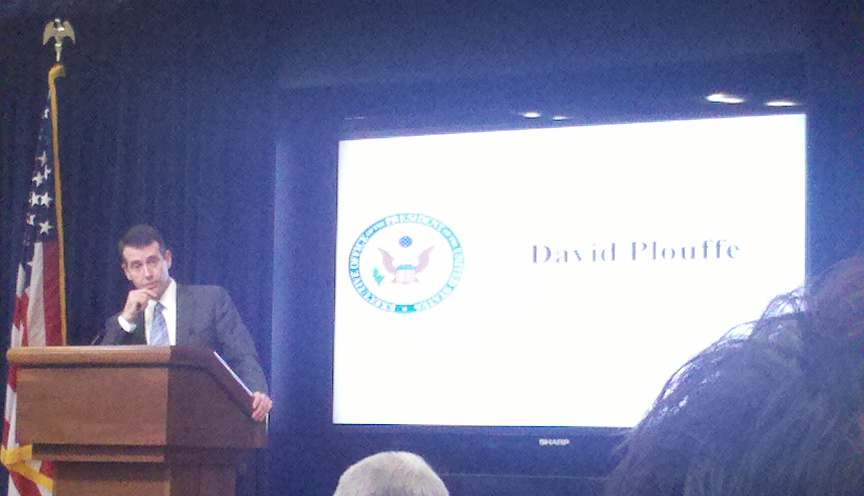
    Plouffe taking questions

  • David Plouffe (Senior Advisor to the President), also former campaign manager for the Big O, talked a lot about how to move forwards, shifting between calling himself a progressive but also mentioning the importance of balancing budgets. He took questions for a long time, and when asked what President Obama wanted his foreign policy legacy to be, he speculated that it would be ending the war in Iraq, giving AfPak the attention it needed, reestablishing the U.S. leadership role, and non-proliferation (a la START). In short, a “cleaner and safer planet.”
  • Alexia Kelley (Director, Center for Faith-Based and Neighborhood Partnerships) talked about her office’s work across the country and ways to partner with the government in communities. It’s also worth noting that during this segment I slipped out to use the restroom and upon my return I passed the First Dog, Bo. It was pretty legit.
  • Brad Cooper (Director, Joining Forces) talked about the launch of his program, which is a support system for military families and is definitely going to be getting bigger.
  • Anne Filipic (Deputy Director, OPE) emphasized the importance of taking our experiences home and spreading the word about the White House’s outreach programs. OPE is holding all sorts of round tables and focus groups across the country to get a better idea of what exactly people are wanting to see from the presidency, which is a pretty great effort. She also referenced ways to connect with the White House via technology.

    Carson taking questions

  • Jon Carson (Director, OPE) didn’t meet with me privately, but instead came to talk to everyone, which was pretty cool. Referencing the small size of OPE, he called on individuals to act as conduits for making sure people in the communities’ voices were heard. When asked about the LRA by one of our own, he said that building networks was an imperative, and called on involving diaspora groups (which I have always been on the fence about, given a majority of them’s contempt for Museveni). When we challenged him to get a strategy going, though, he seemed to take to heart that advocates like us really want to see the Executive Branch give a little and get some skin in the game. He later referenced that, when it came to cuts in the budget, community activism was the key to keeping money where it was needed the most.

As the White House event closed up, one of my fellow advocates – a child psychologist in Kentucky that works in Uganda rehabilitating former child soldiers through art – presented Jon Carson with letters and a drawing made my children addressed to President Obama. Carson assured her that he would pass them along, which is great news.

In the aftermath of the event, we congregated outside the White House and a few of us did interviews with Ricky from Discover the Journey, who was filming a short segment on Resolve’s work at the White House. I did my little part, and also hung out with some great people by the gate.

And that was my day at the White House. It was a pretty neat experience, and it was great to be surrounded by such a great group of advocates. Not all of the speakers were great, but the briefing overall was wonderful. Thanks go to Resolve for the invite and to Citizens for Global Solutions were setting up the briefing in the first place and for hosting a neat workshop the following day at their offices.

Why Norway is Great

Today, Norway suffered a terrible attack. An explosion tore through central Oslo, killing seven and hospitalizing almost a hundred more, and a shooting rocked a Labor Party youth camp in Utoya where over 80 young activists lost their lives. I have always thought that Norway was a great country, and it pains me to see this happen anywhere – but especially Norway. Prime Minister Jens Stoltenberg said that Norway’s answer to the attack would be “more democracy, more openness” and said to terrorists, “you will not destroy us.” Championing democracy instead of war in the face of terror is one way to win my heart.

In addition, Mark Goldberg added to why we love Norway so much:

I have never been to Norway, but I still love the place — and I am not alone. Norway is among the most beloved nations in the international community and for good reason.

Norway has a population about the size of the state of Kentucky. It is the 47th largest economy in the world, putting it between Chile and Romania.Yet, for a country as small as Norway, it is arguably the most generous country in the world.  It allocates a full 1.1% of its Gross National Incometo international development activities. This puts Norway on top of all developed world countries in its relative contributions to global poverty reduction. (By comparison, the United States contributes about 0.2% of its GNI to official development assistance–roughly the same percentage as Greece.)

Beyond its official development assistance, Norway is among the most generous countries in the world when it comes to responding to natural and man-made disasters. When tragedy strikes somewhere in the world, the Norwegian government steps up. Last year, it gave $832,585,693 for crises like Haiti, Burma, and Sudan.  Earlier this month, when UN agencies began to warn of a hunger crisis in Somalia, Norway stepped up with a big relief package.

My thoughts are with Norway, like a lot of people tonight.

Drug War Turns 40

So, last week was the fortieth anniversary of the infamous War on Drugs. The internet was abuzz with people talking about all sorts of aspects of how much of a failure it’s been. Instead of giving anything anecdotal or analytical, I figured I’d just share one of the most effective infographics I’ve seen on it, via Colorlines:

Bin Laden is Dead.

Earlier this morning, May 1, 2011, President Obama gave the go-ahead for a military action that resulted in the death of Osama bin Laden. The President gave a late Sunday address from the White House today, and social media and news channels are all abuzz with the news. I feel like typing about it, so here it goes.

Osama bin Laden is pretty fucking evil. Even the shortlist of what he’s done includes bombing the American embassies in Nairobi and Dar es Salaam in the 1990s, helping the Taliban wage war against the Northern Alliance, and spearheading the 9/11 attacks on America. Longer lists include involvement in attacks all across the Middle East/North Africa, Europe, Asia, Africa, you name it. We were able to diplomatically evict him from Sudan in the 1990s and militarily evict him from Afghanistan in the 2000s. Now, we were able to kick him out of life.

It’s taken almost ten years of fighting across two countries. We have bombed the shit out of Afghanistan and the Pakistani border. We have lost many American lives and taken even more. We’ve spent a lot of money. And we got him. But what’s next? The war in Afghanistan has only marginally been about al Qaeda – recent fighting has been almost solely against the Taliban in that region. The fight against al Qaeda has been in Yemen, Somalia, and other corners of the region. So, does this change the war in Afghanistan at all?

Right now, news cameras are showing the brouhaha on Pennsylvania Avenue. It started with maybe fifty people chanting “USA! USA!” and at times included girls doing a college/high school style cheer, a singing of the national anthem, lots of screaming, and allegedly beach balls. I wouldn’t be surprised if there was beer and boobies. I saw a handful of facebook statuses display “amen” and “thank god.”

Bin Laden sucked. A lot. But he also died, at the expense of a fuckton more than his life. And the amount of cheering at the death of the enemy seems oddly symmetrical to chants of “Magbar Amrika” (Death to America) in Tehran and flag-burning in Baghdad. I know it’s not the same. But I’ll be damned if the former doesn’t make me think of the latter. And that worries me. If we want to show Islamists that America is great and not the enemy, we probably shouldn’t flaunt our head-shot victories like a bunch of arrogant, well, Americans. The scene is a bit troublesome.

In the past ten years, America has changed a lot. We’ve gotten openly and militarily involved in three and a half countries (one could argue that Pakistan’s only a half). Guantanamo Bay’s detention facilities have become synonymous with America’s disregard for international law and decency in favor of abducting people with names that sound similar to enemies just in case. The PATRIOT Act has expanded the government’s intrusion into our private lives. A large and vocal minority in our country has shifted ill-will towards good-hearted American Muslims.

Once these things happen, it’s hard to undo them. It’ll take a long time to scale back these policies, stigmas, and fear-mongering. And the war must go on. It will, for who knows how long, while we beat on the Taliban in Afghanistan and al Qaeda everywhere. And the government will continue to ignore problems like our crippling recession, a crisis in education, and a broken border system.

Osama bin Laden did lots of terrible things, and he won’t be able to anymore. That’s good. War’s still ongoing, and it’ll be hard to really get things back to pre-bin Laden status. I don’t know what all of today means, but I would really like some good news. Today was, by and large, news.

Quick Update: I definitely want to give props to Obama. Even though he failed to mention the embassy bombings in Africa, he devoted a much-needed bit to Muslims and the fact that America is not fighting Islam. Sadly, it needs to be said every once in a while. I’d like to count myself among those “who believe in peace and human dignity.”

The Right to Walk

In case you haven’t heard, protests rocked Uganda this week, leading to lots of arrests, police violence, and several deaths. The Daily Monitor has a decent live feed, but I’ll summarize bits. It all began with the opposition protesting the Museveni government’s economic policies. With fuel prices rising, opposition leader Kizza Besigye explained that “we are just asking people to walk to work two times a week and we want to do so to show solidarity with the already tens of thousands of people who are walking to work every day because they can no longer afford the cost of public transport.”

Apparently, walking to work is illegal.

Specifically, the Assistant Inspector General of Police stated that by announcing a campaign to walk to work in solidarity with others, opposition leaders were in effect leading a procession, which requires a permit and all sorts of other limitations. The police went out in force to oppose such illegal processions.

Riot police kept Besigye from leaving his home town, a Kampala suburb, because they believed his walk would incite violence. Amid the scuffle, Besigye was shot with a rubber bullet and suffered a wound to the hand. In Masaka some 300 youth, presumably boda drivers, fought with police when their march was interrupted. News outlets were ordered not to provide live feed updates about the campaigns and protests, under penalty of losing licenses. In addition, the Daily Monitor’s internet connection was cut. Several opposition MPs were arrested, and a reporter in Masaka was attacked by police.

Masaka’s actions seem to have been started by young boda drivers walking their motorcycles across town in protest, but the protest grew in size and resulted in the army taking over the town. These young kids are bearing the brunt of Museveni’s economic policies, and it’s interesting to see just how the security forces responded to their protests.

Meanwhile, when police arrested opposition figure Norbert Mao, they incited violence. After Mao was arrested, Gulu erupted. Eventually the police called in the army, who showed up in armored cars with guns firing. With the town suffering a blackout, citizens burned tires and threw stones at the army. Three people were killed and Mao has called for a prayer and fast in protest.

Some have been saying that the army was able to restore calm and stability. I’d have to say, restricting the rights of the press and of protesters, even the rights of people to work peacefully to work, is hardly a status quo worth staying in.

What’s Happening in Uganda Tomorrow?

On Friday, Uganda will be holding presidential elections.  Even eight months ago when I was in Uganda it was big news.  So, what’s going on in Uganda?

Yoweri Museveni, President of Uganda for over twenty years and leader of the National Resistance Movement, will be running for re-election yet again.  He is running against a slate of opposition figures, chief among them Kizza Besigye of the Forum for Democratic Change.  But what’s important about this election?

Despite having won every election since seizing power, Museveni’s victory margin has been diminishing.  In the last election he only won with 59% to Besigye’s 37%.  With notable corruption and a diminishing economy in addition to failure to secure the north and west against rebellions, Museveni faces the possibility of winning only a plurality in tomorrow’s election.  According to Ugandan law, if there is no clear majority than the front-runners compete in a run-off election.  If this is the case, it is likely that the less viable opposition figures such as Norbert Mao and others would throw their support behind Besigye, ushering him into the presidency.

That said, Museveni is consolidating control.  In both 2001 and 2006 the Supreme Court of Uganda ruled that the elections were flawed with corruption and vote-rigging, but both upheld the election returns for various reasons.  This election season there have already been rumors that the NRM has been buying votes in certain regions.  There are even cases of Museveni personally handing out envelopes of money to prospective voters and of Parliament receiving funds that slant towards NRM victory.  This in addition to a possible repeat of Museveni’s announcements a couple of years ago that any districts that did not vote for him would risk not receiving national funds for programs.

It looks like Museveni is setting up the elections in his favor.  Regardless, there may be some room for the opposition to sneak a victory.  But, even if that happens, he may not relinquish power.  Besigye has been exiled before and accused of treason, a strong run against the President could result in similar consequences.  With the vote taking place tomorrow, I’ll be keeping my eyes on how things unfold.