Arizona’s Progressive Constitution – 100 Years Ago

Last night, I attended a forum at the Arizona Historical Society on the state’s constitution. The panel at the forum was made up of a history professor (who taught the first university class I ever took!), a law professor, and a lawyer. I wanted to paraphrase some of what was discussed, as well as reflect a bit.

Arizona on the verge of statehood in 1911.

At the forum, historian Phillip VanderMeer touched on the historical context of Arizona’s constitutional convention in 1910. State governments had shifted from a strong legislature to increasingly balanced branches of government, and at the time of Arizona’s statehood, progressive ideas were finding their way into states’ founding constitutions, revised constitutions, and amendments. At the turn of the century, Arizona’s economy was deeply influenced by railroad and mining companies, and the workers in these companies struggled to achieve rights. It was at the constitutional convention that organized labor brought ideas including an eight-hour workday, an elected state mine inspector, the prohibition of blacklists of labor leaders, and a ban on child labor – all of which made it into the constitution, along with broad progressive ideas such as initiative, referendum, recall, and direct primaries.

Paul Eckstein, a civil lawyer here in Arizona, spoke about the actual debates and influences on the constitutional convention in 1910. He explained the nature of Arizona’s divided demographics – the territorial legislature was predominantly Democrat, but the territorial governor (appointed by the President of the U.S.) was almost always Republican. Across the border, New Mexico was predominantly Republican, and so both states were admitted at the same time in the name of balance. Eckstein pointed to Arizona’s constitution’s progressiveness relative to our sister state’s founding document as well as contemporary models of statehood across the West and Midwest. He listed a number of things New Mexico’s constitution did not have, that Arizona’s did have (remember, this is in 1912, and both constitutions went into effect almost simultaneously):

  • Initiative
  • Popular Referendum
  • 2 year terms for elected officials
  • Advisory popular vote for the U.S. Senate
  • Direct primaries
  • Public campaign contribution provisions
  • State anti-trust laws
  • Progressive income tax

Some of these are clearly at the forefront of the progressive movement at the turn of the century. Arizona was talking about campaign finance, direct election of Senators, and a progressive income tax before the federal government had made any headway on these issues. Women gained suffrage in 1912, before the 19th Amendment was passed, and prohibition in 1914, five years before the 18th Amendment. President Taft opposed the right to recall judges, leading the territory to remove the provision in order to gain statehood – only to reinstate it almost immediately.

Progressive ideals, especially the idea that the government should be held accountable to the public, is clear in Arizona’s constitution. Two year terms for elected office and the ability to recall elected officials combine for a strong opportunity to keep lawmakers on tight reins. In addition, the executive branch in Arizona was very weak – he was among over a dozen elected officials in the executive and had relatively few appointment powers. The people refused to allow the legislature to run rampant without the support of the general populace.

While some Arizonans today are unfortunately supportive of the more restrictive pieces of legislation put forth in the legislature, the real problem is that the constitution is no longer recognized for what it is supposed to do – lawmakers are not answering to the public and the three branches are not utilizing checks and balances. One of the main tenets of the constitution – to hold government accountable to the public – isn’t happening anymore. Our legislators are not being scrutinized as much as they should – even in light of the recent recall of Russell Pearce.

Update: The sequel of this post, examining how the state’s courts have treated the constitution, can be found here.
Civil Rights in Mad Men and Beyond

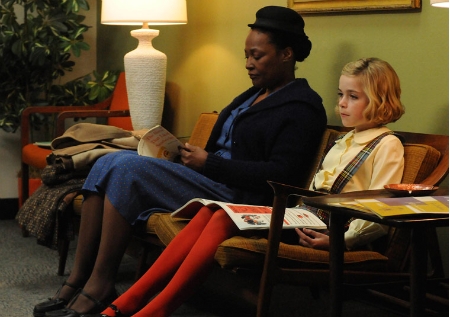
The only black character that has been on Mad Men for more than two episodes is Carla, the Draper housekeeper. That might change this season.

If you didn’t see the season premiere of Mad Men this week, you should know one thing: racism and civil rights have intruded upon Sterling Cooper Draper Pryce. The show has referenced racism a few times, with Paul and Sheila going to the South to register voters, but it has never been a prominent theme like women’s role in the workplace has. It seems, however, that the fifth season could feature race quite a bit, especially if the office hires a person of color. As Tanner Colby points out, most seasons have included a major historical event (Kennedy’s election, the Cuban Missile Crisis, and Kennedy’s assassination), and if this season spans about two years it could include Martin Luther King Jr.’s assassination.

In this first episode of the season, race is treated as a problem that nobody wants to fix.  The opening scene of the premiere features a few executives at Young & Rubicam water bomb a Civil Rights protest going on outside their office,* which gets them in the papers. From there, the partners at SCDP decide to take the opportunity to rub salt on Y&R’s wounds by placing an ad in the paper declaring themselves “an equal-opportunity employer.” The boys at Y&R fire back, sending a resume and an African artifact through the door while a number of black applicants sit in the lobby.

While the premiere spends a lot of time showing how SCDP employees struggle with their home lives (with two new children, two new homes, and a new wife), the issue of race is tossed back and forth between SCDP and Y&R throughout the episode, with each agency trying to stick the other with the Civil Rights problem.

During the time in which Mad Men is set, the Civil Rights movement was often treated in the same way.  Politically, both Democrats and Republicans voted against civil rights reforms in Congress, despite Presidents of both parties putting forth piecemeal plans for reform.  Kennedy denounced the Freedom Riders for provoking violence and criticized SNCC for inciting harassment as well.  It would take James Meredith’s enrollment at the University of Mississippi and Bull Connor’s crackdown in Birmingham to force his hand.

The biggest victories for blacks, the Civil Rights Act and the Voting Rights Act, arguably only came about because Johnson realized that black votes were important. By and large, the rights of America’s blacks were hot potato’d until politicians realized that black votes, not black people, were something to attract and protect.  One of the boys at Y&R shouted for the protesters to get a job, then pranked SCDP into accepting resumes – neither agency actually wanted to address the problem, but in the end one had to. Most politicians during the time didn’t want to deal with the “problem” of civil rights, but were forced to. I’m definitely not an expert on civil rights history, but I think this was a recurring theme until the movement grew enough to demand attention.


* Fun fact: Young & Rubicam was actually the first ad agency to hire a black adman, Roy Eaton, and that was in 1955.

HB 2675 is Gone

The Daily Wildcat is reporting that the minimum tuition bill, that would have forced students to pay at least $2000 in tuition regardless of need-based scholarships, was withdrawn yesterday. It’s great news for students – and really anyone who cares about higher education. Thanks go out to everyone who raised a fuss and especially student activists that were involved in speaking out against the bill.

In honor of the bill’s withdrawal, I’d love to quote our very own Arizona Constitution, Article 11, Section 6

The university and all other state educational institutions shall be open to students of both sexes, and the instruction furnished shall be as nearly free as possible.

Students Aren’t Irresponsible – The Minimum Tuition Bill Is

Amid my short bout of confusion this afternoon over the status of the minimum tuition bill, HB 2675, I contacted the original sponsor, Representative John Kavanagh, asking if the bill had been withdrawn, and received a simple answer that the bill has not been withdrawn and will be discussed in the Appropriations Committee this week (see my update on today’s prior post). In addition, Kavanagh also sent me talking points as to why the bill should be passed, which I have decided to post in its entirety for you:

  • Currently about 48% of students at our state universities pay no tuition at all. Only 5% are academic or athletic scholars. The rest are being given unearned tuition subsidies from the universities.
  • HB2675 requires students, other than academic and athletic scholars, to pay $2,000 of their approximately $9,000 yearly tuition – a mere 20%. They may use their own money, university work-study program money or outside scholarships, grants, gifts or loans, excluding Pell grants, to pay this $2,000.
  • HB2675 still allows the universities to give these students up to $7,000 per year in unearned tuition subsidies, about 80% of their tuition.
  • The $18 million that this frees up will be kept by the universities and may be spent for other purposes, such as tuition rate reductions or improving academics.
  • Even if some students have to take out loans to pay the minimum $2,000 tuition per year and an extra $1,500 per year for fees and books, that still would only amount to a four-year debt of $14,000, which is less than the cost of a Chevy Sonic. Our state university degrees are worth far more than the cost of a Chevy Sonic. In addition, based upon an inspection of university parking lots, students have no trouble getting car loans for greater amounts and paying them off.
  • These unearned tuition subsidizes, which pay the full tuition of non-academic and non-athletic scholars, cause several unintended negative consequences:
    • The free tuition often makes it cheaper for students to attend universities rather than community colleges, which lures some less academically prepared students to universities, when they would be better served going to smaller, more teaching-focused community colleges for a year to two before going to impersonal university with greater distractions. As a result, some of these students fail or drop out, lowering the completion rates of our state universities, which lowers their national ratings and devalues the worth and prestige of their past, present and future degrees.
    • When students pay nothing towards their tuition, some take their studies less seriously and then fail to graduate. This lowers the completion rates of the universities, their national ratings and the value of their degrees.
    •  Taxpayers who generally do not have university degrees wind up paying the tuition of those who will statistically earn one-half to a full million dollars more in salary over their lifetimes. This is unfair.
    • Currently, nearly half of all in-state undergraduates pay no tuition due to this unearned subsidy, which extends this aid well beyond the poor.

Kavanagh repeatedly refers to need-based full-ride scholarships as “unearned tuition subsidies,” arguing that completing the admissions process and qualifying for funding based on financial necessity is not enough to warrant being awarded the funds to pay for education. Again, we are seeing a division being made between the academic and athletic scholarship recipients, who “earn” (and by extension, deserve) their scholarships, and those who apparently receive unwarranted scholarships. And he covers for it by saying that he’s only making them pay a mere 20%, a mere $2,000 a year. But that’s precisely why people receive these types of scholarships – because otherwise they wouldn’t be able to afford the education for which they are striving. To call this anything other than a war on the lower class is to admit that you’re not paying attention.

But it’s not enough to force the poor to pay for tuition that they can’t afford. Why not add a dose of condescending humor? Kavanagh decides to compare the overall cost of tuition to a cheap car, assumes that value equals dollars rendered and nothing else, and then says this:

…based upon an inspection of university parking lots, students have no trouble getting car loans for greater amounts and paying them off.

What kind of assholey argument is that? Kavanagh is ignoring that transportation – like education – is often a necessity, while simultaneously ignoring that a large number of students rely solely on public transportation to reach campus. He ignores that students sometimes need cars to get to jobs to help pay for rent, books, and other costs – things that a full-ride scholarship still doesn’t cover. He’s ignoring that, without a scholarship to cover tuition costs, paying for things like cars – or even parking on campus – is difficult for many. He’s also ignoring that students are individuals worth more respect than his little jab at fiscal responsibility conveys.

The fact that Kavanagh thinks that students – especially poor ones – are irresponsible and unable to make good decisions is continually reinforced with every bullet point. It goes beyond “students who get scholarships waste money on cars.” Students who can’t afford higher education don’t deserve a chance to get it. Students who successfully get admitted to research universities aren’t committed or prepared enough to finish college. Students who don’t pay for their education don’t value it and as a result won’t try hard. Those who want to pursue higher education, but can’t afford it, don’t deserve the help of the community that would benefit from their work.

That this type of legislation can be seen as anything but an attack on the poor is absurd. And yet it’s only when the marginalized (or in the case of Occupy, the newly marginalized) try to stand up that it’s called class warfare. This is just one of many instances in which the legislature is trying to put more pressure on those that have little and are striving for more. It’s a shame that this type of legislation is even seeing the light of day in a time when more and more people are being squeezed by the recession and are fighting to attain a higher education. Students aren’t irresponsible for aiming to get an education. However, it is irresponsible for the government to try to walk away from its obligation to provide an education to residents that are a part of the community, help fund the institution, and want to be educated.

HB 2675 Might Be Gone (with updates)

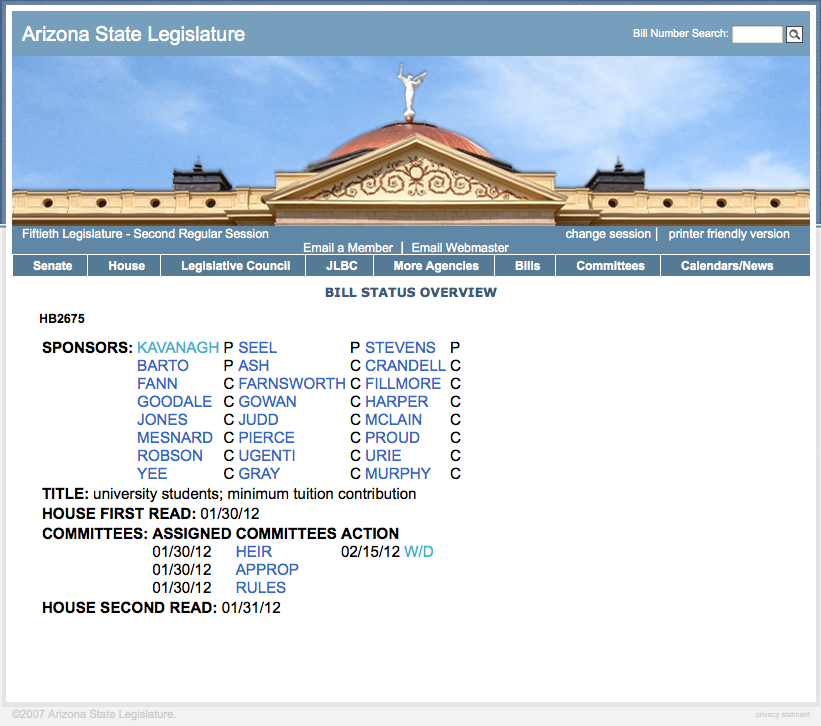
A few moments ago, I was on the Arizona state legislature’s website to check up on a current nemesis, the minimum tuition bill that would get rid of need-based full-ride scholarships. While on the site, I found the bill and checked its status – nothing had changed. I checked the overview and its most recent action was listed as “2/15/12 W/D,” which indicates (to my knowledge) that the bill was withdrawn.

Most recent action lists the bill as withdrawn. (Screen captured at 11:40 today)

Having not heard much, I perused local newspapers and asked the internet about it, so far to no avail. I called the original sponsor of the bill, but got no answer. For a while, the state legislature’s website was rerouting me to this bill, a bill from the previous legislative session regarding food stamps. Manually finding my way back to the current session, the bill still says it was withdrawn last week. I’ll update more on this as the day moves continues.

12:45 Update: It appears that the bill has been withdrawn from the Committee on Higher Education, Innovation and Reform, although I have not found out why. The Appropriations Committee, of which Rep. John Kavanagh is the chairman, is still scheduled to discuss the bill tomorrow morning. Including Kavanagh, six sponsors of the bill are on the 13-member committee. The HEIR Committee had no sponsors among its membership.

9:40 Update: Earlier this afternoon I e-mailed the original sponsor of the bill to ask about its status. He responded with a long list of reasons to support the bill, which I just finished criticizing here.

Feb. 23 Update: The House Appropriations Committee voted yesterday to pass the bill after a very intense testimony from students and other stakeholders. It’s a sad move towards a potential equivalent to a $2,000 tuition increase for the poorest students in the state. An amendment was passed exempting students living on campus, but an exemption for veterans was not passed.

Mar. 1 Update: The bill was withdrawn by Rep. Kavanagh yesterday!

What’s So Different About Arizona Politics?

As Arizona celebrates its one hundred years of being a state, I think it might be important to see where the state’s politics are now, and where they might be going as we look out towards the next one hundred years. I don’t just mean the shift to extreme conservative politics, which is definitely a factor not to be overlooked, but here I want to look more at overall change the way politics happens on the state level here in Arizona.

Mark Lacey, bureau chief at NYT; Jennifer Steen, professor at ASU; Art Hamilton, former House Leader; Tom Zoellner, journalist and author, in October. Photo from Zócalo.

Last fall I went to a panel discussion hosted by Zócalo Public Square in Scottsdale about Arizona’s position on the national stage (you can watch the full video here), where there were several references to Arizona as the 21st century’s antebellum Kansas or Civil Rights Alabama. That is, that Arizona is sitting at the epicenter of a change in the political system either from the anti-immigrant discourse that is being created or from the state-versus-federal narrative that is being woven here. The talk itself was titled “Is Arizona the Front Line of American Politics?”

The event went far beyond the effect on national politics of immigration in Arizona. Arizona has been at the forefront of quite a few different issues, be it immigration, gun control, or education. ASU is still in the midst of privatizing the law school and ethnic studies programs are being forcibly removed from classrooms. It’s not weird to see people with guns on their hips at the grocery store or sitting at McDonald’s. Recent laws allowing concealed weapons without a permit were of huge debate at the talk since Tom Zoellner, the author of A Safeway in Arizona, a book about the impact of the attack on Rep. Gabby Giffords, was one of the panel speakers.

One thing that has been a fact for a long time in Arizona regarding the limits to laws (I don’t know about other states, on the frontier or elsewhere), is that the police no longer have a say. Both in regards to SB 1070 and to numerous gun laws in Arizona, the law makers no longer defer to law enforcement. Before, police would weigh in on whether or not concealed rifles would be safe in the city – now nobody seems to care what the police think. Zoellner argued that this was partially because other border states in the Southwest were much older and had more matured political institutions, allowing Arizona to come to the fore on new ground for lawmaking. It’s an interesting idea that Arizona is a younger and more reckless state. It’s one explanation for why Arizona has served as a sort of test lab for new ideas, more so than most state governments. But what makes that possible?

At the same panel, Former House Minority Leader Art Hamilton argued that term limits left a legislature with no institutional memory or respect, and that “nobody takes care of the house” anymore. It’s an argument with which I’ve always agreed – rules in institutions like legislatures are open to abuse if there is no order, which is what we’re seeing in Arizona. From a joint report on term limits in Arizona [pdf] released in 2005:

Some observers suggested, however, that term limits have led to an increase in the number of dumb or frivolous bills being introduced and have prompted more people to introduce legislation they know nothing about just to make some sort of record and/or to please some interest group. With a weakening of leadership and the committee system, some observers saw also bills being passed with less vetting.
The emergence of a large group of newcomers more anxious than ever to get involved and make a mark for themselves has generated pressures for a more inclusive policymaking process, This has been especially marked in regard to the making of the budget, the most important thing the legislature does on a regular basis. While these changes may be viewed by many as generally positive, on a broader level, constant turnover in members and leaders, were linked by observers with more general chaos, more emotional decision making and more unpredictability as to results. The departure of several old-times has been accompanied by a loss of institutional memory regarding legislative norms, procedures, and protocol. Conversely, the increase in the number of inexperienced legislators has produced a body where more legislators are uncertain about how to do their jobs and are relatively uninformed about the issues facing the state.

On top of that, Arizona allows people to run for office once they have lived in the state for three years. This could compound the problem of legislators being uninformed about issues regarding the state in particular, and open the state up to imported politicians. While I agree with both of these points, and it seems that they definitely have something to do with the problems in Arizona’s state politics, I found that Arizona’s rules are comparable in the region.

California and Texas have almost identical eligibility and term limit laws, and yet Arizona stands out as the state constantly in the news for bills that challenge the status quo and sanity. Looking at these rules as flaws is a place to start, but I have yet to find what really is the answer to Arizona’s peculiar position in national politics. What sets Arizona’s government apart from other states’? Regardless of the answer (which I’m still looking for), I think it’s clear that Arizona is at the front line for national politics.

Russia and China Veto Resolution – Everybody’s Pissed

This morning, the United Nations Security Council failed to pass a watered down resolution addressing human rights abuses and massacres in Syria. Last night, in the hours leading up to the vote, the Syrian government launched a campaign against the city of Homs resulting in anywhere from 200 to 300 deaths. Today, both Russia and China vetoed the UNSC resolution. In the aftermath, there were a number of officials that were furious and ready to unleash.

U.S. Ambassador Susan Rice was angry, saying:

 The United States is disgusted that a couple of members of this Council continue to prevent us from fulfilling our sole purpose here-addressing an ever-deepening crisis in Syria and a growing threat to regional peace and security. For months this Council has been held hostage by a couple of members. These members stand behind empty arguments and individual interests while delaying and seeking to strip bare any text that would pressure Asad to change his actions. This intransigence is even more shameful when you consider that at least one of these members continues to deliver weapons to Asad.

Since these two members last vetoed a resolution on Syria, an estimated 3,000 more civilians have been killed. 3,000. Another almost 250 killed just yesterday. Many thousands more have been held captive and tortured by Asad and his shabiha gangs. Since these two members last vetoed a resolution, however, and despite the absence of Security Council action, we have seen more and more Syrians speak out in peaceful demonstrations against the regime.

Once again, the courageous people of Syria can clearly see who on this Council supports their yearning for liberty and universal rights-and who does not. And during this season of change, the people of the Middle East can now see clearly which nations have chosen to ignore their calls for democracy and instead prop up desperate dictators. Those who opposed this resolution have denied this last chance to end Asad’s brutality through peaceful means under Arab League auspices. Any further blood that flows will be on their hands.

The British ambassador to the UN Marc Lyall Grant expounded on what had happened leading up to the vote:

Four months ago, to the day, two Council members vetoed an attempt to send a clear message to the Syrian regime to end the bloodshed. That day, the death toll stood at 3,000. And the Syrian regime only continued its brutal repression.

The death toll today stands at around 6,000. The Syrian regime has ferociously escalated its already brutal repression in the last 24 hours, subjecting the citizens of Homs to artillery and heavy weaponry. The death toll will be high. Those that blocked Council action today must ask themselves how many more deaths they are prepared to tolerate before they support even modest and measured action?

Last Tuesday, this Council – and the world – heard from His Excellency Sheikh Hamad bin Jassim of Qatar and the Secretary-General of the League of Arab States. They came with a simple request for Security Council support for the Arab League’s plan to facilitate a political transition and bring about a peaceful resolution to the crisis.

The original Moroccan draft resolution did just that. It had, from the outset, support from the vast majority of Council members and had the backing of the Arab League. Yet some Council members argued that the resolution imposed regime change. It said no such thing. But in an attempt to reach consensus, we provided further assurances in the text.

The same minority argued that the text could somehow be used to authorise military intervention. It did no such thing – it was a Chapter VI resolution. But in an attempt to reach consensus, we provided further assurances in the text.

The same minority argued that very modest language expressing concern about weapons was somehow tantamount to an arms embargo. It was not. But we took it out.

They said that mere mention of the existence of Arab League sanctions was tantamount to sanctions. It was not. But we took it out in an effort to reach consensus.

Mr President,

The facts speak for themselves. There is nothing in this text that should have triggered a veto. We removed every possible excuse.

The reality is that Russia and China have today taken a choice: to turn their backs on the Arab world and to support tyranny rather than the legitimate aspirations of the Syrian people. They have failed in their responsibility as permanent members of the Security Council. And they have done so on the most shameful of days of the Syrian killing machine’s 300 days of repression.

I’ll add more quotes throughout the day as I find reliable sources.

A New Burden for Arizona Students

Recently, State Representative John Kavanagh introduced a bill, HB 2675 [pdf], that would establish a minimum tuition that has to be paid by the student. The bill will force students to “pay $2,000 unless they have a full-ride scholarship based on athletics or academics” – effectively getting rid of needs-based full-ride assistance. The bill, if passed, would even restrict students’ ability to pay with other awards: it says that any other awards from a source affiliated with the university cannot be used to pay for tuition. This would include things like this fellowship that I won in my junior year, or countless other awards offered by the university, colleges, centers, and even the university’s foundation, forcing students to either work or take out loans to pay for their education.

The bill has 24 sponsors right now, and the body is comprised of sixty members. It’s not unrealistic to believe that this bill could become law very soon. It was introduced in the House by John Kavanagh, who you might know as the representative who was a staunch supporter of controversial SB1070 and was a big supporter of contracting with private prisons, in addition to the mastermind behind charging people $25 to visit their family members in prison. Not coincidentally, he is also an active member of ALEC and he received donations from prison privatization lobbyists. It looks like he’s now set his sights on higher education.

According to the linked article, Kavanagh thinks that $8,000 in loans isn’t much since those who choose to go to college will make more than those who don’t. Not only does that ignore the fact that many students who get full-ride scholarships still take out loans for cost of living, an $8,000 loan turns into almost $12,000 due to interest. Kavanagh also defends the fact that merit-based full-ride scholarships remain intact by saying that they contribute to the school. Because if you don’t get recognized  for your intellect of your athleticism in the form of cash, you must not bring anything to the table. He also argues that tax payers shouldn’t pay for higher education because then students don’t take classes as seriously and because it encourages enrollment of students who aren’t actually ready for college. He actually said that.

It’s important to note that the state constitution says that education must be as nearly free as possible. Instead, Kavanagh thinks it’s appropriate to throw a $2000 tuition increase at the most vulnerable students. The response in Arizona’s universities will be interesting. The universities in Arizona have been hit pretty hard over the years, including massive cuts in state funding over the last three years. Just during my time at ASU tuition has skyrocketed while class sizes get bigger. By law, each university will have to host a public hearing about the law since it constitutes a tuition increase for some students. It will be interesting to see if the student community can mobilize itself enough to speak up about this bill.

Links from the Internet Blackout

If you were near the internet yesterday, you probably noticed that things were a little different. As a part of a protest against the Stop Online Piracy Act and the Protect IP Act, websites like Wikipedia and reddit went completely dark while many, like Google, drew attention on their pages to the legislation. Throughout the day, several former sponsors of the legislation backed down in both the House and the Senate. If you haven’t already, here are some links to learn about the piracy/censorship laws on the table. This was supposed to be posted yesterday morning, but my computer was being slow and I was busy. Probably SOPA’s fault. If you haven’t read these already, take a look:

Wikipedia takes action, the Electronic Frontier Foundation asks you to do two things, and Mashable breaks it down. Google also had this spiffy infographic.

Angus Johnston found two quotes on SOPA, Someone on Twitter found that the author of SOPA might be stealing content. Joe Sestak says the corporate lobby’s argument doesn’t make sense. Gimodo has photos of some of the website’s blacked out cover pages. And how SOPA/PIPA will affect women and artists.

Rwanda isn’t a Model for Anything but Autocracy

About a year ago, I attended a conference about human rights in Africa.  One of the keynote speakers was a PhD candidate in justice studies who spoke mostly about the Arizona state legislature’s divestment related to atrocities in Darfur.  But she made an off-hand comment about Rwanda that made me double take. I’ll paraphrase it to something like “the streets are clean and the cities are safe, it’s come a long way since 1994!” It wasn’t the main point of her speech, so I shook it off, but not before writing a small post about my own thoughts on Rwanda. But it seems it might be time for another.

I attended an event last month where I saw Carl Wilkens speak. Wilkens is well known for being the only U.S. civilian to remain in Rwanda during the genocide, where he helped aid many Tutsis that were in hiding.  He had a lot to say about his work at the time and his personal story, and it was very moving.  I picked up a copy of his recently published memoir and hope to read it soon.  Hearing him speak, I could tell he cared a lot for Rwanda’s well being – he continues to do work there and seems to have a deep connection with the country.  Given what he went through, it’s hard to blame him.  During the Q&A portion of the event, though, I was struck by his strong support for the current regime there.

First, someone asked how Rwanda had changed.  Wilkens qualified that the government was somewhat overreaching and even used the word “autocratic,” but also argued that the streets were clean, crime was down, and people were safe.  He ignored that petty criminals are whisked away and never seen again and that the civil society and press are severely choked by government restrictions (both of which I mentioned in the aforementioned post).  Recently, the genocide survivors group Ibuka condemned Paul Rusesabagina’s Lantos prize.  Ibuka is one of the biggest survivor groups, but it has been aligned with the government ever since its more outspoken leaders were purged by Kagame in 2000.

And then someone asked what African country could be seen as a model for the way forwards. I was expecting something like Botswana, but instead got accolades for Rwanda again.  Wilkens explains that the Rwandan government was establishing infrastructure, citing efforts to lead an information-based economy in Kigali to lead the region. As some have mentioned, that can’t be the only solution.  An authoritarian government that stifles opposition cannot grow much further than Rwanda has.

Once you clean up your streets (by banning plastic bags and arresting people for begging) and shore up your border (by invading your neighbors and stealing their resources) and win “popular” elections (by intimidating and threatening opposition groups), you can’t call your country a beautiful model for new African governance. I’ve spent years learning about Uganda, and I sure as hell love a lot of things about that country. But in learning to love that country, I’ve also learned to call a spade a spade. No matter how close you are to Rwanda, it’s important to take a step back and call an authoritarian government what it is, with no excuses or apologies.