Caesar Achellam’s Defection Story

This morning former LRA Maj. Gen. Achellam Caesar spoke to a group of Congolese and Central African civil society, government, and religious leaders in Gulu. A Central African asked him whether he defected or was captured, and I’m summarizing what Achellam responded. I recorded the event, and will try to get a full transcript up later. But, according to Achellam:

He was first abducted in 1988 for being an NRM collaborator. He was told that if he tried to escape the LRA would attack his home village, so he decided to stay with the rebels. In July of 2007, Achellam was detained by the LRA on suspicion of encouraging other rebels to defect. He was beaten and placed in solitary confinement. It was around this time that Vincent Otti, Kony’s second in command, was executed. Achellam remained in detention until June of 2009, when continued attacks from the UPDF-led Operation Lightning Thunder forced the LRA to flee. He was detained again in 2011, and escaped in May of 2012. He fled with a few others across into CAR and followed tracks that the UPDF had left behind, surrendering to them when they met.

If this story is true, and who knows if it is, then it seems Achellam’s capture was  more of a defection. This is important in terms of the legal aspects of amnesty – which is granted automatically upon application after escape or defection, but must be approved by the Director of Public Prosecution if the applicant was captured.

Achellam’s status is very, very vague. He lives in the army barracks in Gulu with his family, and many assure that he is a free man. But when he arrived today it was with military personnel in tow, and his freedom is rather questionable. That said, an army spokesman said yesterday that Achellam may be in the process of negotiating a leadership role in the UPDF, which is important to note. We’ll see how this all pans out. I’ll add more later if I get more information about his case.

A Note on Defection Messaging

Most of my blogging from this trip will be more about research than traditional travel-blogging, but I’m doing a short e-mail newsletter for friends and family. If you’d like to be included on that list, feel free to comment or e-mail me at scootles7 [at] gmail [dot] com.

So, I’ve been in Uganda for a week now. My research has been slowly progressing, which already puts this trip as wildly more successful than my last sojourn to this country, which I deemed “a failed attempt” at an internship. I’m nervous about the Congo portion of the trip not least because it’s the Congo and all of the associations, realistic and overblown, that come with that, but also because I don’t speak a bit of French, Lingala, or Zande and because the schedule is very, very up in the air. But, for now, it’s nice to be back in Uganda and be (somewhat) active in my work.

So far, I’ve interviewed the head of radio for Invisible Children and the program director for Mega FM, one of the biggest stations in the north. These interviews have all been about defection messaging, also called come-home messaging (dwog paco in Acholi). The messages include former rebels telling other rebels that it is safe to come home, encouraging them to take advantage of the amnesty law. You can find out more about these messages here and even hear some samples clips in different languages at The Voice Project.

It is widely agreed that the radio messages are extremely effective. This isn’t just coming from the people who work in radio, it has been labeled by aid workers and peace advocates as an effective means of encouraging LRA escapes and surrenders for some time now. Mega FM was started with a large amount of funding from DFID with come-home messaging in mind, USAID’s policy on the LRA includes capacity-building on radio defection efforts, and this programming has recently been a primary thrust of Invisible Children, which states that 89% of returnees cite the messaging as one of the reasons they returned.

But not everyone agrees. I met with Tim Allen, professor of development anthropology at the London School of Economics and long-time (like, long-time) follower of the LRA, a month ago and he said that he thought that the role that radio played was vastly overstated. Indeed, in his and Mareike Schomerus’s report on reception centers [pdf] in 2005, their team found that:

Hardly anybody from the sample heard about the amnesty while still in the barracks and reception center staff have confirmed that most who arrive in the center do not know about it.

[…]

Of those who had heard about the amnesty, many had a negative impression of what it actually meant. In the bush, LRA commanders tell combatants that the amnesty is actually a government ploy to lure people out of the bush and kill them. Commanders deny their soldiers access to radios and make every attempt to suppress information.

Many reception centers say that, anecdotally, returnees say that they try to sneak around and listen to radios when they can to hear news from home, and that is how they find out about the amnesty.  This report was written in 2005, so perhaps things have changed between then and now, or perhaps some center staff had different experiences. Allen and his team raise some concerns about the reliability of returnee anecdotes, citing that one of the jobs of reception center staff is to teach returnees how to talk about their experiences in constructive ways. Some returnees may be picking up that they should cite radio regardless of their personal experience, either as an unintentional side-effect of the rehabilitation process or as part of the belief that it will get them better aid packages.The point remains that there is some ambiguity over how much access to radio the lower-level members of the LRA have.

My research is predominantly on how the messaging works, which may or may not assume that it works. I’ve been an ardent supporter of messaging, but Allen and Schomerus provide some important arguments to keep in mind. The biggest spike in returns occurred during a time of both heightened radio programming and a major military attack in the early- to mid-2000s, so it’s hard to figure out which event had a bigger impact. No doubt both played a role, and I’d much rather advocate for radio messages than military action. And so that’s what I’ll be studying, and we’ll see how it goes as I move forwards. See update below.

With two interviews down, I’ve traveled back to my old stomping grounds in Lira today. Tomorrow morning I’ll be visiting Radio Wa, a Catholic radio station here that also did come-home messaging, called karibuni programming, which is inexplicably a Swahili word in a region where few speak it. I might ask about that. I’ll be back in Gulu tomorrow to round out my radio-in-northern-Uganda interviews, and then be moving onto other things. Besides that, I’ve been doing a lot of things most expats do: using the internet, eating street food (although there’s a disappointingly small amount to offer in Gulu), avoiding eye contact with other expats, while also making friends with some expats. Same old, same old, here in Uganda.

Update: Friend of the blog and Director of Civic Engagement at Invisible Children Lisa Dougan had this to say on Facebook:

Question for you: Tim and Mareika’s points (at least the ones you’ve mentioned in your blog) were specifically about whether or not AMNESTY messaging was encouraging defections. That can be differentiated from come-home/defection messaging more broadly. We’ve found that several recent LRA defectors have referenced defection messaging as having a role to play in their surrender/escape, while they might not necessarily specifically mention Uganda’s amnesty policy. Some LRA seem to just need assurances that if they surrender, they will have a safe place at which to defect, where they will not be hurt by the FARDC, FACA, or local community, and they want to know that they will be able to go home. We’ve also been the degree to which reintegration programs/packages are actually more important to LRA defectors than an amnesty certificate itself. The distinction between amnesty (as legal protection from prosecution) and a more comprehensive reintegration program might be something you’ll want to look into. Thanks again for your work.

To which I responded:

I think you’re right to differentiate between amnesty messaging and general come-home messaging, and the first portion of Tim & Mareike’s report that I quoted was specific to amnesty and how the UPDF treated it… but the latter section questioned how often lower-level rebels actually listened to the radio at all. I know a lot of people have told me that rebels sneakily listen in when they can, but the report gives a few reasons to be wary about returnee anecdotes.

I do want to restate that, broadly, I’m on team radio on this topic. I really do think it’s done a lot of good, and I think it’s a positive way to bring about more escapes and surrenders. Looking at some of the data, I just wonder if it’s playing as big a role as we think it is. I think flier drops and aerial loud-speakers are a great addition to this that may indeed improve upon the radio method.

Violent in America

It’s been a while since Daryl Johnson, the analyst at Homeland Security tried to raise the alarm about right-wing violent extremism (and then lost his job amid Republican outcry). And it’s only been a few months since a study connected to Westpoint drew the connections between various right-wing groups and the use of violence (also criticized by the Republican Party). And yet, we have to observe recent evidence:

The head of the Colorado Department of Corrections was shot dead at his front door by a White Supremacist parolee who was later killed in a shootout with Texas police. And the Kaufman County, Texas, district attorney and his wife were just murdered, and a lot of people are linking it to the assistant district attorney’s murder in January after an investigation into the Aryan Brotherhood was opened.

Hayes Brown recently pointed out a study that showed that right-wing extremists are “highly engaged” with the Republican Party on Twitter, citing a report’s findings that the GOP could engage with these extremists in an effort to discourage violence. Instead, every time a study makes the connection between far-right groups and violence, Republicans say that they ought to be concentrating on Muslim extremists abroad rather than right-wing shootings at Sikh temples, attacks at abortion clinics, and targeted killings of law enforcement officials.

Compare this to the majority of liberals and even progressives that decry left-wing anarchist and animal rights violence. Even a single broken window at Occupy Oakland was shunned by a majority of liberals. Meanwhile, conservatives are working to discourage action on actual violence by actual extremists in their camp.

Post-Trauma or Mid-Trauma?

PTSD is invoked in the context of a discourse that is dominated by ideas of an innocent and victimized ‘child soldier’. My discussion suggests that this discourse might not necessarily mirror the FAP’s [formerly abducted person’s] own view of his past. The concept of PTSD is based on assumptions, some of which should be challenged in the context of northern Uganda. Parker, reflecting on mental health in the context of north-east Africa, writes: ‘One of the most important issues which requires attention includes the following: PTSD is imbued with culturally culturally specific conceptions of normality and deviance and it is thus difficult to make appropriate diagnosis’ (Parker 1996).

An essential feature of PTSD is an aetiological event in the past – a distressing experience that lies outside the range of usual human experience. The problem, of course, is that what my informants would consider a usual experience is probably quite distinct from the usual human experience of someone living in the Western world. In fact, the narratives presented here suggest that even within their own life the idea of normality is a shifting category.

[….]

Another issue is that the disorder works within a temporal framework: the disagnosis of PTSD follows the logic of a traumatic event in the past that is connected to the present in forms of defined symptoms. As Young puts it: ‘[PTSD’s] distinctive pathology is that it permits the past (memory) to relieve itself in the present […] The space occupied in the DSM-III classificatory system depends on this temporal-causal relation: aetological event –> symptoms.’ (Young 1995).

In Uganda, narratives of PTSD go hand in hand with ideas that locate the FAP’s traumatic experiences in the past with the LRA. An alternative view suggested in this chapter emphasizes the periods of transition. While one period of transition takes place with the LRA after abduction, another distressing time might be experienced after return from the bush when the LRA fighter witnesses further threats and the breakdown of the moral space in which he acted as an LRA combatant. Thus, what could be described as a traumatizing time lies not only in the FAP’s past with the LRA, but also in the present. To diagnose PTSD against a background of continued insecurity, terror and fear is difficult, Parker writes: ‘- especially as some of the primary symptoms may be adaptive responses to particularly awful circumstances.’ (Parker 1996).

These are excerpts from Ben Mergelsberg’s chapter in The Lord’s Resistance Army: Myth and Reality. I’ve never really thought about Post-Traumatic Stress Disorder as a cultural construct, but it makes a lot of sense, especially since what constitutes traumatic events is rooted in what one perceives as normal. More importantly, Mergelsberg makes the important distinction that many returned abductees are still in the midst of what could be labeled traumatic events. After spending much of their lives, and indeed very formative years, growing up in the culture of the LRA, they have been uprooted – voluntarily or not – and are stuck in a transition into a new community with new rules and new behaviors. Can one suffer from post-traumatic stress disorder while still in a state of trauma, or is what we see there something different? Especially in the context of Mergelsberg’s wider argument – that returnees are balancing two separate worlds: one as rebel and one as civilian – it’s something to keep in mind when trying to understand what happens to returnees as they adapt to life out of the bush – with or without rehabilitative services.

One Year After Kony2012: Resources for the Lord’s Resistance Army

Today marks a year since Kony 2012 was released, which means a year minus a couple of hours since it went viral. In the aftermath of the controversy, I threw together a link roundup about the video. To mark the occasion, I wanted to try my hand at a definitive reading list on the conflict and its many facets. I’ve broken this into categories to help anyone looking for specific aspects of the LRA conflict. A lot of the links are open access, but there are a lot of journals too. If you have trouble opening any articles, drop me a line. Please let me know in the comments if you know of other works I should include.

For a broad overview, there are two big things you should read. The e-book, Beyond Kony 2012, edited by Amanda Taub, is available at whatever price you’d like to pay. It includes everything from the history of the conflict to advocacy responses to Invisible Children, all from great people in various fields. The Lord’s Resistance Army: Myth and Reality,  edited by Tim Allen and Koen Vlassenroot, is a good primer and tackles some of the myths around the conflict.

If you’re looking for other broad resources, International Crisis Group (ICG) has a report on understanding the conflict. The Justice and Reconciliation Project (JRP) has a number of field reports explaining and analyzing various events in the conflict’s history, all of which are worth perusing. For specific aspects of the conflict, Berkeley’s Human Rights Center and Tulane’s Payson Center for International Development have a report on LRA abductions. In additon, the LRA Crisis Tracker has just issued its annual security review on LRA activity.

There are quite a few decent articles on motivations and politics of the LRA: Frank van Acker and Ruddy Doom and Koen Vlassenroot have written good analyses of the LRA; Adam Branch situates the conflict around Acholi  peasants; Paul Jackson views the conflict from the greed vs. grievance perspective.

Patrick Wegner wrote a great piece on the Internationally Displaced Persons (IDP) camps in Uganda. Chris Dolan has written a whole book (Google Books preview here) on the camps, in which he details their damaging effect on the entire northern Ugandan society in a case of what he terms “social torture.” He was also the first to break the conflict into phases, pointing out the trends in the conflict which Branch and Atkinson would later pick up on. The Refugee Law Project has a paper [pdf] on effects of violence on displaced communities.

Adam Branch has written a book (preview) about the consequences of humanitarian involvement that is absolutely imperative – his analysis of IDP camps, of the ICC, and of AFRICOM are all vital, and his history of the war is probably the most comprehensive. Sverker Finnström‘s book examines living in northern Uganda during the conflict, and sheds light on the political motivations behind the LRA.

Regarding the ICC, Allen’s short book on the subject is best, but you can also settle for his DFID report [pdf]. Branch has written this short piece [pdf] and a longer one [pdf] on ICC involvement. My professor in undergrad, Victor Peskin, wrote this analysis of the ICC’s approach to both Uganda and Sudan. The Refugee Law Project has working papers on the ICC and traditional justice. Also worth perusing is a series of blog posts at Justice in Conflict about LRA commander Thomas Kwoyelo’s trial in Gulu.

On the flip side, regarding Uganda’s amnesty process, Louise Mallinder analyzes the amnesty process and Linda M. Keller looks at alternatives to the ICC. The first issue of JRP’s magazine, Voices [pdf], was about the amnesty process, and the Refugee Law Project has a working paper [pdf] on it as well. ICTJ and Berkeley’s Human Rights Center have a report on popular attitudes towards the ICC and amnesty, and ICTJ, Berkeley, and Tulane later published a joint report [pdf] on attitudes towards these ideas and reconstruction.

ICTJ and JRP have a joint report [pdf] on memorials and memory in LRA-affected regions. There’s also this piece on young adult perceptions of the LRA, which is an interesting perspective. Accord has a great report [pdf] on the long history of peace negotiations between the LRA and Uganda. They also put out this addendum [pdf] by Chris Dolan about the Juba peace process.

Looking at the military side of things, Mareike Schomerus has a look at the UPDF’s actions in Sudan, Sverker Finnström wrote about Kony 2012 and military humanitarianism; a group of authors wrote this article shedding light on what a military solution to the conflict would actually require. The Resolve LRA Crisis Initiative released this report right before Kony 2012, outlining what U.S. involvement should look like. More recently, Resolve helped release this report [pdf] on problems with the UN’s response. ICG has a report spelling out what else is needed beyond Kony’s capture/death.

This is my no means an exhaustive list of readings, merely the ones I think are the most important or ones with interesting perspectives, in addition to some reports with lots of information. Again, if you know of other things that are missing that you think are important, leave a comment.

Update (9/1/2013): I’m editing this post to add some things I’ve come across recently. Firstly, Ron Atkinson’s The Roots of Ethnicity: Origins of the Acholi of Uganda is about precolonial Acholiland, but the second addition includes a very thorough history of post-colonial Uganda, including analysis of the LRA conflict. In 2009 he also wrote two good essays about Operation Lightning Thunder. Also, Chris Blattman has linked to the data from the Survey for War-Affected Youth (SWAY) that includes tons of information. In the year since I initially wrote this post, Resolve has published two important reports [both pdfs]: one reveals that Sudan is supporting the LRA again, another is the most recent in-depth look at who makes up the LRA and outlines effective defection strategies.

Silencing Propaganda: When Art and Speech Become Violent

Last week, my history class discussed the death of Thami Mnyele, a South African anti-apartheid activist and artist who was killed in an attack by South African forces in Botswana. Mnyele, the subject of a biography by Diana Wylie (which was our reading for class), was a South African artist whose works went from emotional depictions of oppression under Apartheid to campaign posters as a part of the Medu Art Ensemble. He was also an anti-apartheid activist influenced by Black Consciousness and was a part of the ANC’s militant wing. Despite not being a high-level ANC leader, Mnyele was killed as a part of South Africa’s famous raid on Gaborone in 1985, when South African soldiers crossed into Botswana in the middle of the night to attack a number of ANC safe houses.

My professor told us to ignore his militant side and asked what it meant to consider whether or not his murder was legal. What it meant to even think about saying it was okay to go across borders to kill an activist. I pointed out that it gives credence to South Africa’s argument that propaganda is violent. But I didn’t say that because I thought the government was wrong – propaganda can definitely be just as violent as a gun or a bomb – words and images have power. I was merely pointing out that contemplating whether or not crossing borders to kill activists is okay implies that it could be. But I suppose the real question is, at what point is it okay to silence that speech? And back to my professor’s point, what does it mean to consider that as an option?

Looking at Mnyele’s art (Wylie’s book is replete with images), my mind kept coming back to Aaron Bady’s recent ruminations on free speech and its place in America. In looking for the line between speech and violence, he argues:

My point is not that any of this is or isn’t legitimate; some forms of speech are odious, and if the state has a right to prohibit, criminalize, and punish “violence,” then criminalizing speech is just one of those things it’s going to do, and does. But the difference between behaviors which are prohibited and those which are protected has nothing to do with the red line between speech and violence, and never has, because  no such line exists.

We’ve been dealing with this a lot, be it freedom to camp in parks as expression or right to post other people’s photographs online. To what extent is expression or speech or art okay, and to what extent does it need to be silenced by censorship, arrest, or even murder? At what point is shooting up an Obama campaign sign or tweeting that #AGoodJew is #ADeadJew something that must be stopped? And at the more extreme end, at what point does anti-state speech warrant assassination? Mnyele was clearly an enemy of the South African government – he was actively opposed to its rule, and worked against it – militarily, yes, but primarily through art and recruitment. Similarly, Anwar al-Awlaki was allegedly involved in planning some terror attacks, but his true value to al Qaeda lie in his ability to preach and recruit for the cause; Samir Khan was an editor for a magazine published by al Qaeda in the Arabian Peninsula. Like Mnyele, neither were high level operatives, but both were effective recruiters through propaganda. Both were American citizens killed by a drone strike in Yemen without due process, solely because of the threat their speech possessed.

In light of the drone strike, the questions mentioned before have been flipped around. Because Apartheid = Bad, and America = Good, al Awlaki’s death is made to seem okay. Instead, people are left to debate what it means to even consider that killing him was wrong. People who raise his rights as an American citizen and point to his low-threat position in militant operations are shunned in the name of national security. “But he was al Qaeda.” But what does it mean to consider that this killing is okay? Again, it means that you’re giving credence to the state’s assertion that preaching and publishing warrants death. And again, it’s not that recruiting through speech and expression can’t have negative effects – it’s that we haven’t been able to find the point at which it’s okay (and as a result, find the point at which it’s not okay) to silence our opposition. And this is because, perhaps like the line between speech and violence – it doesn’t exist. The state will always weild its right to crack down on its enemies, we just have to wait and see who falls into what category. The government will decide who falls into the category threatening enough to put a name on a list. That’s how Mnyele was targeted, and that’s how Khan and al Awlaki were targeted.

But because that wasn’t enough, al-Awlaki’s 16-year-old son would be killed two weeks later, and when asked how he could justify the killing, Press Secretary Gibbs explained, “I would suggest that you should have a far more responsible father if they are truly concerned about the well being of their children.” It’s not just the threat level that goes into determining if you deserve to live or die. It seems, in some cases, your lineage is enough to warrant your guilt, and therefore your assassination – but we already knew that.

Kony 2012 Panel – A Response

Over the weekend I penned a lengthy recap of Friday’s panel on Kony 2012 at the New York Society for Ethical Culture that was hosted by Congo in Harlem. If you’re interested in the LRA, central Africa, or Invisible Children, it’s worth perusing. I promised to contribute something to the conversation, and this is what I ended up with:

Today I wanted to take a brief look at a particular moment of last week’s panel, when Kate Cronin-Furman gave her opening remarks. She chose to talk about the decision for Invisible Children to concentrate on the International Criminal Court, and to look at what that meant for the campaign specifically as well as the narrative of the conflict as portrayed in the video. She began by looking at the circumstances that resulted in the ICC referral and compared it to Uganda’s justice system today. She also argued that a campaign that only addressed the ICC was either “not thoughtful advocacy” or was “window dressing for an all-military approach.” She ended with the question, why are we treating a complex political situation like a law enforcement problem?

There’s lots to talk about in this discussion. We could hold a whole other panel on the ICC in Uganda (and I’d love to go to that, if any panel organizers are reading this), and there are plenty of papers and several books on just this subject. Kate touched on a number of contentious points about the ICC’s involvement in the conflict and how that involvement has been executed. I want to expand on and respond to a few of these discussion points, because a lot of what Kate said is the stuff I’ve been thinking about for a long time. Continue reading

Kony 2012 Panel – A Recap

Last night, I had the privilege of attending a panel discussion of the Invisible Children film, Kony 2012. The panel was convened at the New York Society for Ethical Culture as a part of Congo in Harlem, a week-long series of film screenings and other events related to the DRC. It was the best way I could have spent my birthday (I know, right?) and I would like to recap everything covered at the event for all of you who couldn’t be there. (In addition, the Congo in Harlem website should have a full audio podcast up in the near future). Early next week I will also (attempt to) write up my own response to what was said. Below is a run-down of what was said by whom, in a very not-verbatim transcript rendered from my notes.

Continue reading

Bombing Funerals is Reprehensible

Afghanistan, six months ago:

A suicide bomber attacked a funeral in northern Afghanistan on Sunday, killing at least 20 people, officials said, in what appeared to be the Taliban’s latest strike against Afghans who have ties to the national government.

The American Embassy called the bombing “reprehensible,” and said it “further illustrates that the Taliban and other insurgents are waging a murderous campaign against innocent Afghan civilians.”

Pakistan, this week:

Ten more people have been killed by a US drone strike against suspected militants in Pakistan, with the aircraft firing its missiles into a gathering mourning one of two fighters killed in a similar atttack the previous day.

At the time of the attack, suspected militants had gathered to offer condolences to the brother of a militant commander killed during another US unmanned drone attack on Saturday. The brother was one of those who died in the Sunday morning attack.

The History of Peace and Conflict with the LRA

As Invisible Children and Resolve continue the push to support the US advisers in their collaborative mission to apprehend Josephy Kony, there continues to be a lot of discussion about the perceived militarism of the campaign.  One of the primary focuses of the Kony 2012 campaign is, of course, to capture Kony. If the multinational effort to apprehend Kony is successful, it will have lasting impacts on peace and security in the region as well as bolster the fragile framework of international justice. If it is unsuccessful, it has the potential to be damning for the people on the ground. The more peaceful the resolution to this conflict, the better. But it’s worth discussing why this is the option that many of us are talking about right now.

Historically, both peaceful negotiations with the LRA and armed operations against the LRA have led to instances of violence against nearby civilians. This is due to the rebels’ horrific tactics but also to inconsistency in the Ugandan government’s stance. The usual pattern is that the LRA would drag out peace talks while they regrouped, and then the Ugandan government would grow tired of peace talks and launch a failed attack, thus driving the now regrouped LRA to lash out at civilians, leading to perhaps another set of negotiations. For example:

The Growing LRA Problem: From Operation North to Peace Talks to Massacres
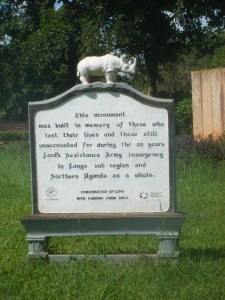
A monument to LRA victims in Lira town.

The LRA grew out of the Alice Lakwena’s Holy Spirit Movement, but incorporated other northern rebel groups in the aftermath of current President Yoweri Museveni’s rise to power. In the ensuing years, the LRA became more and more of a problem for the government, which reacted in two ways. Betty Bigombe was appointed as a government minister to deal with the insurgency in 1988, and she encouraged defections and established a dialog with the LRA. Meanwhile, the Ugandan military (NRA) launched Operation North, which included arbitrary arrests of alleged collaborators and attacks against LRA positions. In 1992, Bigombe set about creating Arrow Groups, village militias to defend against the LRA, but the rebels reacted with brutal attacks against civilians to discourage collaboration with the government.

In 1993, Bigombe decided to reach out to the LRA to begin the process of a peaceful resolution to the conflict. Talks began that November, with the LRA searching for blanket amnesty in return for disarming. During the peace talks, Gulu was incredibly peaceful and NRA leaders began taking part – but relations deteriorated as military leaders asked for surrender while LRA wanted integration.

LRA placed the talks on hold and NRA leaders grew more impatient, and in February of 1994 President Museveni suddenly announced in Gulu that the LRA had seven days to surrender. Attacks resumed almost immediately, and the LRA began to perceive the Acholi civilians as collaborators, leading to the rise of civilian casualties. Soon the LRA began establishing bases in Sudan, where they rearmed and stepped up attacks in northern Uganda, including the Atiak massacre. This was also the beginning of widespread use of abductions both as a tactic and for recruitment.

Civil War Expands: Displacement, Invasion, and Retaliation

The IDP camp in Kitgum, credit K. Burns, USAID.

In response to massacres like the one at Atiak and the high-profile abduction of the Aboke girls, the Ugandan government enacted a dubious plan to address the crisis in Northern Uganda – by corralling civilians into displacement camps.  The camps were ostensibly to protect civilians but in reality had little protection and scarce food, water, and sanitation.

The government of Sudan supported the LRA, in part as retribution for Uganda’s support of the Sudanese Peoples Liberation Army (SPLA), the rebel movement that would later help win independence for South Sudan. With this support, Kony and the LRA unleashed more violence against Ugandan civilians in the north while maintaining bases in southern Sudan, where they also attacked civilians on behalf of the government there. After the 1998 embassy bombings and even more after 9/11, the U.S. pressured Sudan for assistance in counter-terrorism efforts that also led to an agreement allowing the Ugandan military, now the Ugandan People’s Defense Force, to launch an attack across the border into southern Sudan.

The Ugandan military had just withdrawn from the DRC, where soldiers had looted the country’s resources and killed numbers of civilians during the Second Congo War. Many of these returned soldiers were sent to Sudan to take part in Operation Iron Fist. The results were disastrous: the LRA fled the attacks and slipped back into Uganda, carrying out reprisal killings at IDP camps across the region.

In the mid-2000s, the two sides were brought together for infrequent negotiations.  The Ugandan parliament passed an amnesty law that allowed some LRA to return home and a ceasefire zone was established, but talks ended when chief negotiator for the LRA Sam Kolo surrendered to the government. It was also during this time that the ICC investigated the LRA for mass atrocity crimes, eventually issuing indictments for the LRA leadership. Meanwhile, most rebel fighters migrated westward to the Garamba National Forest in northeastern DRC, where they settled as a new set of peace talks began in Juba, Sudan.

Leaving Uganda: The Juba Peace Talks, Operation Lightning Thunder, and the Christmas Massacres

From 2006 to 2008 the Juba Peace Talks [PDF] sputtered forwards with marginal ceasefires and the movement of the LRA to assembly areas for negotiations. While the LRA were gathered in the DRC, where they received food aid from Caritas (with support from several European governments) to keep them from raiding villages for supplies, however there were allegations that they secretly sold some of the food for arms. The two sides agreed to five main agenda items that they worked on when they weren’t threatening to leave the talks:

  1. Cessation of Hostilities included a series of short-term ceasefires, allowing northern Uganda to begin its recovery while negotiations continued.
  2. Comprehensive Solutions, which included issues of the national government’s institutional mistreatment of northerners and the resettlement and rehabilitation of IDPs.
  3. Accountability and Reconciliation was one of the biggest issues that forced the talks to be put on hold several times. Eventually, they agreed on a hybrid system that included a truth-telling mechanism and reparations for victims along with the creation of a human rights branch in the High Court of Uganda and the removal of the LRA from Ugandan terrorist lists. The issue of the ICC was somewhat vague, but both sides seemed willing to accept an end to the conflict in exchange for withdrawing warrants.
  4. Permanent Ceasefire was signed in early 2008,  assigning a battalion of SPLA soldiers as ceasefire monitors once the final peace agreement was signed.
  5. Disarmament, Demobilization, and Reintegration required the Ugandan government to address the ICC issue and allow LRA fighters to reintegrate into the national army. Those not willing to join the army agreed to disarm, and child soldiers would be supported through reintegration and educational programs.

In 2007 there was progress on the issue of accountability and reconciliation, but this progress was tainted by rumors that Vincent Otti, Kony’s second-in-command, had been executed after a power struggle within the LRA. Despite this, the two sides reached agreement on accountability in terms of alternative forms of justice, but the question remained of whether the ICC would drop its warrants in exchange for a peaceful resolution to the conflict. Kony refused to sign the final agreement until the indictments were lifted, and Uganda refused to apply to try war criminals under complementarity until after the LRA disarmed. The talks collapsed in April of 2008, with several failed attempts to reconvene throughout the summer, along with reports of LRA attacks in rural South Sudan and the DRC.

It was against this backdrop that the UPDF launched Operation Lightning Thunder, an attack coordinated with the DRC and South Sudan with intelligence and logistics support from the U.S., in December of 2008. The attack routed the rebels, who anticipated the attack, but failed to lead to the capture of any leaders and freed a minimal number of abductees. In response, the LRA set in motion what has been dubbed the Christmas massacres. In a coordinated attack across several towns and villages in the DRC, the LRA massacred hundreds of civilians and abducted around 100 more.

Since then, the Ugandan force was kicked out of the Congo in early 2009 due to international disputes, and the ill-equipped Congolese military has continued the charge against the LRA there.  The UPDF halved its LRA-hunting force in order to step up its presence in Somalia as a part of the peacekeeping force there, AMISOM, and the forces that remain on Kony’s tracks are ill-equipped for a manhunt.  The LRA, according to the LRA Crisis Tracker, have shifted further west and north to ungoverned spaces in CAR and DRC.
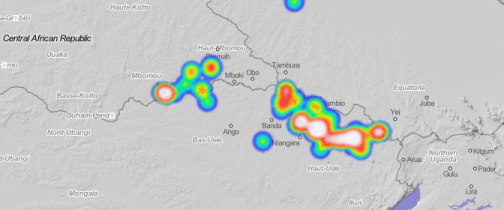
LRA attacks and sightings in 2012, to date. via LRA Crisis Tracker.

More recently, the US sent military advisers to the region in October of last year, and the African Union has nominally stepped in to create a multinational, Ugandan-led force. The hunt for Kony seems to be active in CAR, DRC, and South Sudan with some US advisers based in Uganda while others work in the field (reportedly setting up a base in Obo, CAR).  Civil society groups both locally and in the US have called on the forces to ensure the protection of civilians from retaliatory attacks and have put forth efforts to encourage LRA combatants to disarm and come home. As Paul Ronan points out, however, Uganda’s Amnesty Act is set to expire this year, which could have dire consequences for the effort to convince rebels to return.

The Way Forwards

The multilateral deployment continues its hunt for Kony.  As Patrick Wegner explains, the mission has had some success in reducing the amount of attacks carried out by the LRA in late 2011 (although this could be an LRA tactic since attacks dropped after a meeting between LRA commanders supposedly occured), but has accomplished little so far as capturing Kony and has failed to protect civilians in remote parts of the DRC.

The history I just bulldozed through shows that a military plan is not foolproof. But it also shows why many remain skeptical of a peaceful solution. Historically, the Ugandan government has alternated between negotiations and military incursions, and the LRA have used peaceful time periods to rearm and regroup. When the Juba Peace Talks fell through, the LRA had rearmed and the Ugandan government had given up on waiting for Kony. We are currently seeing lower hostilities committed by the LRA, but they may be regrouping once again.

Ever since the peace talks failed, groups like Resolve have looked at the option of a military apprehension of Kony that can effectively end the LRA. As Resolve recently stated, they are not opposed to a peaceful resolution. Indeed, if the LRA and relevant governments can reach a peaceful and legitimate agreement that addresses grievances of victims and leads to an end to the conflict, it would be a huge step towards pacifying the area and rehabilitating abductees, and it would avoid putting abducted soldiers and innocent civilians in danger. But if disingenuous, negotiations could lead to an impatient military attacking a rearmed rebel group again.