“Dr. No” Got the Message

Roughly a year ago, when local lobbying was at its height for the LRA Disarmament and Northern Uganda Recovery Act, the bill’s co-sponsors tried to pass it by unanimous consent.  With more co-sponsors than any Africa-related legislation in modern American history, it was a good idea.  And then Tom Coburn stepped in.  Known for blocking everything that costs more than a penny for Congress, Coburn had decided that the LRA bill would be one of his many stands.  He he blocked a bill with bipartisan support from the country at large, including his state’s senior senator , and thousands of his constituents.  Needless to say, grassroots organizing got a move on.  Quite a few of my friends, from across the country, held a vigil in front of his Oklahoma City office 24/7 until he took the hold off.  All told, the vigil lasted eleven days before a deal was reached, and the bill passed the Senate the next day.

Dr. Coburn was in the news again this past week for being one of the more vocal opponents to the 9/11 health bill.  The bill would have compensated a number of first responders who were suffering from health problems related to 9/11 and the rescue efforts that followed in the rubble.  After Jon Stewart hosted a number of first responders on his show to call out opponents, the general populace started getting up in arms about it (including Rudy Guiliani and Mike Huckabee).  After all the uproar, Coburn finally decided to give in (after bringing down some costs, obviously).

I’m all for being careful with money and watching where the government spends money, but Coburn has gone to the extreme. He also blocked aid to Haiti after the earthquake there, among other hot topic blocks.  It seems like he always needs a level of shame before he’ll back down.  I hope he gets smarter about where he chooses to put his foot down in the future. It’d make government work a little better, which – according to Coburn – has been his intention all along.
Remembering December

In early 2008, the Juba Peace Process between the Ugandan government and the Lord’s Resistance Army failed.  In December of that year, a joint offensive by Uganda, the DRC, and South Sudan invaded the LRA’s hiding place, dispersing the rebels.  It was a messy, ill-advised attempt at apprehending rebel leaders and freeing abducted civilians.

On Christmas Eve, the LRA lashed out at the local population, destroying whole villages. In the ensuing month, as reported by a number of news papers and human rights groups, the rebels killed at least 900 people and abducted at least 160 children.  They rounded up villagers who had been celebrating Christmas, tying them up and killing them with clubs, axes, and machetes.  A number of women were raped and whole families burned.  In the following year they would kill over 1500 and abduct over 3000, 700 thought to be children.

In December of 2009, the LRA issued a warning – saying they would celebrate Christmas with the people of the region. On December 14th, to celebrate the one-year anniversary of the military incursion, the rebels lashed out again, attacking a number of villages and towns in eastern DRC.

This is a blog post I’ve been meaning to write for a week or so.  It’s about something that has me worried.  It’s December.  It’s almost the two-year anniversary of the beginning of hostilities and one-year anniversary of the 2009 attacks, as well as the two-year anniversary of the Christmas Massacre.  Who knows what the LRA are planning this year?  Having spent a good four years learning about this conflict, and having met a number of victims in Uganda effected by the LRA, I’m worried for the people of the DRC, CAR, and Sudan.

On this subject, the Obama administration’s LRA Strategy was released almost two weeks ago, and I’ve been reading and reviewing it.  I’ll put up a praise/critique soon, hopefully. After two years of relative peace from 2006-2008, these past two years have been pretty brutal for the people of east-central Africa.  I’d like to see it end.

A Campaign Deferred

In April of this year I met with a number of like-minded individuals at Arizona State University.  By like-minded, I mean people who are concerned about social justice and human rights.  We had a vision of linking our student organizations – interests like women’s rights and fair trade, LGBTQ equality and anti-genocide came together.  Our primary goal was to establish something ASU didn’t have, but that we thought it needed: a Committee for Socially Responsible Investing.’

A number of universities have these committees.  They’ve manifested themselves in different structures and with different goals.  One early and prominent campaign was the campaign to cripple the South African regime through divestment (which started in the US with the Sullivan Principles and in universities with Stanford).  Recently there has been a push to divest from companies like PetroChina that do business with Sudan, a frequent human rights abuser.  Currently a number of universities have begun the controversial but justified effort to sever ties with the aggressive and abusive Israeli government.  Yet ASU does not have a committee to oversee what money is spent on.  There is definitely no one looking over the Fulton Foundation’s investments.

So we established the ASU Coalition for Human Rights.  And we drafted a proposal.  And we began meeting with Vice President for University Student Initiatives Dr. James Rund.  We began making progress.  I was among four students in a meeting with Dr. Rund at the end of September.  We spent the better part of an hour debating the need for a committee and the trend of social responsibility that ASU is missing.  We began debating the structure of such a committee – who would serve on it? how would the Coalition be involved? would the committee’s decisions be binding? It was at this point that I turned to Dr. Rund and asked, bluntly: “So, are you saying that you support the creation of a committee, but want to debate the structure of it?”  To which he casually responded, “I’d say yes, yes I am.” We later adjourned the meeting and agreed to speak with Student Government’s Council of Presidents on the issue and come back to Dr. Rund.

Last week, a number of my like-minded peers met with Dr. Rund.  Just weeks after telling me that, yes, yes he supported the idea of creating a committee, we were told that the committee was a bad idea.  We were challenged not only on the structure of the committee, but on the structure of the Coalition itself (we had recently voted down an application from a political student organization on the grounds of the Coalition being apolitical and purely human rights-oriented) and even on the premise of the necessity of such a committee.  We were told that, if there is a question of ASU’s investments, feel free to bring it up with ASU’s leadership.

A lot of our success has been curbed, but we’re not stopping.  ASU has not yet made an official proclamation to have sweatshop-free merchandise (although ASU did cut its contract with Russell Athletic over labor disputes, which deserves some applause).  ASU has not taken a stance in making sure its electronics are audited to be conflict mineral-free.  The Fulton Foundation’s finances have not been made public, so I personally have no idea if my tuition dollars are indirectly supporting genocide in Darfur now or election-disruption in South Sudan in January.  Who knows where that money goes?

I still have hopes that my university will take a step forward.  I have hopes that our organization will be able to keep the pressure on until a permanent Committee for Socially Responsible Investing is established at Arizona State University.  Let’s keep this going.

Tweeting the Revolution (or at least the Rescue)

The internet has been pretty a-buzz over Malcolm Gladwell’s recent article in the New Yorker.  It’s called “Small Change: Why the revolution will not be tweeted” and it’s generated a lot of backlash.  Gladwell’s main argument is that modern social networking – through Facebook and Twitter – won’t translate into revolutionary social activism.  He points primarily to the differences between strong ties and weak ties and what type of actions each tie generates.  His primary focus is the sit-ins in Greensboro in 1960 and he contrasts that to a recent online campaign to get people to register as bone marrow donors.

So far, I’ve only read a few responses.  Angus Johnston provides a critique that follows the 1960s activism theme by contrasting SNCC with SDS and showing the strength of weak ties in organizing.  Patrick St. John did a pretty good job of showing how effective decentralized non-hierarchical networks can be. There’s also a good article at Wired that provides some great evidence as to why weak ties are useful for organizing.

I just wanted to provide a short contemporary example that hasn’t been added to the deluge of responses.  For years I’ve grown a number of weak ties with friends across the country for an idea that few others share: that a war in a far off place can end with our help.  It was called The Rescue. In April of 2009, we tweeted and facebooked our way to tens of thousands of people attending events simultaneously in 100 cities.  Some of my friends whom I convinced to initially show up were weak-tie friends.  And when the Phoenix event closed up shop and people caravaned to Albuquerque (then Wichita, then Chicago) the weak ties kept me updated as to what was going on.  Peruse the #therescue hashtag.  Watch “Together We Are Free,” the film about how The Rescue played out over six days and brought 500 people to Chicago.  Most of the Rescue Riders started off as weak ties and grew stronger.

Now, spending a week living on parks, vans, and church gyms is one thing.  Changing the world can be a bit different, I know.  But the attention that peaked with the Rescue carried into something huge.  A year-long local lobbying effort led by young people started off with the biggest Africa-related lobbying initiative in Washington history and culminated with the most widely co-sponsored Africa-related bill in modern legislative history.  And since the LRA Disarmament and Northern Uganda Recovery Act passed, we are anxiously awaiting the Obama administration’s response.

As one of the ones who abducted himself, I say that weak ties have power.

Whistleblowers

Last week, I was told to blog.  Blog to get the word out.  Blog to spread awareness.  Blog for peace.

Last week, Sean Carasso, the founder of Falling Whistles came to ASU to speak.  We had a packed room, and it was really great to finally hear from him (last year I tried to get the FW Bike Tour, a trio including my friend Seth that was biking from St. Augustine, FL to San Diego, CA, to come to ASU – but they ended up going through Tucson).  Sean started the story by talking about his work with Invisible Children and TOMS Shoes, then dove right into his trip to the DR Congo.

After spending a couple of days trying to find out more about the conflict(s) in the DRC, Sean made his way to an army camp.  At the camp, a number of children were imprisoned for being enemies of the state – they had been kidnapped by rebels and forced to fight.  Talking to the children, Sean found out about an even more grave situation.  Some of the abductees were too small to carry guns and help the rebels.  They were given whistles and told to blow them during the charge to try to frighten the enemy – if they were killed they would be used as shields by the rebels.  This sent Sean on an immediate course to find out why the conflict was continuing and how to end it.  It turned into Falling Whistles soon after.

Hearing Sean speak was really interesting because he talked about his actual experience in the DRC and his experience trying to start the movement Stateside.  At the heart of this conflict is minerals – chief among them is tungsten, tin, tantalum (three Ts) and gold.  I’ve been following the conflict minerals stuff for a couple of years, but this semester I’m taking a class on environmental conflict and we’ve been talking a lot about resource conflicts – the DRC is the best example.  Those minerals are used in virtually all electronics.  So, how do you keep one of the largest deposits of important minerals from being used in our electronics?  How to you constrict the funding of rebel groups?

It is ridiculous to propose to this generation a boycott of laptops and cell phones.  Maybe a clothing company, maybe a car company.  A whole industry – and the one that we’re most intrinsically connected to?  Nah.  But, Sean touched on a great way to fight back.  Use them to end the war too.  If these minerals go into cell phones and laptops, you can use those same things to foster a movement that could actually do some good.  Use their weapon as yours.  It’s a notion embodied by the whistles that Falling Whistles sells to fund child rehabilitation in eastern DRC.  Their weapon.  Your weapon.

Conflict minerals legislation passed this summer in Congress as a part of Wall Street reform.  It’s hardly the end of the road.  Soon the details of the legislation will result in recommendations, and then the recommendations have to be analyzed and carried out.  Ultimately, hopefully, companies wanting to sell electronic goods in the United States will have to be able to provide independent audits that prove that materials did not come from rebel-held territories. I can only hope it’s more comprehensive than the Kimberley Process.  The solution to blood diamonds has largely been a piecemeal plan that relies on the honor code – but diamonds are a whole other monster thanks to DeBeers.  However, conflict minerals are serving a similar purpose to diamonds in Sierra Leone in the ’90s and – gasp – the DRC too.  An effort to limit the prevalence of conflict minerals in the market could keep our products clean from violence and maybe lead to the end of a war.

Update: If you’re worried that conflict minerals legislation will make our precious electronics go up in price – don’t worry.  Some companies have already stated that the auditing process in the legislation would raise prices of each product by about a penny.

From Promise to Peace

A few months ago, President Barack Obama signed into law the LRA Disarmament and Northern Uganda Recovery Act.  It was a piece of legislation that I had spent almost a year pushing for through local lobbying and organizing.  I think most of you can remember my excitement when the House finally passed the bill. In total, I attended seven or eight lobby meetings and made dozens of phone calls before it was finally passed.

Three months later, it looks like I’m back at it.  Included in the law was a mandate that, in 180 days, the Obama administration draft a strategy of how the United States would assist in apprehending the LRA leader Joseph Kony.  Upon signing the bill into law, the President stated that the U.S. was dedicated to this mission.  Soon after, Secretary of State Clinton said much the same thing.  Since then, not a word – and there’s only 70 days left.

Resolve Uganda is about to launch a campaign to keep pressure on the Obama administration from putting together a piecemeal strategy.  If this law is going to do anything, it needs to be a comprehensive plan.  Last week I met with the District Director at Rep. Harry Mitchell’s office and urged my representative in the House to state that he would read and review the strategy.  I’m trying to muster some support for an end-of-month meeting at the office of my former representative, Jeff Flake.  Hopefully, we can keep the pressure on or else this year of lobbying will have amounted to little.

Rotaract: Uganda Style

So, in the move to Lira I forgot to post about my experience with Rotaract! The night before I left I went with Morris to the Makerere University Rotaract Club’s installation (where they inaugurate the next year’s officers).

I have spent 2 1/2 years in the Rotaract Club at ASU. I’ve been involved with Rotary, Rotaract’s parent organization, since I was born. My dad has been an active member in Rotary for years and I can’t count the number of meetings I’ve attended and the number of fun events in which I’ve been involved.  It was nice to see the work of a club in another country.

I met a lot of great people, hanging out and having drinks before we all sat down for the big night. The departing President gave a speech and talked a lot about how Makerere had moved forward in the passed year, and the incoming President gave a long speech in which he described Rotaract, and I think rightly, not just as a project of Rotary but also as a partner.

After the speeches there was some downtime in which one of the officers asked trivial questions and gave out airtime for rewards. I won 2000 UGX for knowing the club’s web address! Thank goodness it’s in Morris’s e-mail signature :)

After some free time we started dinner, and it was a sizeable sum of pasta and meats with some traditional food mixed in.  Morris and I left soon after dinner as people started dispersing to different afterparty parties. On the way out I met, who would have thought, a college student who will be going to ARIZONA STATE this fall. How weird is that?

Anyways, the whole affair was much more like a Rotary Club induction than anything Rotaract Clubs, or at least mine, do. We have an annual benefit dinner in the spring and we usually use that time to introduce the incoming President.  I’ve been to a couple with my dad for his club and what I saw in Kampala was reminiscent of  that.  All in all a fun night!

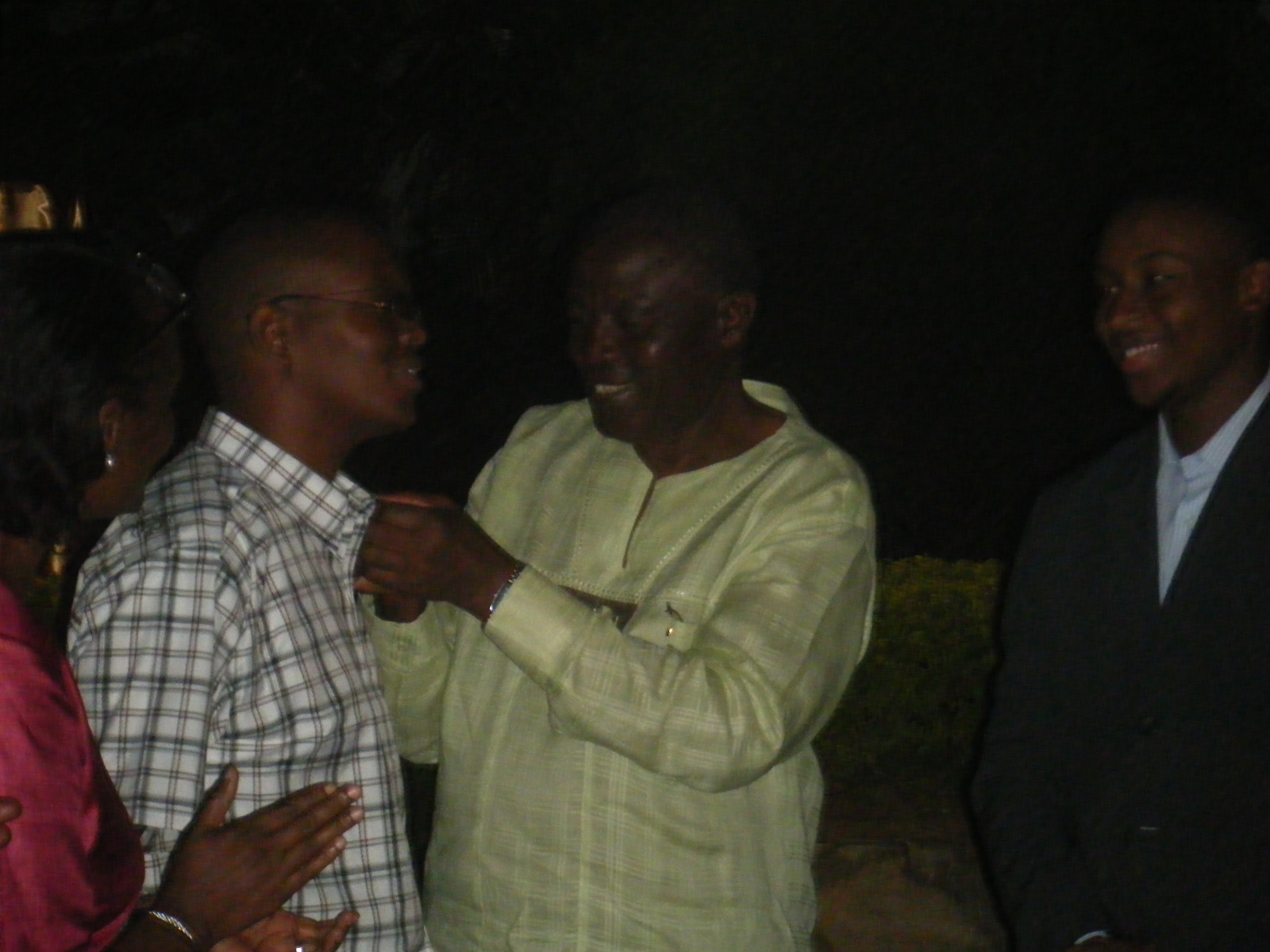
The President of a local Rotary Club putting a pin on the incoming Rotaract President
Morris receiving recognition for networking with Interact, the younger branch of Rotary.

Morris and a blurry me.

Without Objection

Yesterday evening, the United States House passed the Lord’s Resistance Army Disarmament and Northern Uganda Recovery Act of 2009.  I was at home watching C-SPAN and was elated to hear it pass.  A number of representatives made statements on the floor about the atrocities carried out by the LRA, including all of the original co-sponsors and both the chairman and ranking Republican of the Foreign Affairs Committee.  In theses statements, several representatives mentioned the work of advocates and activists.  And boy it’s been a long haul for a lot of the people I know.  Invisible Children made a sweet video breaking down everything I’ve written here, so feel free to get some visuals. In April of 2009, nearly 100,000 activists took to the streets in 100 cities around the world for a campaign that ended six days later in Chicago.  In May, Senators Russ Feingold (D-WI) and Sam Brownback (R-KA) introduced the bill, and a piece of partner legislation was introduced in the House by a trio of representatives.  A month later, 1700 activists descended on Washington, DC for two days – the most for any lobbying initiative.  The months since have been dotted by district meetings all over the country, and slowly the support trickled in.  In addition to lobby meetings, over 250,000 signatures were gathered for the Citizen’s Arrest Warrant for Joseph Kony and were hand-delivered to the State Department.  When Senator Tom Coburn tried to block the bill from passing in the Senate, a grassroots campaign led to activists sleeping outside of his office for 262 hours until he removed his hold (and the bill passed with unanimous consent). The bill gained the support of 65 Senators and 201 Representatives, the most of any policy bill in this session and the most for any Africa-related bill in either chamber in modern American history.  And on Wednesday it passed the House by voice vote and without objection. If you want to know more about what this means (and doesn’t mean), my friends at Resolve Uganda put together a break-down Q & A and John Prendergast wrote an article for Huffington Post about the bill as well.  The main thing you should know is that it will soon become law for the US to help apprehend Joseph Kony.

UPDATE (5/14) – Kim and I totally saw an Invisible Children ad on TV last night.  Totally weird, totally cool.  If you get Halogen.tv you should check out all of the IC films they’re showing. :D

UPDATE (5/15) – A couple more links for everyone! Senators Russ Feingold, Sam Brownback, and Jim Inhofe, together with Representatives Jim McGovern and Ed Royce issued a joint statement celebrating the passage of the bill that you can read here.  And, props to Resolve Uganda are in order.  The organization called for supporters to ask for statements from their representatives.  Their goal was five (only about 10 have made statements on this issue in the past ten years) and by the time the bill came to a vote fifteen statements had been made.  You can see a full transcript of the statements on Resolve’s website.

Social Consciousness

So, I haven’t posted in ten days.  What a slacker!  I will make up for it by posting a thousand times this week*.  It’s been a busy few days.  I’m waste-deep in schoolwork, trying to figure out the logistics of getting myself to Uganda, and trying to move forward in wedding planning.  I think a few blog posts will be forthcoming to address all of the recent events.  The first of which will be a post which I am very proud to write.

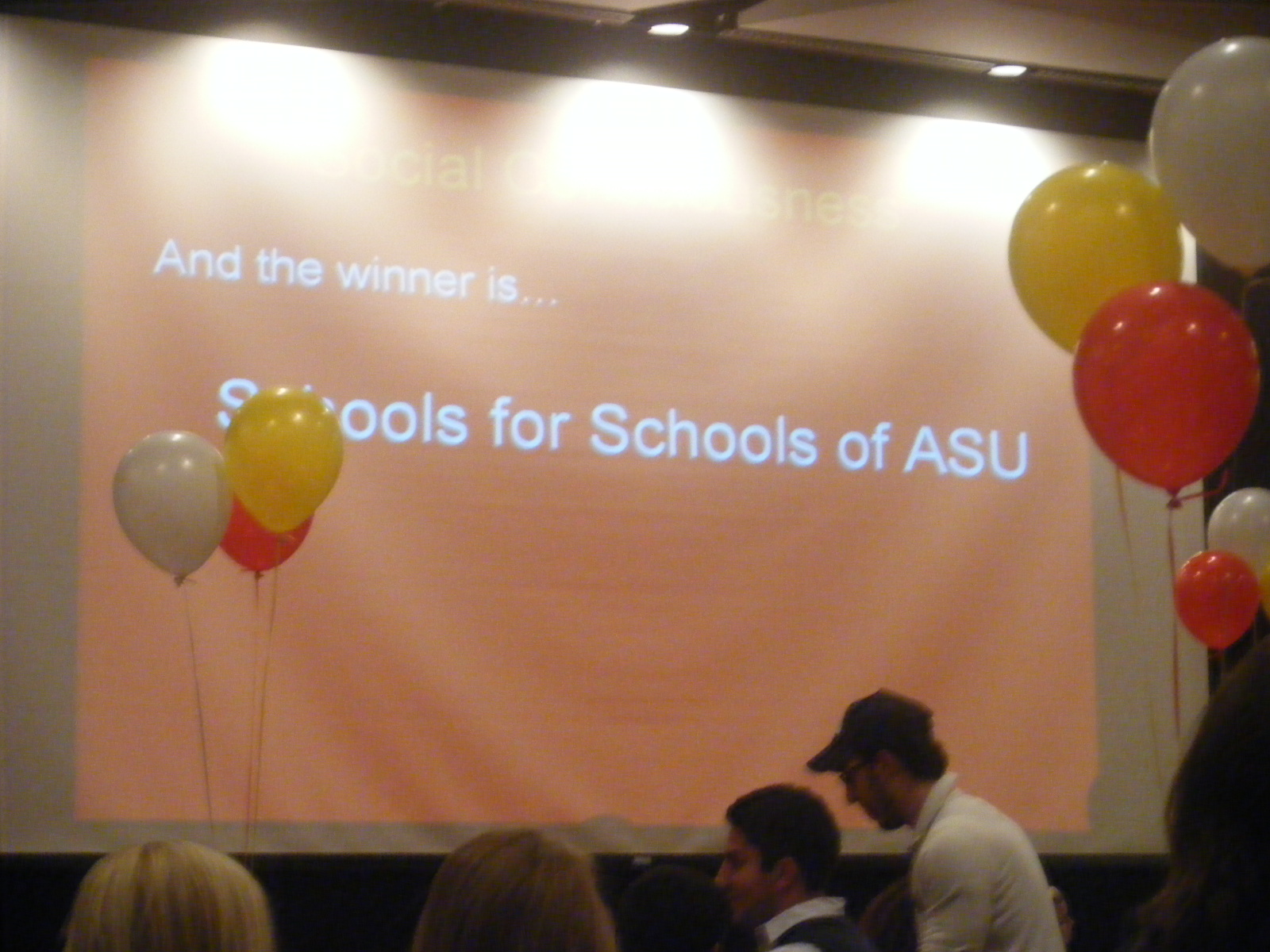
In September of 2007, I started a student organization to help end a war.  Lofty ambitions, I know – but it all began with raising money to rebuild a school.  Each spring, Arizona State’s Student Organization Resource Center (SORC) holds a Hall of Fame awards event honoring some of the clubs on campus.  I’ve thrown our name in the mix every year, mentioning camp-out events and national conferences, fund raisers and educational screenings.  Each year, I’ve nominated us for the Social Consciousness Award, and each year we haven’t even been mentioned.  But this year?

This year our bullet points looked pretty damn good: we contributed to the Rescue, How it Ends, Schools For Schools, the Hometown Shakedown, the Legacy Tour, and our own lobby days.  I had high hopes at the award ceremony.  I was talking to the guys at my table – part of a society for business majors – and they wished me luck.  I was listening to what the other groups had done and, albeit great work, I was convinced that we were going to win this year.

WE WON!  I was so ecstatic to be recognized!  I marched on up there, probably with a goofy smile, and accepted a fancy framed certificate.  It was a good feeling to hear my club’s name at the awards ceremony.  Thinking back, the past year’s work has included the help of soooo many people and I appreciate it so much.  Looking forward, I hope that we can keep it going and run again next year.  Talking with club members and supporters from the community, I think we’ll be able to keep up the work.  I guess the work starts now?  Let’s go!

*1000 = 2 or 3, probably.

Victory.

Big news for my friends in Oklahoma and across the country, as well as for us here in Arizona.

On March 9th, 41 days after he put a hold on the bill and 262 hours after activists began camping outside of his district office, Senator Tom Coburn from Oklahoma released his hold on the bill.  Just a few hours later, it passed the Senate with unanimous consent.  The compromise they reached was pretty simple – changed some language to make it more direct that the $40M would be offset and not add to the deficit.  Coburn sticks to his principle, we stick to ours.  So, so excited to see this go through the upper house.  Now we just need to turn to the House of Representatives, where we only have 162 co-sponsors so far.

Speaking of which, here’s the personal victory.  In June my friends met with Representative Harry Mitchell’s staff in DC.  I’ve met with his staff twice here in Tempe.  After all of this, my friend Kristi met him at a fundraiser and mentioned the bill – he said he had never heard of it.  Demoralized, I sent a few follow-up e-mails to his staff and voila!  He co-sponsored yesterday!  I’m such a happy camper right now.  Nationally, we passed the bill in the Senate and my friends in Oklahoma managed to do the unthinkable.  Locally, a few good friends and myself put this obscure African bill on the desk of our representative and convinced him to put his name on it.  It’s a good day for activism.

I want to leave you with a little evidence of how commited people are.  The circles are the homes of people who ended up in Oklahoma City for 262 hours in the rain.

The Hold Out came from all over! (Picture by Rachel Bryan)