Dealing with Hate

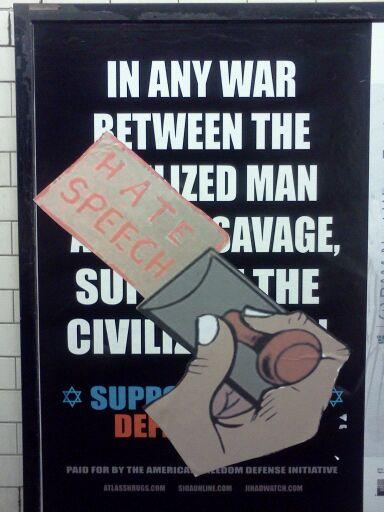
By now you’ve probably heard about Pamela Geller and her American Freedom Defense Initiative, which bought ad space in New York City that many have called hate speech (because it is). Earlier this month New York’s Metropolitan Authority was forced put up the ads, which a court ruled were protected under freedom of speech (indeed it is). The ads read “In any war between the civilized man and the savage, support the civilized man.  Support Israel. Defeat Jihad.” Earlier this year, the same group put the same ads on buses in San Francisco. Both situations have brought forward the number of ways to respond to free speech used in hateful ways. When hate speech is used, and critics call it such, the defenders of hate routinely argue that you can’t infringe upon their right to free speech. This is true, but the conversation doesn’t stop there. The First Amendment goes both ways, and there’s a diversity of tactics to respond to hate speech. The so-called “anti-Jihad” ads have shed light on just a few ways to shout down hate speech.

This Monday, New York’s MTA put up the ads in ten places throughout the city. Almost immediately, street artists took up the task of marking the posters for what they are, labeling them “hate speech” and “racist.”

Photo originally posted at Mondoweiss.net

Photo originally posted at Mondoweiss.net

Not long after that, Mona Eltahawy embarked on a quest to spray paint over one of the posters when a woman with a camera stood in the way, creating a weird scuffle of paint and yelling that ended in Eltahawy’s arrest.

Photo from the New York Post.

Last month, San Francisco’s saw a very different response. The SFMTA announced that any proceeds from the AFDI ads would go to the San Francisco Human Rights Commission, and subsequently put up their own ads to complement the hateful posters. The new ads read “SFMTA policy prohibits discrimination based on national origin, religion, and other characteristics and condemns statements that describe any group as ‘savages.'” They are posted on the same buses as the AFDI ads, and there’s a big arrow to make sure everyone understands what they’re talking about.

Photo by WarzauWynn

The First Amendment guarantees free speech, but it doesn’t shield you from criticism or from others speaking against you. I think a lot of us can agree that the ads should be allowed to go up and still be absolutely elated when they’re graffitied, covered, and mocked. SFMTA and the activists in New York called the ads what they are: hate speech. And they have the right to do so. To paraphrase Maryam Monalisa Gharavi, in any war between hate speech and stickers/spray paint/counter-ads, support whatever the hell isn’t hate speech.

Who’s in Their Corner? Obama and Chicago’s Picket Line

Senator and Presidential hopeful Barack Obama, in November, 2007:

“Understand this: If American workers are being denied their right to organize and collectively bargain, when I’m in the White House, I’ll put on a comfortable pair of shoes myself. I’ll walk on that picket line with you, as president of the United States of America. Because workers deserve to know that someone’s standing in their corner.”

That didn’t happen in Wisconsin. Or Indiana. Or Ohio. Chicago’s teacher’s aren’t in a showdown over collective bargaining so much as larger class sizes and longer days with less pay, but the question remains: do teachers deserve to know that someone’s standing in their corner?

KONY2012: Six Months Later

It has been six months since Invisible Children’s viral video, Kony 2012, hit the internet.  From getting over 800,000 views in its first 24 hours, the video went on to 100 million views in a week, becoming the internet’s most viral of viral videos and launching Invisible Children and its cause into the spotlight.  Six months later, the attention on the Lord’s Resistance Army has died down, but the campaign continues to plod along.  Where is Kony? Where is Invisible Children? And what has the world’s biggest humanitarian viral video campaign achieved so far? This post aims to look at Invisible Children’s history to explain Kony 2012’s impact, and to look at what exactly that impact has been.

Kony 2012 was the fastest-growing online video in history.

Some are rightfully skeptical that Kony will be captured by the 2012 deadline in the film.  The more pessimistic will say that Kony is no closer to being captured than he was six months ago, and that things haven’t really changed. The LRA’s disparate brigades continue wandering the Democratic Republic of Congo, Central African Republic, and South Sudan, with rumors that some troops, including Kony himself, have sought haven in Sudan, an old ally.  Rebounding from a piecemeal turnout for Kony 2012’s subsequent “Cover the Night” campaign, Invisible Children has moved on to other campaigns.  The San Diego-based non-profit is sending out its fifteenth tour of roadies, interns tasked with showing IC films to audiences at high schools, churches, and community centers across the country.  Their programs on the ground in Uganda and the DRC continue to serve war-affected communities.  But the fact is, things have changed, and to truly see how things have moved in the past six months you have to look back a few years. Continue reading

Thoughts on Invisible Children and WikiLeaks

Earlier this month, Black Star News sifted through the WikiLeaks cable database and uncovered some evidence that Invisible Children may have handed information over to the Ugandan government that led to the arrest of a member of the opposition. I have been refraining from writing about this until more information comes to light, but it seems that everyone is remaining silent, so now’s as good a time as any to reflect.

According to the cable, Invisible Children gave information to the Ugandan government concerning a Patrick Komakech, a former LRA abductee whom the government alleged was a part of a plot to create a new rebel group, the People’s Patriotic Front. Komakech was a recipient of IC’s aid at one time, and was arrested by the police and charged with treason.

According to an article in The Monitor, both the Ugandan military and Invisible Children deny that the exchange of information ever occurred. In an e-mail to Foreign Policy, a representative for IC stated that they were “cooperative in providing information to the US Embassy regarding the nature of our relationship with and academic support to Mr. Komakech [after the US Embassy contacted IC about him]. In light of the severity of these allegations, the organization severed all ties immediately with Mr. Komakech.” But the statement emphasizes that there was no IC involvement in his eventual arrest, nor does it acknowledge any involvement with the Ugandan government, only the US embassy.

Since virtually everyone involved in Uganda knows the government tends to unjustly crack down on opposition figures, it’s curious how quickly IC separated themselves from an LRA survivor that was a beneficiary of their programs and services. But what actually transpired still seems pretty murky, and a number of questions still need to be answered. If Komakech was indeed involved in planning any sort of violent actions, it would be understandable why IC would want to wash their hands of him. They would be getting as much criticism for aiding a rebel-in-the-making as they are now for indirectly supporting the Ugandan military. If we take this cable to be true, and IC did give information to the government of Uganda, we need to ask more questions. Who approached whom about Komakech? And whose decision was it to pass information to the government (or not)? Did anyone confirm or at least investigate the government’s allegations?

Without getting some answers, I would still refrain from joining critics saying that IC pledges blind support to the Ugandan government. While the efforts of IC and their partners have directly led to increased US funding, training, and arms to the UPDF, it’s worth noting that IC isn’t unaware of government abuses, even if it wasn’t prominent in Kony 2012. When I saw IC co-founder Laren Poole speak in San Diego in 2007, he came incredibly close to calling the IDP camps in northern Uganda a genocide, and the Sunday bracelet video is almost exclusively about the poor conditions in the government-mandated displacement camps (you can find out more about the camps at Justice in Conflict, where Patrick Wegner looked specifically at the genocide question). More recent videos have been specifically about the effects of the contemporary LRA attacks in eastern DRC and CAR, events that so far haven’t been host to UPDF abuses (for the most part).

While the verdict is still out on the Komakech controversy, and it will be important to continue watching how current operations go in the region, I don’t think I would call this a fatal blow to the movement. With a rogue rebel group in survival mode and a growing force looking for it (now with the AU label), the situation will definitely continue to be something to monitor as the advocacy-for-peace-and-justice-through-military-means path marches on.

Stop at Nothing, but Read First

Tonight, countless activists will descend on their cities with community service and a ton of posters invoking a campaign to capture Joseph Kony. It will be the answer from the masses to the call to action at the end of the Kony 2012 video that Invisible Children premiered in early March, and I expect – in many cities – it will be pretty big. I know of dozens of friends across the Phoenix area that will be doing something to mark the occasion. I personally won’t. As I’ve mentioned before, I think that passing a widely cosponsored bill and getting advisers sent abroad means you’ve got awareness on your side already.

I’m taking action in a different way. Earlier this week I joined a number of students and adults in meeting with the district director of my Congressman. We talked for almost an hour about Joseph Kony and the role the U.S. can play in the region. We discussed support for a House resolution confirming support for President Obama’s deployment and a resolution to expand the Rewards for Justice program. After 6 years of learning about this conflict, it’s the best way for me to take action.

The absolute best way to get involved in any cause, though, is to learn about it. Once you do your homework, you can choose how best to insert yourself into the movement. There is tons of reading to do on this particular campaign, thanks in part to the vast expanses of the internet. More recently, an informed volume of essays has been collected by Amanda Taub of Wronging Rights fame, and its available in an e-Book. Go have a look at Beyond Kony2012: Atrocity, Awareness, & Activism in the Internet Age. I’ve only just started reading, but it offers brief but in depth history and analysis of the conflict as well as informed critiques about the campaign, and it’s downloadable in all sorts of formats at whatever-price-you-can-afford. If you want to learn about the cause – whether you’re a critic or a supporter – it’s a good place to start.

Weekend Reading: #KONY2012 Edition

A tinge of humor before you read fifty articles about atrocities and development.

Earlier this week, I put together a post on Invisible Children’s new campaign and video, Kony 2012.  It’s gotten a huge amount of readership, which this humble blogger is very proud and thankful for.  Since the whole of the internet joined in what turned out to be a huge debate over both the issue of LRA disarmament specifically and Invisible Children as a whole, I began gathering links to anything I thought was worth reading. The list has gotten a bit bigger than I expected, so I’m re-writing everything here in what I hope to be a more digestible format as an early edition of the weekly reading feature.

Reporting

  • “Stop Kony, yes. But don’t stop asking questions,” by Musa Okwonga at The Independent.
  • UN Dispatch has a two-sided post on sensationalist vs. savior.
  • The Wired’s Danger Room gives a quick look of Kony 2012.
  • A blog post at the Washington Post covers the debate.
  • Michael Dreibert gives a succinct history of the conflict.
  • The Guardian has a long live-feed of updates on the debate.
  • NPR asks if the campaign will actually work.
  • The Guardian has an article including an interview with Jacob Acaye, one of the children featured in IC’s original video, as well as criticisms from Victor Ochen, who runs a great youth rehabilitation center in Lira.
  • The Monitor, an independent newspaper in Uganda, has this report that includes support from the UPDF but a criticism from former Gulu Mayor Norbert Mao – who has worked with IC in the past.
  • The New York Times’ Room for Debate features a number of important voices on the Kony 2012 campaign.

Critiques

There are a number of critical takes on both the Kony 2012 campaign and on IC itself as an organization:

Kings of War has a critique on the military side of the campaign.  African Arguements has a piece up by Angelo Izama about the video’s misrepresentations. A guest post at FP by Michael Wilkerson criticizes the video’s apparent inaccuracies; Wilkerson also wrote about it at The Guardian.  Elizabeth Dickinson writes about the moral conflict of the campaign as well as comparisons to the Darfur advocacy campaign.  Global Voices has a collection of Ugandan criticisms of the Kony 2012 campaign. And here’s another look at the backlash of the campaign. Max Fisher at The Atlantic has a good article criticizing the video as well. An FP article explains that the danger of troops being withdrawn might be unfounded. Adam Branch at the Makarere Institute for Social Research thinks IC is a symptom of US actions and doesn’t affect things on the ground. Timothy Burke questions the goal of Kony 2012’s direct action.

TMS Ruge wrote specifically about how the narrative denies agency to Ugandans. Africa is a Country has a post lambasting IC co-founder Jason Russell and Kony 2012’s white savior narrative.  Amanda and Kate from Wronging Rights wrote a piece at The Atlantic – also they made a drinking game.  Teju Cole tweeted a short burst of criticism against American sentimentality. There’s also a fun, satirical interactive map.  This article in the CS Monitor touches on the need to reach out to African groups. Alex de Waal argues that elevating Kony to “make him famous” isn’t the right way forwards. There is also an article on Kony in the real world.

In Defense

Resolve, Invisible Children, and Enough released a letter to President Obama (pdf) that is a blueprint for the way forward.  Invisible Children also released a response to critiques directly responding to many of the critiques. Paul Ronan, Resolve’s Director of Advocacy, posted this from South Sudan, where he has been doing research in the field.  Anneke van Woudenberg wrote a recent piece for Human Rights Watch explaining the need for action. Senator Chris Coons wrote that we should work together to capture Kony. Invisible Children CEO Ben Keesey responds to financial critiques in this new video.

And a critique of the Visible Children blog in defense of Invisible Children was posted on Facebook by an IC staffer working on the Crisis Tracker. Bridgette Bugay offers a response to criticisms at the LSE blog. Sarah Margon, a former staffer for Senator Russ Feingold (who spearheaded the bill that was passed in 2010) has this defense to offer. Jared White, a development worker at IC’s Uganda office, wrote about the benefits of IC’s three track system.  James Pearson criticizes the video, but give his support to the mission of Kony 2012. A former IC roadie wrote a half-defense at Dave Algoso’s blog.

Things to Think About

Daniel Solomon gives some views on the way forward.  Kings of War’s original post on the topic covered the dangers of “crowdsourcing intervention.”  Shanley Knox does some reflecting on interacting in Uganda as a savior versus a partner.    This World We Live In offers a warning against hubris. Dave Algoso touches on the differences between simplification and distortion in advocacy. Think Africa Press has a piece on Uganda’s military and a survivor’s story that’s important to consider. The Washington Post interviewed Glenna Gordon, the photographer who caught the filmmakers posing with soldiers in 2008.

Siena Anstis provides a number of ways to learn more about the crisis. Hayes Brown looks at whether or not the UN could harness the momentum, while Give Well has an argument for concentrating on malaria, which could actually be stopped if more people paid attention. Mafoya Dossoumon argues that we should hold African leaders more accountable, which is a great point. Daniel Solomon also has a piece on seeing advocacy as discursive, and how that changes the approach. Here is a look at the video’s impact on documentaries. And Aaron Bady put together a list on the “Genre of Raising Awareness of Someone Else’s Suffering .

A Week Later: More Links

Catching Joseph Kony

This Monday, Invisible Children released its newest film – the thirty minute Kony 2012. I’ve been involved with IC since early 2007, and my relationship with them is almost always in flux – ranging from being inspired and truly believing in the work to being a critic of the trendy oversimplification. After helping Resolve and the Enough Project gain support for the LRA Disarmament and Northern Uganda Recovery Act in 2010, IC has embarked on a new mission of trying to effectively end the war in 2012, with this video as a part of the broader campaign.  The video is centered on Jason Russell, one of the founders of Invisible Children, explaining Joseph Kony, the war criminal in charge of the LRA, to his son.  The take-away from the video is that the goal of the next two months is to teach people who Kony is, thus leading to more change and ultimately his capture.

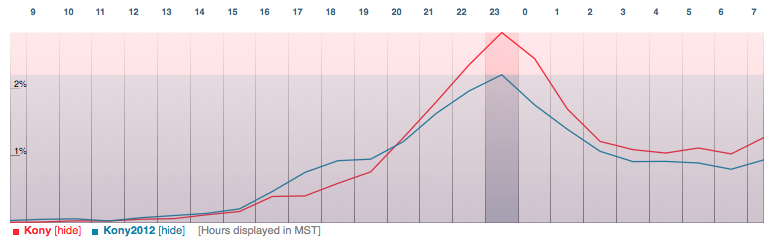
Through most of Monday evening Facebook and Twitter were slowly ramping up in my world. I have met scores of people in my work on the issue, and many of my friends are on the staff at IC, so the hubbub was expected.  By Tuesday afternoon, some staff members were tweeting that, in the first 24 hours, the video had been viewed 800,000 times. Late Tuesday evening, the campaign took up six of the top ten trending topics on Twitter, and “Kony” and “#KONY2012” accounted for 3-4% of all tweets.
The last 24 hours (checked at 7:45am, MST today) of Twitter traffic, from trendistic.

Like many who are aware of the crisis in central-east Africa, I would love to see Joseph Kony brought to justice as soon as possible. Kony is the leader of a highly centralized rebel group comprised of abducted fighters – some of them children. Kony is among the first criminals indicted by the International Criminal Court, and his arrest would go a long ways towards ending the Lord’s Resistance Army as we know it and reinforcing an essential international institution like the Court.

”]As I mentioned, I’ve been a supporter of varying tenacity, and I have disagreed with Invisible Children here and there over the years. I support many of their programs on the ground in the region – granting scholarships for students to attend rebuild schools, teaching displaced people employment skills, and building a radio warning system among them – and am one of the many that first got involved in human rights and activism through their work here in the States. I’ve always felt that there is a huge disconnect between the great work being done in the region and the simplistic, sexy, and purely PR work Stateside, which is a shame. I’m not as much of a critic as others, but I do have a few qualms with the current campaign that’s launching right now.

Invisible Children continues to oversimplify the message of how to get rid of Kony. I understand that advocacy groups need to take really complex problems and boil them down so that it can be disseminated among supporters. As the movement grows, however, the leaders should be better educating their followers.  Being involved for five years, I have yet to see IC expand on its very simplistic history of the war, which is critical to understanding how best to approach ending it.

Something needs to be said about the narrative that IC creates, but I’ll leave that to everyone else.  IC has been running programs in northern Uganda for several years – ineptly at first but more recently they operate like any other aid organization there. Meanwhile, their PR campaigns in the States aim to address the LRA, who left Uganda – which has been in relative peace and experiencing slow recovery – in 2006. The videos blur the lines between the countries, and simplify everything to Kony roaming Africa abducting kids. That’s not to mention that there is no evidence of the 30,000 children figure endlessly repeated by IC and other NGOs, and no discussion of how to define abduction (which is important, since some are forced to help transport supplies before being set free, while others are forced to kill their own family members before being conscripted for life). The story IC creates will drive policy, and it needs to ensure that we have a dialog about the peace-justice debate, the accountability of the Ugandan military, and ways to move forwards without losing momentum.

IC’s campaign for the next two months is heavy on awareness. We supporters are to tell all of our friends and put posters everywhere, and then write messages to 20 cultural leaders (who control public discourse) and 12 political leaders (who are involved with real change). This build up is to April 20th, when we’re supposed to plaster our cities in Kony 2012 posters to “make him famous.” There is footage of “Kony 2012” – to make him as popular as possible – a sort of Public Enemy #1.

When I first got involved with IC, I attended an event that included learning about displacement camps in northern Uganda – an eye-opening experience that really pushed me to start a student organization in college. This year’s big event is to put up posters. This is all in the name of garnering more name recognition for Kony to make him (in)famous, but when you get the most bipartisan congressional support for any Africa-related bill in history and you claim hundreds of thousands of youth support you, you’ve gotten the word out. Claiming that nobody knows about Kony (the video says “99% of people” have never heard of him), is absurd. There is enough attention that we can move from awareness to action now. It’s time to pursue real change – front and center. E-mailing the Chairman of the Senate Foreign Relations Committee should not just be a side-note to hanging up flags and tweeting at Oprah, who is probably sick of IC distracting her from her work in South Africa anyways.

As Daniel Solomon notes (and you should definitely read his post), if people are tweeting at me to watch the video and aren’t reading the ICG report to learn more, then a vital part of the campaign has missed the mark. Mark Kersten also calls out the campaign in a post you should read, and here’s a critique of “crowd-sourced intervention.”

After six years of building a massive youth-led base in America – including raising millions of dollars in record time and directing masses of young people – we have passed the deadline for moving forwards. In the film, IC tells us the Kony 2012 campaign expires at the end of the year – a movement has an expiration date alright, and it’s important to freshen up the whole IC movement.

Update: The list of related links has moved to a new post, as it continues to grow.

Black Bloc Reading

If you’ve been following Occupy, you have probably heard about the recent debate over Black Bloc tactics. I don’t know if I’d ever engage in the more militant tactics of Black Bloc, but I also don’t think there’s anything “violent” about protecting fellow protesters and defending yourself. It’s also absurd to view the tactics as a menace to the movement or anything like that, to me at least. That said, you should do some reading if you’re interested in forming your own opinion.

Chris Hedges started the debate by calling the Black Bloc “the cancer of Occupy” and denouncing the tactic outright. David Graeber, one of the architects of Occupy Wall Street, responded with this open letter that provided both a history of the tactic and an analysis of Hedges’ argument. Additional reading should definitely include Susie Cagle’s on-the-ground analysis and this historical perspective at PhD Octopus.

Update: There is also good reading to do on the Black Freedom Movement and Chris Hedges’ misuse of history and on a look at Hedges’ Hypocrisies: Surgeons of Occupy. There’s a moderate “intervention” on the debate at Dissent Magazine and another at American Leftist.

Links from the Internet Blackout

If you were near the internet yesterday, you probably noticed that things were a little different. As a part of a protest against the Stop Online Piracy Act and the Protect IP Act, websites like Wikipedia and reddit went completely dark while many, like Google, drew attention on their pages to the legislation. Throughout the day, several former sponsors of the legislation backed down in both the House and the Senate. If you haven’t already, here are some links to learn about the piracy/censorship laws on the table. This was supposed to be posted yesterday morning, but my computer was being slow and I was busy. Probably SOPA’s fault. If you haven’t read these already, take a look:

Wikipedia takes action, the Electronic Frontier Foundation asks you to do two things, and Mashable breaks it down. Google also had this spiffy infographic.

Angus Johnston found two quotes on SOPA, Someone on Twitter found that the author of SOPA might be stealing content. Joe Sestak says the corporate lobby’s argument doesn’t make sense. Gimodo has photos of some of the website’s blacked out cover pages. And how SOPA/PIPA will affect women and artists.

I’m Wary of Kristof

When I first got into this whole caring-about-human-rights thing, I was directed to the writings of Nick Kristof. He’s the ubiquitous columnist for the Times that is always writing about the tragedy of violence in the under-developed world. You know, subjects like genocide and mass rape and child slavery. He’s been lauded by many as a reporter with a drive to raise awareness about injustice in the world. I used to read some of his work to learn more about the world’s tragedies, but now I peruse it occasionally out of anger.

Over time I’ve gradually distanced myself from Kristof and his writing as it has become more and more clear that his work doesn’t really achieve all that much. Recently, I read two particularly good pieces that explain how this is so (thanks to Aaron Bady and Tom Murphy for the links). Exhibit A is a lengthy but very well-written piece at The New Inquiry, “Nick Kristof’s Anti-Politics” – the whole thing is well worth a read. In it, the author analyses the living shit out of Kristof’s writing style, his subjects, and his imagery. What is revealed is a startling formula:

Kristof fabricates legible narratives out of snapshots of distant worlds. He then crafts stunningly simplistic solutions to the seemingly irrevocable problems that plague those backwards places. Kristof accomplishes this by using a standard and replicated formula: some mixture of (1) a construction of a bestial and demonic Other creating a spectacle of violence; (2) a rendering of the object of that horror—a depoliticized, abject victim, usually no more than a body; (3) a presentation of a (potential) salvific savior figure(typically the West writ large or a Western agent—some teleological process immanent in capitalism or development, the reader himself (who can act by donating money), and almost always Kristof himself as well); and (4) an introduction of potential linkages with larger systems and structures … only to immediately reterritorialize around the non-political solutions and the savior implementing them.

It’s a formula that attracts attention and a following, but doesn’t do enough to actually make a difference – at least not the type of difference it should make. Educating people about conflict is usually seen as the first step to galvanizing action, encouraging them to write a letter to their Senator or maybe inspire a business student to go into development. But for Kristof raising awareness isn’t the first step to anything – it’s the only step. He makes you aware and simultaneously makes that all that is needed. Now you know about the tragedy, but it’s been taken care of by other brave, ambitious souls and there are no more problems. Since the orphan now has a roof over his head in the refugee camp, he ostensibly will not be worried about deplorable living conditions or  the resumption of conflict or being marginalized in society. He’s safe now. But knowing about injustices only solves everything for the reader.

Merely knowing about (parts of) it rather than doing something about it signifies the critical orientation toward the phenomenon. And as a result, Kristof’s attempts to shock the conscience serve, perversely, to push out the frontier of what no longer offends or alarms.

Kristof educates you enough to say that you are aware, but stops short of you wanting to do anything. In a different way, taking a line from this Esquire piece on Jon Stewart – he “shows you how to give a shit without having to do anything about it.” But that’s just part of it. In addition to this type of writing, Kristof also engages in all some shady behavior. He includes the names and photos of rape victims, a general journalism (and humanity) no-no, citing that it’s acceptable because they probably aren’t affected by his reporting. Even if that were true it is still a shame that he doesn’t think that these people’s privacy is worth protecting. He is also proud of the fact that he has bought slaves in order to free them, which is controversial because he has effectively funded the slavery system. And on top of all that, we have this take-down at whydev.org which critiques these two Kristof excerpts:

“This new research addresses an uncomfortable truth: Poverty is difficult to overcome partly because of self-destructive behaviors. Children from poor homes often shine, but others may skip school, abuse narcotics, break the law, and have trouble settling down in a marriage and a job. Then their children may replicate this pattern”.

Besides questions around the differences between correlation and causation, a theme and assertion emerging from Kristof’s writing seems to be this: that ‘poor families’ simply do not love each other as much as non-poor. Whether this is a conscious assertion or not, I do not know. But, it seems to be quite visible. In a 2010 New York Times Op-ed on global poverty, he states

“that if the poorest families spent as much money educating their children as they do on wine, cigarettes and prostitutes, their children’s prospects would be transformed. Much suffering is caused not only by low incomes, but also by shortsighted private spending decisions by heads of households”.

Besides being an extremely broad and patronising generalisation, it is dismissive and unaware of the structural, geographical and local factors that can affect a family’s income, its allocation and access to education.

Again, this writing seems to come from the same perspective as the first articles. He makes an “other” out of the impoverished by showing how they do not value their children or education as they should. It’s a terrible message to spread, and it points to how this other group of people needs our assistance instead of pointing to why things are the way they are. It encourages donating to a charity or sponsoring a child in school rather than asking the big questions like how trade policies affect global poverty.

I guess I’m realizing more and more that, when people set out to raise awareness about tragedies happening in our world today, they need to think of how they are telling that story. Telling someone about a grave injustice does not require that you can mistreat the oppressed on paper. They are still people deserving of being more than a prop in your awareness campaign. Kristof is a prime example of a platform misused – but maybe that’s our own fault since so many choose to read his work. His writing on the horrors of the world inform us that something is wrong and allow us to go back to eating dinner, when it should show us what is wrong and allow us to go help address it.