HB 2675 Might Be Gone (with updates)

A few moments ago, I was on the Arizona state legislature’s website to check up on a current nemesis, the minimum tuition bill that would get rid of need-based full-ride scholarships. While on the site, I found the bill and checked its status – nothing had changed. I checked the overview and its most recent action was listed as “2/15/12 W/D,” which indicates (to my knowledge) that the bill was withdrawn.

Most recent action lists the bill as withdrawn. (Screen captured at 11:40 today)

Having not heard much, I perused local newspapers and asked the internet about it, so far to no avail. I called the original sponsor of the bill, but got no answer. For a while, the state legislature’s website was rerouting me to this bill, a bill from the previous legislative session regarding food stamps. Manually finding my way back to the current session, the bill still says it was withdrawn last week. I’ll update more on this as the day moves continues.

12:45 Update: It appears that the bill has been withdrawn from the Committee on Higher Education, Innovation and Reform, although I have not found out why. The Appropriations Committee, of which Rep. John Kavanagh is the chairman, is still scheduled to discuss the bill tomorrow morning. Including Kavanagh, six sponsors of the bill are on the 13-member committee. The HEIR Committee had no sponsors among its membership.

9:40 Update: Earlier this afternoon I e-mailed the original sponsor of the bill to ask about its status. He responded with a long list of reasons to support the bill, which I just finished criticizing here.

Feb. 23 Update: The House Appropriations Committee voted yesterday to pass the bill after a very intense testimony from students and other stakeholders. It’s a sad move towards a potential equivalent to a $2,000 tuition increase for the poorest students in the state. An amendment was passed exempting students living on campus, but an exemption for veterans was not passed.

Mar. 1 Update: The bill was withdrawn by Rep. Kavanagh yesterday!

70 Years Since Executive Order 9066

Real democracy is not hereditary. It is a way of living.

— Student government page, 1944 Hunt High School yearbook, Minidoka Relocation Center

On February 19, 1942, President Franklin Delano Roosevelt issued Executive Order 9066, authorizing the establishment of military zones. Angus Johnston reminded me of this anniversary this afternoon, and I thought I’d jump in on marking one of the more somber occasions in American history first with some overview and then with a look into more local history.

Map of internment camps

Executive Order 9066 authorized military leaders to establish military areas and to exclude civilians from those areas. With these powers, Lt. Gen. John DeWitt began instituting curfews directed at Japanese-Americans in Military Area No. 1 – all of California and parts of Washington, Oregon, and Arizona (Japanese-Americans in Hawaii, interestingly, did not face relocation or internment). Throughout March of that year, DeWitt issued several proclamations that increasingly restricted the rights of Japanese-Americans, culminating in the Civilian Exclusion Order No. 34, which included the mandatory evacuation and detention of Japanese-Americans. Almost simultaneously, Congress passed a law making violation of Executive Order 9066 a misdemeanor.

Over the next few months, approximately 112,000 people involuntarily left their homes and were interned in camps across America. 2/3 of them were American citizens. None of them was ever charged with treason or disloyalty, although over a hundred were sent to prison for challenging the internment itself. Most lost all of their belongings and livelihood, and only those still alive in 1988 received any compensation from the government.

The federal government’s actions were challenged several times: the curfews were challenged (and upheld) in Hirabayashi v. United States and the constitutionality of the order itself was challenged (and also upheld) in the more famous Korematsu v. United States. Neither of these decisions has yet to be overturned. On the same day as the Korematsu decision, the Supreme Court also ruled, in Ex parte Endo, that the government could not continue to detain people that it recognized as loyal, but it also left loyalty to be determined by the government itself.

Military Area No. 1 bisected Phoenix

While the demarcation of Military Zone No. 1 encompassed California, it cut through the other states. In Arizona, and likely Washington and Oregon, the line zig-zagged through many cities. If you’re a native of the Phoenix area, you’ll recognize the roads on the map to the right, which I got from the Arizona Historical Society. The line ran along Grand Avenue, Van Buren, Mill Avenue, and the Southern Pacific Railroad. If you lived southwest of this line, you were forcibly evacuated to relocation centers (usually in Poston or on the Gila River Indian Reservation). The arbitrary line decided whether or not some families had to endure the trying ordeal of relocation and internment.

When the war first began, Japanese-Americans were kicked out of the military due to suspicions of sabotage. The prohibition wasn’t lifted until 1943, and the draft was reinstated in 1944 while many still lived in internment camps. Across the country, many Japanese-Americans protested the contradiction of living in camps due to their disloyalty but being drafted to defend the country. In the Poston Relocation Center 100 men resisted the draft and were prosecuted by the government. A sympathetic judge decided that their punishment should be a 1 cent fine, since living in the camps was punishment enough.

The United States has a history marked with good and bad deeds. The internment of Japanese-Americans is one of the darkest events in modern American history. It’s important to be aware of this history, and to acknowledge just how much damage hatred and racism can do. It’s important to remember that 70 years ago, a hundred thousand civilians were rounded up because of their heritage.

Weekend Reading

Here’s your second dose of weekend reading on this blogfront.

A study accidentally links ship activity to whale’s stress levels in post-9/11 silence.

Louis C.K. talks about raising girls in the 21st century.

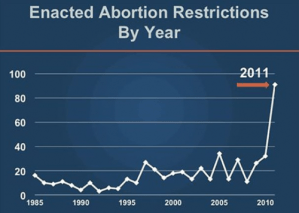
Is there really a culture war truce on things like abortion legislation? This graph says no.

And a look at the war on women and abortion in Africa.

And another look at religious freedom and contraception:

You can force people to pay taxes that pay for guns, but you can’t actually force them to shoot the guns, personally. You have to let them be stretcher-bearers instead, or something of the sort. Only in this case the objection is to one particular form of stretcher-bearing, as it were. But it’s really hard to take this too seriously. It’s not as though anyone is suggesting we force Catholic employers to hand out birth control pills personally, much less that we force them to force employees to take the pill or anything like that. Forcing employers to pay someone else – an insurance company – potentially to pay for someone else – a doctor – to tell someone else – a pharmacist – to give something to someone that the employer wouldn’t ever ask for, for themselves, hardly seems analogous to asking a pious Quaker to shoot a man.

And the editors at The New Inquiry have this to add:

Increasingly, what we are seeing from the right when it comes to women’s issues is not conservatism but radicalism: a bid to roll back the gains and freedoms that feminism has managed to earn for women. During the various imbroglios over Planned Parenthood, for instance, why weren’t more conservatives making a principled case against abortion while also conceding—and applauding—the important role that the organization has played in allowing women to take control of their health and their lives? We are adamantly pro-choice; yet we could certainly respect a principled abortion opponent who took this position. Unfortunately, this is not what we have heard from most conservatives. Instead, we have seen a rush to demonize Planned Parenthood wholesale, oblivious to the crucial work it does for women.

Write like a Mad Man, advice from an advertising executive.

A spooky memo: a contingency speech for Nixon to give if Neil Armstrong and Buzz Aldrin got stranded on the moon.

Alan Moore on V for Vendetta, Anonymous and Occupy.

A couple of weeks ago, caring about privacy at internet cafes was terrorist activity. Nowadays it’s buying coffee with cash.

How do states act once they get nuclear weapons?

Changing from a soldier in Iraq to working on Wall Street to protesting at Occupy Wall Street.

How to spot bad history.

Oprah meets a Hasidic family that has no idea – and doesn’t really care – who she is.

We should probably take a look at a White History Month, to learn both the good and the bad.

Grappling with your ancestor’s pastThe Reader and South Africa.

To celebrate Valentine’s Day, three large student groups broke up with major banks due to things like predatory lending and supporting anti-union politicians.

The gay marriage debate is dividing the house, Lincoln style:

For years now the Supreme Court has been doing its damnedest to pass the hot potato on gay marriage. Different states have passed different laws regarding it and different federal courts have issued conflicting decisions. Because the Full Faith and Credit Clause of the Constitution requires things like marriage licenses issued in one state to be recognized as valid by others, it simply is untenable for this patchwork, confusing approach to continue. Now that one federal district court has ruled California’s Prop 8 unconstitutional we have reached the decision point. Gay marriage bans cannot be unconstitutional in one state or one federal court district but constitutional in others.

We have kicked the can down the road for too long already. It is time to decide whether we will become all one thing or all the other. Is this legal or is it not? Will all states recognize legal gay marriages or will none? The Supreme Court appears to be painted into a corner. An appeal of this decision is a certainty and it is unimaginable that the Court would be so derelict in its responsibilities that it would not accept the case. My confidence in the current Court to make the correct decision here is shaky, but regardless we need this issue to come to a head. The status quo is untenable and it is time for the Supreme Court to do its job.

Is there conservative art? Sure, conservatives just don’t embrace art.

And an interesting look at the power of femmes fatales.

Six-word modern love stories.

The idea of duck-and-cover predates the Cold War.

Noam Chomsky on Vietnam, China, and America’s Decline:

By 1970, U.S. share of world wealth had dropped to about 25%, roughly where it remains, still colossal but far below the end of World War II.  By then, the industrial world was “tripolar”: US-based North America, German-based Europe, and East Asia, already the most dynamic industrial region, at the time Japan-based, but by now including the former Japanese colonies Taiwan and South Korea, and more recently China.

At about that time, American decline entered a new phase: conscious self-inflicted decline.  From the 1970s, there has been a significant change in the U.S. economy, as planners, private and state, shifted it toward financialization and the offshoring of production, driven in part by the declining rate of profit in domestic manufacturing.  These decisions initiated a vicious cycle in which wealth became highly concentrated (dramatically so in the top 0.1% of the population), yielding concentration of political power, hence legislation to carry the cycle further: taxation and other fiscal policies, deregulation, changes in the rules of corporate governance allowing huge gains for executives, and so on.

Meanwhile, for the majority, real wages largely stagnated, and people were able to get by only by sharply increased workloads (far beyond Europe), unsustainable debt, and repeated bubbles since the Reagan years, creating paper wealth that inevitably disappeared when they burst (and the perpetrators were bailed out by the taxpayer).  In parallel, the political system has been increasingly shredded as both parties are driven deeper into corporate pockets with the escalating cost of elections, the Republicans to the level of farce, the Democrats (now largely the former “moderate Republicans”) not far behind.

Another discussion on the use of adjuncts in universities, and whether or not to give them tenure.

The U.S. News College Rankings: The Root of all Evil.

Sean Penn should give his Malibu home back to Mexico.

Do online matchmakers really work?

“The Justice Department was not following the law.” Congress has been oblivious to DOJ’s wiretapping.

Oakland: a city of radicals:

The impact and influence of Occupy’s refusal to negotiate with the city or obey free speech limiting ordinances has been copious and it has inspired exactly the communities it has been said to alienate. When SEIU workers came to city hall to protest their lay offs at the hands of a city pinching pennies while blowing millions on police wildings, they didn’t do it by waiting patiently in line at the podium. They didn’t nervously hope to be taken seriously while the council members’ squandered their time by fidgeting with Iphones and Blackberries like adolescents; they invaded and occupied with well over a hundred members, stacking the council chambers from floor to balcony. They hooted, hollered, heckled and berated the entire time. They were far more like occupiers than the polite city union that gave the city everything it wanted in contract negotiations last year.

Perhaps even more importantly, the prototypically vulnerable population that is always brought up as the one community Occupy will never win over—Latinos—have approached Occupy for help in labor fights. Not just once—for the licorice strike—but twice now. Pacific Steel workers in Berkeley, fired in a ‘soft raid’ after a battle with their union, headed by none other than the city’s biggest hypocrite, Ignacio de la Fuente, recently asked for solidarity in a march they’re having to bring attention to their plight. These are workers with families who’ve logged decades at their jobs and have families that they’ve raised solely in this country.

One of the Pac Steel workers I spoke to the night that they initially approached the Labor Solidarity Committee, told me he had worked for the company for over twenty years, had raised a family here, had his whole life in the US. If any group of people has something to risk by associating with Occupy Oakland, its people like this. The Pacific Steel workers could have gone to Occupy Berkeley; but they didn’t. They came to Occupy Oakland.

The Good, the Bad, and the Ugly: a follow-up on playful thinking history class experiment.

What the Sumerians can teach us about data.

Laurie Penny on being rootless and ruthless.

Against TED – asking for something newer and better than TED Talks.

Washington’s drone war on Yemen, and how it’s not really working:

For years, the elite Joint Special Operations Command and the CIA had teams deployed inside Yemen that supported Yemeni forces and conducted unilateral operations, consisting mostly of cruise missile and drone attacks. Some of the unilateral strikes have killed their intended targets, such as the CIA attack on Awlaki. But others have killed civilians—at times, a lot of civilians. And many of these have been in Abyan and its neighboring province of Shebwa, both of which have recently seen a substantial rise of AQAP activity. President Obama’s first known authorization of a missile strike on Yemen, on December 17, 2009, killed more than forty Bedouins, many of them women and children, in the remote village of al Majala in Abyan. Another US strike, in May 2010, killed an important tribal leader and the deputy governor of Marib province, Jabir Shabwani, sparking mass anger at the United States and Saleh’s government. “I think these airstrikes were based on false intelligence from the regime, because that is the nature of the contractor,” Qahtan charges. “The contractor wants to create more work in return for earning more money.”

The October drone strike that killed Awlaki’s 16-year-old son, Abdulrahman, a US citizen, and his teenage cousin shocked and enraged Yemenis of all political stripes. “I firmly believe that the [military] operations implemented by the US performed a great service for Al Qaeda, because those operations gave Al Qaeda unprecedented local sympathy,” says Jamal, the Yemeni journalist. The strikes “have recruited thousands.” Yemeni tribesmen, he says, share one common goal with Al Qaeda, “which is revenge against the Americans, because those who were killed are the sons of the tribesmen, and the tribesmen never, ever give up on revenge.” Even senior officials of the Saleh regime recognize the damage the strikes have caused. “People certainly resent these [US] interventions,” Qirbi, the foreign minister and a close Saleh ally, concedes.

Such resentments mingle easily with the political and religious message of Al Qaeda and with the growing radicalization of the religious landscape, particularly in impoverished areas neglected by the Yemeni government, like Abyan. “Of course, when people are in that kind of circumstance then they need to hold on to some kind of ideological banner, so they start talking about the Caliphate and all that stuff,” says Iryani.


Black Bloc Reading

If you’ve been following Occupy, you have probably heard about the recent debate over Black Bloc tactics. I don’t know if I’d ever engage in the more militant tactics of Black Bloc, but I also don’t think there’s anything “violent” about protecting fellow protesters and defending yourself. It’s also absurd to view the tactics as a menace to the movement or anything like that, to me at least. That said, you should do some reading if you’re interested in forming your own opinion.

Chris Hedges started the debate by calling the Black Bloc “the cancer of Occupy” and denouncing the tactic outright. David Graeber, one of the architects of Occupy Wall Street, responded with this open letter that provided both a history of the tactic and an analysis of Hedges’ argument. Additional reading should definitely include Susie Cagle’s on-the-ground analysis and this historical perspective at PhD Octopus.

Update: There is also good reading to do on the Black Freedom Movement and Chris Hedges’ misuse of history and on a look at Hedges’ Hypocrisies: Surgeons of Occupy. There’s a moderate “intervention” on the debate at Dissent Magazine and another at American Leftist.

Weekend Reading

Last fall I went on a blogging adventure and created Historically Speaking. It was short-lived, and I plan on revisiting it sometime when I’m able to concentrate more on history and politics academically. One thing the blog had before it abruptly ended, one thing that I want to bring back, was the weekend reading. I’m hoping to hold to this, so bear with me while I link you to everything worth reading from the year so far, in something that closely resembles no particular order.

To start, here are some vintage advertisements rife with sexism. And in a similar vein, why this book is “better” than a beautiful woman.

This President is quite impressed with marshmallow launchers.

Aaron Bady inaugurated his new corner at The New Inquiry with this fantastic review of David Graeber’s Debt.

A moving testimony against SB 1474 (which is a bill in Arizona that would allow guns on college campuses).

While we’re at it – another bill that the Arizona legislature wants to pass, prohibiting colleges from being obscene.

Comparing vintage cereal boxes to contemporary ones over at the Retronaut.

An Egyptian artist feminizes a tank.

A day at South Sudan’s only zoo.

Are single people discriminated against?

Ron Paul and the revised Civil War.

Eight annoying things that Homeland Security does to make you feel better, but don’t really help.

Praying While Shi’a, yet another scandal in the NYPD.

A look back at the Oakland Police Department’s transgressions by al Jazeera.

World Vision is standing by their decision to send Patriots Super Bowl shirts (and other gifts-in-kind) to the developing world, because they’re addicted to stuff we don’t want.

During last year’s controversy, Aid Watch requested documentation proving the need for and impact of their GIK program. World Vision admitted that they had not conducted a single evaluation of the GIK program because they state that these are donations, not a program. Yet GIK makes up one quarter of their annual revenue. It would seem both prudent and professional to evaluate such a large part of their work – however you want to classify it. At $251 million per year, the amount World Vision claims in GIK is greater than the total annual revenue of most non-profits in the United States.

While World Vision did not evaluate their GIK program before last year, you would think that they would have made an effort to evaluate their massive GIK program since then, after all many professionals in the field spoke out against their GIK program. Instead World Vision’s recent blog post states:

“Some individuals knowledgeable about the effectiveness of community programs in the developing world have contended that product donations, especially shirts and other clothing, is ‘bad aid,’ and should play no role in the work of non-governmental organizations. Based on our more than 60 years of experience, World Vision respectfully disagrees.”

So in 60 years they’ve never evaluated the need, impact, or effectiveness of their GIK and they’re certainly not going to start doing that now. Where is the “continuous improvement?”

Privatization is a trap, no matter what industry it’s in.

Why some women in Iran are training to become ninjas.

1962: Arizona’s Halftime.

Only terrorists care about privacy while at internet cafes. Only terrorists.

How Twitter leads to a meritocracy of ideas in international development.

From a long time ago – Wonder Woman fights breast cancer.

PACs Americana: a future that needs no political campaign to not coordinate with.

Martin Luther King, Civil Rights, and Occupy Wall Street.

Some people still  might think this my analogy ridiculous and offensive. African Americans under Jim Crow suffered real, horrific racial discrimination. The suffering of the so-called 99% cannot compare, and thus cannot justify civil disobedience. Well it’s true that Jim Crow was horrible, and that America has made a lot of progress since the 1960s, thanks to people like MLK. But the poor in this country still suffer greatly. Poor people of colour still suffer worse, fighting against unequal opportunity, an unfair and brutal police system and prison industrial complex, racism and xenophobia, a real lack of safety net, and an unfair financial and economic system that privileges the wealthy. On a global level, the gap between the haves and have-nots is even more terrifying, and the racial divide is even starker. So I think all that is worth blocking a few streets, or yelling outside some buildings peacefully, and striking, and rallying, and demanding justice.

How Congress is redlining our schools.

Modern art on the streets of a Swiss town.

What happens when Bambi meets Godzilla? Labor in higher education.

Your bank knows when you’re getting divorced.

Reverse Orientalism from the Arab Spring to Africa.

What the occupation of Iraq did to its universities.

When Ignorance and Bigotry Become “Parental” Rights.

Driving while white on the I-95: Tim Wise flies below the radar.

Providing education as a right rather than through debt.

Toure sat down and watched The Help, and had this to say.

Feeling conflicted about conflict minerals.

DVR versus broadcast television viewers.

The government as the debt collector.

Puritan baby-naming needs to make a come-back, please.

For my local readers, the demise of Maryvale, a Phoenix suburb I drove through a lot this past fall. It’s a story replicated across Phoenix, and probably a lot of suburban America.

Its vulnerabilities were literally built in. Everything was cheaply built. These quickly mass-produced, affordable houses offered very few design features to differentiate one from another, ultimately necessary to make them something of lasting value. Maryvale was totally car-dependent, an artifact of an age when gasoline was cheap, America was a petroleum superpower and climate change barely imagined, much less its cause. Walkable retail? Mixed use? Forget it. They were zoned out, using the “up-to-date” codes of the era. Phoenix under Milt Graham, the popular young mayor through much of the 1960s, was vehemently anti-transit (even as it was anti-freeway). The stamped-out effect of production housing is monotonous and deadening, right down to the square, flat parks. With more land than brains, Phoenix kept replicating Maryvale all over, invariably siphoning off residents who hungered for the newest new tract house. Yet for decades, Maryvale prospered. After I left Phoenix, I would run into younger people who went to Maryvale, Alhambra and Carl Hayden high schools — all fiercely proud of their roots and all successful professionals. Maryvale was loved.

Several events created today’s very different place. In the 1980s, the city began an ambitious effort to expand Sky Harbor. Its centerpiece was bulldozing historic barrios, such as Golden Gate, which were equally loved by their Mexican-American residents if not by the city. The displaced residents used their city payout to buy houses in Maryvale. White flight ensued, and there were plenty of places to fly because the Long model had been reproduced across the Valley, morphing into “master planned communities.” Spec retail space in newer areas drew away many stores, and residents didn’t have their old purchasing power. The diverse economy that created plenty of middle-class jobs declined, leaving a huge gap between the super-rich and relatively affluent, and the working poor. This barbell economy was the antithesis of the one that favored Maryvale. Schools declined along with the tax base. Finally, the vast migration from Mexico from the 1980s through 2007 dramatically destabilized the old Mexican-American population of Phoenix, an event heavily felt in Maryvale. Owner-occupied housing plummeted, and with it the sense of proprietorship that comes with owning property.

Now Maryvale Precinct would be my first choice for a ride-along. Crime and gangs are widespread. Most houses have either fallen into disrepair, or been remade with outside walls sporting spikes and ironwork. Many of the front lawns are now just dirt (or worse, gravel), the pools green and lethal. I still know proud Maryvale residents; none Anglo. They are part of a law-abiding, hard-working majority trapped in decaying suburbia, where the banks won’t make loans for historic rehabs, the state won’t properly fund the schools, and the economy lacks the rungs in the ladder of upward mobility. Transit is difficult at best, a key impediment for people needing jobs. No wonder studies now show poverty has become centered in American suburbs, not center cities.

The limits of the Responsibility to Protect, comparing Libya to Syria.

Daniel Trombly gives some in-depth analysis at Syria too.

Why trying to “even the odds” in Syria isn’t realistic.

The History of ALEC and Prison Labor.

One Town’s War on Gay Teens.

What courts can and will do – the case of marriage equality and the case of orca slavery.

Do Scholarship and Politics Mix? Another look at academic freedom.

Solving the money-in-elections problem with more money, Chris Blattman gives you the MegaPAC.

What’s So Different About Arizona Politics?

As Arizona celebrates its one hundred years of being a state, I think it might be important to see where the state’s politics are now, and where they might be going as we look out towards the next one hundred years. I don’t just mean the shift to extreme conservative politics, which is definitely a factor not to be overlooked, but here I want to look more at overall change the way politics happens on the state level here in Arizona.

Mark Lacey, bureau chief at NYT; Jennifer Steen, professor at ASU; Art Hamilton, former House Leader; Tom Zoellner, journalist and author, in October. Photo from Zócalo.

Last fall I went to a panel discussion hosted by Zócalo Public Square in Scottsdale about Arizona’s position on the national stage (you can watch the full video here), where there were several references to Arizona as the 21st century’s antebellum Kansas or Civil Rights Alabama. That is, that Arizona is sitting at the epicenter of a change in the political system either from the anti-immigrant discourse that is being created or from the state-versus-federal narrative that is being woven here. The talk itself was titled “Is Arizona the Front Line of American Politics?”

The event went far beyond the effect on national politics of immigration in Arizona. Arizona has been at the forefront of quite a few different issues, be it immigration, gun control, or education. ASU is still in the midst of privatizing the law school and ethnic studies programs are being forcibly removed from classrooms. It’s not weird to see people with guns on their hips at the grocery store or sitting at McDonald’s. Recent laws allowing concealed weapons without a permit were of huge debate at the talk since Tom Zoellner, the author of A Safeway in Arizona, a book about the impact of the attack on Rep. Gabby Giffords, was one of the panel speakers.

One thing that has been a fact for a long time in Arizona regarding the limits to laws (I don’t know about other states, on the frontier or elsewhere), is that the police no longer have a say. Both in regards to SB 1070 and to numerous gun laws in Arizona, the law makers no longer defer to law enforcement. Before, police would weigh in on whether or not concealed rifles would be safe in the city – now nobody seems to care what the police think. Zoellner argued that this was partially because other border states in the Southwest were much older and had more matured political institutions, allowing Arizona to come to the fore on new ground for lawmaking. It’s an interesting idea that Arizona is a younger and more reckless state. It’s one explanation for why Arizona has served as a sort of test lab for new ideas, more so than most state governments. But what makes that possible?

At the same panel, Former House Minority Leader Art Hamilton argued that term limits left a legislature with no institutional memory or respect, and that “nobody takes care of the house” anymore. It’s an argument with which I’ve always agreed – rules in institutions like legislatures are open to abuse if there is no order, which is what we’re seeing in Arizona. From a joint report on term limits in Arizona [pdf] released in 2005:

Some observers suggested, however, that term limits have led to an increase in the number of dumb or frivolous bills being introduced and have prompted more people to introduce legislation they know nothing about just to make some sort of record and/or to please some interest group. With a weakening of leadership and the committee system, some observers saw also bills being passed with less vetting.
The emergence of a large group of newcomers more anxious than ever to get involved and make a mark for themselves has generated pressures for a more inclusive policymaking process, This has been especially marked in regard to the making of the budget, the most important thing the legislature does on a regular basis. While these changes may be viewed by many as generally positive, on a broader level, constant turnover in members and leaders, were linked by observers with more general chaos, more emotional decision making and more unpredictability as to results. The departure of several old-times has been accompanied by a loss of institutional memory regarding legislative norms, procedures, and protocol. Conversely, the increase in the number of inexperienced legislators has produced a body where more legislators are uncertain about how to do their jobs and are relatively uninformed about the issues facing the state.

On top of that, Arizona allows people to run for office once they have lived in the state for three years. This could compound the problem of legislators being uninformed about issues regarding the state in particular, and open the state up to imported politicians. While I agree with both of these points, and it seems that they definitely have something to do with the problems in Arizona’s state politics, I found that Arizona’s rules are comparable in the region.

California and Texas have almost identical eligibility and term limit laws, and yet Arizona stands out as the state constantly in the news for bills that challenge the status quo and sanity. Looking at these rules as flaws is a place to start, but I have yet to find what really is the answer to Arizona’s peculiar position in national politics. What sets Arizona’s government apart from other states’? Regardless of the answer (which I’m still looking for), I think it’s clear that Arizona is at the front line for national politics.

There’s More Than One Reason to Dislike Komen(TM) for the Cure(TM)

Since you’re reading this on the internet, I will assume you have heard about the week-long controversy about Susan G. Komen for the Cure cutting future funding to Planned Parenthood, ostensibly due to it being under investigation, but probably due to anti-abortion Vice President for Public Policy Karen Handel (along with other conservatives at the helm). You probably also heard that Komen kinda sorta rescinded the decision (we’ll get to that), and just today there was news that Handel resigned. But before we go flocking back to pink ribbons, it’s important to realize that there are plenty of reasons to think twice about supporting Komen.

For starters, as Angus Johnston has pointed out, Komen hasn’t actually decided to fund Planned Parenthood again. It’s merely decided to allow them to apply for funding again with no real promise of granting the funds.

The new statement does not pledge Komen to reverse its funding decision, and it does not promise Planned Parenthood any new funding. Let’s look at the relevant passage (emphasis mine):

“We will continue to fund existing grants, including those of Planned Parenthood, and preserve their eligibility to apply for future grants, while maintaining the ability of our affiliates to make funding decisions that meet the needs of their communities.”

Komen had never intended to renege on its existing grant commitments to Planned Parenthood, as PP themselves noted in their press releaseannouncing the break between the two organizations (again, emphasis mine):

“In the last few weeks, the Komen Foundation has begun notifying local Planned Parenthood programs that their breast cancer initiatives will not be eligible for new grants (beyond existing agreements or plans).

It’s important to acknowledge that Komen hasn’t had a change of policy, or really even a change of heart. They’re doing damage control, most recently signified by Handel’s resignation, but in a year when the heat has died down they may very well refuse to award Planned Parenthood more funds.

There’s an article on Mother Jones by Clara Jefferey that’s well worth a read, where she explains that Komen used to be quite neutral on the abortion issue until anti-abortion activists began targeting the organization for its Planned Parenthood grants. But besides outside pressure, she takes a deeper look at who sits on the board of directors at Komen and why that could be a problem.

The point is that Komen is a giant grant-making operation (nearly $2 billion since 1982) that purports to represent all of womanhood and it’s being run as if it were still a small family foundation. Brinker and son, Custard, and O’Neill all run in the same circles, sit on the same boards, send their kids to the same elite schools. Komen’s board makes a nod to race (both Lauderback and Leffal are African-American), a nod to medicine, and a nod to someone with pull in DNC circles, but the core is a group of rich, Texan, conservative friends.

Gin and Tacos has the usual mix of snark and anger coupled with this breakdown of what Komen really is – hint, it’s not a charity, it’s a consulting firm:

[Komen founder and CEO Nancy Brinker] draws a salary of $459,000 annually, money well spent compared to the 39% of its budget the foundation spends on “public health education” (i.e., marketing itself). Not to mention that they also spend a million bucks per year in legal fees to threaten other non-profit groups who use the phrase For the Curetm, to which Komentm claims to have intellectual property rights.

That last part is important to the organization, of course, because every successful marketing campaign needs a good logo and a slogan. And that’s all Komen is – a consulting firm that helps large corporate clients sell more of their products through pinkwashing campaigns. By slathering everything from pasta to baseball bats to perfume to fast food with the Pink Imprimatur, consumers are led to believe that their purchases are making meaningful contributions to breast cancer research. Somewhere down the line a few cents per purchase may trickle into those bloated coffers, but the immediate and motivating effect of that pink packaging is to get you to buy things. In short, Komentm is a group of salespeople selling image. Whatever money benefits the sick, researchers, or recovering patients is ancillary.

Point is, Komen might still restrict funding for Planned Parenthood. On top of that, the organization will continue to spend most of its money on marketing and on filing lawsuits against other charities that use “for the cure” in their name. It’s better to give somewhere else. You can give to Planned Parenthood directly, as many have done. Otherwise you can give directly to research institutions and bypass the pink ribbon middleman. In addition to all of that, if you have the time I’d highly suggest reading Barbara Ehrenreich‘s 2001 piece in Harper’s Magazine, “Welcome to Cancerland,” and Lea Goldman’s more recent article in Marie Claire. They both go to great lengths to explain a lot about just what’s wrong with the breast cancer charity industry, from the goals to the mentality of the whole thing.

Russia and China Veto Resolution – Everybody’s Pissed

This morning, the United Nations Security Council failed to pass a watered down resolution addressing human rights abuses and massacres in Syria. Last night, in the hours leading up to the vote, the Syrian government launched a campaign against the city of Homs resulting in anywhere from 200 to 300 deaths. Today, both Russia and China vetoed the UNSC resolution. In the aftermath, there were a number of officials that were furious and ready to unleash.

U.S. Ambassador Susan Rice was angry, saying:

 The United States is disgusted that a couple of members of this Council continue to prevent us from fulfilling our sole purpose here-addressing an ever-deepening crisis in Syria and a growing threat to regional peace and security. For months this Council has been held hostage by a couple of members. These members stand behind empty arguments and individual interests while delaying and seeking to strip bare any text that would pressure Asad to change his actions. This intransigence is even more shameful when you consider that at least one of these members continues to deliver weapons to Asad.

Since these two members last vetoed a resolution on Syria, an estimated 3,000 more civilians have been killed. 3,000. Another almost 250 killed just yesterday. Many thousands more have been held captive and tortured by Asad and his shabiha gangs. Since these two members last vetoed a resolution, however, and despite the absence of Security Council action, we have seen more and more Syrians speak out in peaceful demonstrations against the regime.

Once again, the courageous people of Syria can clearly see who on this Council supports their yearning for liberty and universal rights-and who does not. And during this season of change, the people of the Middle East can now see clearly which nations have chosen to ignore their calls for democracy and instead prop up desperate dictators. Those who opposed this resolution have denied this last chance to end Asad’s brutality through peaceful means under Arab League auspices. Any further blood that flows will be on their hands.

The British ambassador to the UN Marc Lyall Grant expounded on what had happened leading up to the vote:

Four months ago, to the day, two Council members vetoed an attempt to send a clear message to the Syrian regime to end the bloodshed. That day, the death toll stood at 3,000. And the Syrian regime only continued its brutal repression.

The death toll today stands at around 6,000. The Syrian regime has ferociously escalated its already brutal repression in the last 24 hours, subjecting the citizens of Homs to artillery and heavy weaponry. The death toll will be high. Those that blocked Council action today must ask themselves how many more deaths they are prepared to tolerate before they support even modest and measured action?

Last Tuesday, this Council – and the world – heard from His Excellency Sheikh Hamad bin Jassim of Qatar and the Secretary-General of the League of Arab States. They came with a simple request for Security Council support for the Arab League’s plan to facilitate a political transition and bring about a peaceful resolution to the crisis.

The original Moroccan draft resolution did just that. It had, from the outset, support from the vast majority of Council members and had the backing of the Arab League. Yet some Council members argued that the resolution imposed regime change. It said no such thing. But in an attempt to reach consensus, we provided further assurances in the text.

The same minority argued that the text could somehow be used to authorise military intervention. It did no such thing – it was a Chapter VI resolution. But in an attempt to reach consensus, we provided further assurances in the text.

The same minority argued that very modest language expressing concern about weapons was somehow tantamount to an arms embargo. It was not. But we took it out.

They said that mere mention of the existence of Arab League sanctions was tantamount to sanctions. It was not. But we took it out in an effort to reach consensus.

Mr President,

The facts speak for themselves. There is nothing in this text that should have triggered a veto. We removed every possible excuse.

The reality is that Russia and China have today taken a choice: to turn their backs on the Arab world and to support tyranny rather than the legitimate aspirations of the Syrian people. They have failed in their responsibility as permanent members of the Security Council. And they have done so on the most shameful of days of the Syrian killing machine’s 300 days of repression.

I’ll add more quotes throughout the day as I find reliable sources.

A New Burden for Arizona Students

Recently, State Representative John Kavanagh introduced a bill, HB 2675 [pdf], that would establish a minimum tuition that has to be paid by the student. The bill will force students to “pay $2,000 unless they have a full-ride scholarship based on athletics or academics” – effectively getting rid of needs-based full-ride assistance. The bill, if passed, would even restrict students’ ability to pay with other awards: it says that any other awards from a source affiliated with the university cannot be used to pay for tuition. This would include things like this fellowship that I won in my junior year, or countless other awards offered by the university, colleges, centers, and even the university’s foundation, forcing students to either work or take out loans to pay for their education.

The bill has 24 sponsors right now, and the body is comprised of sixty members. It’s not unrealistic to believe that this bill could become law very soon. It was introduced in the House by John Kavanagh, who you might know as the representative who was a staunch supporter of controversial SB1070 and was a big supporter of contracting with private prisons, in addition to the mastermind behind charging people $25 to visit their family members in prison. Not coincidentally, he is also an active member of ALEC and he received donations from prison privatization lobbyists. It looks like he’s now set his sights on higher education.

According to the linked article, Kavanagh thinks that $8,000 in loans isn’t much since those who choose to go to college will make more than those who don’t. Not only does that ignore the fact that many students who get full-ride scholarships still take out loans for cost of living, an $8,000 loan turns into almost $12,000 due to interest. Kavanagh also defends the fact that merit-based full-ride scholarships remain intact by saying that they contribute to the school. Because if you don’t get recognized  for your intellect of your athleticism in the form of cash, you must not bring anything to the table. He also argues that tax payers shouldn’t pay for higher education because then students don’t take classes as seriously and because it encourages enrollment of students who aren’t actually ready for college. He actually said that.

It’s important to note that the state constitution says that education must be as nearly free as possible. Instead, Kavanagh thinks it’s appropriate to throw a $2000 tuition increase at the most vulnerable students. The response in Arizona’s universities will be interesting. The universities in Arizona have been hit pretty hard over the years, including massive cuts in state funding over the last three years. Just during my time at ASU tuition has skyrocketed while class sizes get bigger. By law, each university will have to host a public hearing about the law since it constitutes a tuition increase for some students. It will be interesting to see if the student community can mobilize itself enough to speak up about this bill.

Trial By Fire, A Year Later

A year ago last Wednesday, I walked into a suburban high school social studies classroom and started my student teaching experience. Over the next couple of days, I watched a few lectures, gave two lectures, and helped students put together posters. It was a pretty easy few days of observation, and my mentor teacher and I worked out a slow transition in which I would take over the U.S. History classes completely and help out a little in Government. There was also a little bit of drama, and then…

A year ago today, my mentor teacher quit.

From the next day through the rest of the semester, I went through a stressful and wonderful experience of teaching and learning. I have always loved history and government and I have always loved teaching. I don’t think I would’ve made it through without that. But it wasn’t easy – I spent countless evenings planning lessons (much to my wife’s dismay) and dealt with multiple substitutes and administrators. I had a great group of colleagues who were able and willing to help me as the semester went by and I had a couple hundred students that (for the most part) rocked.

I also learned a lot. I learned how to revise and start over – often in the middle of lessons, and pretty much in the middle of every day. I learned how to deal with all of the stuff that students, parents, and administrators throw at you. I was also on TV announcements more in that semester than in four years of high school. These were things that I’ll be carrying with me (well, not that last thing) – I was constantly revising my work with refugees and I’m sure I’ll be working with different parties no matter what I do with my future.

Yesterday I was substituting in a world history class, watching students take notes out of textbooks, and it dawned on me that I might not end up teaching high school students ever again (unless a teacher somewhere gets really sick, really soon). But while it might suck if that’s not in the future, I know that I can go into whatever else knowing that I went through the most ridiculous student teaching ever, and came out all the better for it.