Weekend Reading

As I prepare to hunker down in the path of both my first hurricane and my first Nor’easter, you can enjoy some reading:

Leslie finds that, now that she’s been elected, her job requires literally dealing with the shit of fellow-politicians. When she tries to increase the hours at a public pool, a councilman blackmails her for access to her private bathroom; she has to eat “racist salad” with a Dixiecrat to find an ally. This is a network sitcom: no matter how corrupt things get, Leslie is unlikely to lose her soul (we wouldn’t want her to). But, for all its warmth, “Parks” suggests the brutality of politics better than many dramas. “Hey, kids, would you like to learn how Leslie got your bill passed?” her enemy sneers, threatening to disillusion the kids she hopes to inspire. “Councilman Knope traded my vote for her—” Before he can finish, he gets pushed into that swimming pool, with a tremendous splash. Lobby all you want for change in Washington; maybe what we really need is a dunk tank.

What you don’t see — and only hear speak of briefly, as if in passing — are the millions of workers who had something or other to do with these Great Men and their construction of industrial America. These workers are milling about in History’s 19th century somewhere, but it’s not too clear where, why, or how. As far as The Men Who Built America is concerned, the men and women who did the actual building don’t matter. I guess mangled limbs and Pinkerton clubs don’t make for good TV? (They so do!)

The show’s complete disregard for the actual men who built America makes sense, though, when you think about life in the Second Gilded Age. We don’t have Robber Barons of the First anymore, but we’ve got Job Creators (and even some Wealth Creators). We’ve got about as much inequality. Lord knows our unions are similarly reviled by capital. Last but not least, who could ignore the parallels between that era’s environmental catastrophes and the looming armageddon of our own?

That could soon be the law of the land in Pennsylvania, where the state legislature has passed a bill that would, asPhiladelphia City Paper blogger Daniel Denvir describes it, “allow companies that hire at least 250 new workers in the state to keep 95-percent of the workers’ withheld income tax.” These workers will essentially be paying their employers for the privilege of having a job. Some have called this “corporate socialism,” but it also calls to mind an even older economic model that was once popular in Europe – except back then, the bosses were called lords. It’s a more modern innovation in the U.S., but combined with increased political pressure from employers and a crackdown on workers’ rights, it all adds up to feudalism, American-style.

The Pennsylvania bill is just the most recent example of state income taxes being turned into employer subsidies. It’s already the law of the land in one form or another in 19 states, and according to Good Jobs First, it’s taking $684 million a year out of the public coffers. The theory is that this will boost job creation. But the authors of the Good Jobs First report note, “payments often go to firms that simply move existing jobs from one state to another, or to ones that threaten to move unless they get paid to stay put.” In other words, it’s more like extortion than stimulus.
We are the 99% – 1890 Style

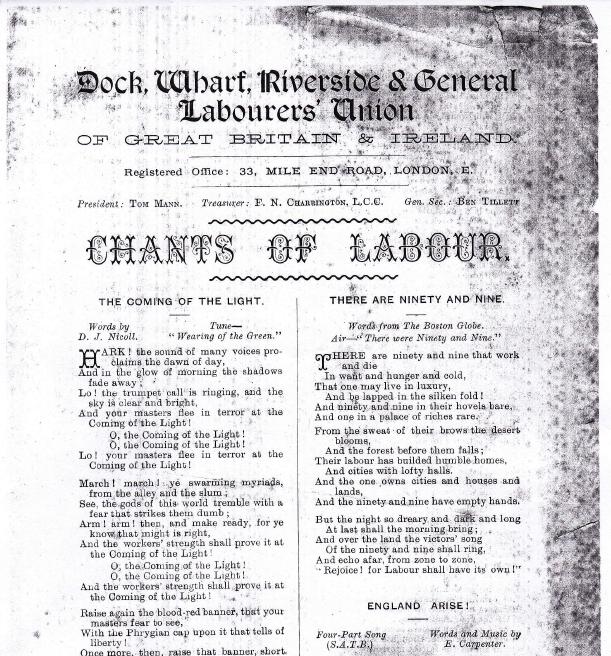
I recently started a part-time job at a library on campus, stamping and source-marking books and manuscripts in acquisitions. My first project has been to sort through a large array of broadside ballads and booklets of songs. Last Friday I happened upon something pretty great: the December 17, 1890 edition of the Dock, Wharf, Riverside & General Labourers’ Union of Great Britain & Ireland. The issue is a collection of labor songs, and one on the front page struck me as particularly linked to contemporary issues. Unsurprisingly, it seems workers chanted against the stark inequality of the top one percent long before last September. Here’s a scanned copy, with the text below.

“Chants of Labour,” from December, 1890.

“There are Ninety and Nine”

There are ninety and nine that work and die
In want and hunger and cold,
That one may live in luxury,
And be lapped in the silken fold!
And ninety and nine in their hovels bare,
And one in a palace of riches rare.
From the sweat of their brows the desert blooms,
And the forest before them falls;
Their labour has builded humble homes
And cities with lofted halls,
And the one owns cities and houses and lands,
And the ninety and nine have empty hands.
But the night so dreary and dark and long
At last shall the morning bring;
And over the land the victors’ song
Of the ninety and nine shall ring,
And echo afar, from zone to zone,
“Rejoice! for Labour shall have its own!”
 

Weekend Reading

Last weekend’s reading ended with a list of really intelligent people talking about Redditor Violentacrez and the scary world that is /r/creepshots. I’m starting this weekend’s reading with more great insight on the same:

And some links on other topics:

At the heart of this issue is how we fund our public schools. As education advocate Diane Ravitch has said, a child’s educational outcomes can be predicted based on her zip code. With few exceptions, the generational nature of wealth transfer means where we live is a direct reflection of how we were born. Wealthier neighborhoods generate more property taxes, which, in turn, can provide greater resources for their public schools. Few of those wealthy parents would advocate for legally barring poor, brown children from attending their schools. But, hardening the border between districts does exactly that: it legally sanctions poor, brown kids from attending those schools. That it also makes inequality a bureaucratic act that distances well-meaning wealthy parents from the dirty act of exclusion is just a bonus.

This is how Stella Ehrhart, age 8, decides what to wear for school. She opens her closet. She opens her book, “100 Most Important Women of the 20th Century.” And she opens her mind.

Voilà, she is Billie Holiday, in a black dress with a red tissue-paper flower tucked into her strawberry-blond hair. Behold, she is Grace Kelly in pink satin lace on her wedding day. Poof, she is Burmese opposition leader Aung San Suu Kyi, wearing a hat her aunt got her in Vietnam.

The Dundee Elementary School third-grader comes to school dressed as a different historical figure or character — Every. Single. Day. And she’s done that since the second day of second grade, when this all started.

Kony 2012 Panel – A Response

Over the weekend I penned a lengthy recap of Friday’s panel on Kony 2012 at the New York Society for Ethical Culture that was hosted by Congo in Harlem. If you’re interested in the LRA, central Africa, or Invisible Children, it’s worth perusing. I promised to contribute something to the conversation, and this is what I ended up with:

Today I wanted to take a brief look at a particular moment of last week’s panel, when Kate Cronin-Furman gave her opening remarks. She chose to talk about the decision for Invisible Children to concentrate on the International Criminal Court, and to look at what that meant for the campaign specifically as well as the narrative of the conflict as portrayed in the video. She began by looking at the circumstances that resulted in the ICC referral and compared it to Uganda’s justice system today. She also argued that a campaign that only addressed the ICC was either “not thoughtful advocacy” or was “window dressing for an all-military approach.” She ended with the question, why are we treating a complex political situation like a law enforcement problem?

There’s lots to talk about in this discussion. We could hold a whole other panel on the ICC in Uganda (and I’d love to go to that, if any panel organizers are reading this), and there are plenty of papers and several books on just this subject. Kate touched on a number of contentious points about the ICC’s involvement in the conflict and how that involvement has been executed. I want to expand on and respond to a few of these discussion points, because a lot of what Kate said is the stuff I’ve been thinking about for a long time. Continue reading

Weekend Reading

It’s time to do some reading, so get on that:

Of course there’s nothing to explain here except that intellectually dishonest hypocrites are doing more of the same. Conservatives are great at this. Hollywood is a cesspit of moral depravity and celebrities are all airheads, but they practically soil themselves with excitement when some star endorses a Republican or talks about running. Experts and academics in the ivory tower are never to be trusted, but hey did you see this new Exxon-funded study from Dr. Shameless at Texas A&M that totally disproves global warming? He’s a scientist, so it has to be true. Government is bloated and expensive and must be drowned in a bathtub, except for the military, farm subsidies, the prison system, massive and politically expedient handout programs for seniors, and more.

Sebastian took a quick flight over and spent a short amount of time there, then flew back to American Samoa. But when he tried to board a flight back home to L.A., he was barred. Immigration and Customs Enforcement said he had self-deported.

“In 2002, an immigration judge with the Department of Justice’s Executive Office for Immigration Review ordered Sebastian to depart the United States,” ICE spokeswoman Gillian Christensen said in a statement. “In December 2011 when Mr. Sebastian traveled to American Samoa and Samoa, he was prohibited from returning to the United States due to the immigration judge’s order.”

Ironically, the White House occupant who best represented the views that now dominate the American Right was a Democrat: Grover Cleveland, the only Democratic president from the eve of the Civil War to Woodrow Wilson in 1912. When Cleveland, a rotund New Yorker, was first elected in 1884, his party’s base was remarkably similar to that of the GOP today: white Southerners from all classes and white workers everywhere who did not belong to unions. The Democrats’ standard-bearer alsoexpressed doubt that any “sensible and responsible” woman would ever want to vote.

As president, Cleveland took several opportunities to denounce those Americans who, as Mitt Romney expressed it to his donors in Boca Raton, expected the government to provide them with the necessities of life. In 1887 he vetoed a bill that earmarked $10,000 to buy seed for drought-stricken farmers in Texas. “I can find no warrant for such an appropriation in the Constitution,” Cleveland explained in his veto message. “I do not believe that the power and duty of the General Government ought to be extended to the relief of individual suffering which is in no manner properly related to the public service or benefit.” He then added a pithy note of pedagogy: “The lesson should be constantly enforced that though the people support the government, the government should not support the people.”

Kony 2012 Panel – A Recap

Last night, I had the privilege of attending a panel discussion of the Invisible Children film, Kony 2012. The panel was convened at the New York Society for Ethical Culture as a part of Congo in Harlem, a week-long series of film screenings and other events related to the DRC. It was the best way I could have spent my birthday (I know, right?) and I would like to recap everything covered at the event for all of you who couldn’t be there. (In addition, the Congo in Harlem website should have a full audio podcast up in the near future). Early next week I will also (attempt to) write up my own response to what was said. Below is a run-down of what was said by whom, in a very not-verbatim transcript rendered from my notes.

Continue reading

Invisible Children, Moving Around the Problem


This week, Invisible Children released Move, they’re most recent film. The film’s goal is to shed some light on the aftermath of the Kony 2012 video, looking at how IC dealt with the rapid growth of the movement and how co-founder Jason Russell coped with the stress of being at the helm. The film also explained the immediate future of the Kony 2012 movement: a large-scale lobbying initiative to take place in November. If Kony is to be captured by the end of the year, a lot of pressure needs to be put on a number of governments to buckle down and really commit to the cause. The push, called Move:DC, aims to concentrate IC’s grassroots support all in one place – the nation’s capitol.

Three years ago, I went to the last big lobby day held by IC, Resolve, and Enough Project. The event was informative and effective, with educational workshops and lobby-training. There were multiple instances where I felt specifically that I was making a difference, that I was where I was supposed to be. And it wasn’t false: almost 2000 constituents made it one of the biggest lobbying initiatives, and over the following year I led a dozen local meetings with congressional staff – the bill ended up passing with more co-sponsors than any Africa-related legislation in modern history. With that in mind, Move:DC will be huge – and I think it will be effective. And while I don’t have the specifics for what the policy asks will be in November, there is a glimpse into what will be going on at the IC blog:

We ask that:

Governments in central Africa provide better protection for their people, while also denying Kony and his top commanders any safe haven. This includes the territory controlled by Sudan where Kony is thought to be hiding, and the Congo, which continues to downplay the impact of LRA violence.

The United States provide increased resources to help train and assist regional forces that are pursuing Kony and other top LRA commanders and contribute resources to overcome the critical gaps in air mobility needed to facilitate rapid movement above the difficult terrain of the region.

All donor governments expand funding for programs that directly benefit affected communities, including initiatives to develop basic infrastructure such as roads and communications systems and help rescue and rehabilitate LRA abductees.

Outside of beefing up military support, there are arguably relatively few drawbacks in these asks. Building up infrastructure in the rural LRA-affected areas could go a long way, and IC is already involved in rehabilitation centers, early warning radio networks, and dwog paco “come-home” messaging to encourage defections from the LRA. Moving our lawmakers to help add to these programs through development agencies could go a long way. The election will have already happened, so hopefully a lame duck Congress can be urged to move forwads on the issue. Lasting peace and the end to the LRA might not be in our grasps, but it could be on the horizon.

But Move fails to help IC truly recover from the Kony 2012 fallout. The film is right that a lot of the attention that was initially drawn to Kony and the LRA ended up turning on IC, detracting from the goal of the video. But they’re wrong to say that is a bad thing that resulted solely from a lack of communication. The video concentrates on the naysayers that called IC a scam, ignoring important critiques that looked at IC’s actual work and narrative and had problems with it. Firmly stuck in the middle of the two, I was disheartened to not see pushback from IC. Self-refelction is hugely important, and this was a chance for IC to better explain what it is they’re doing and why we should continue suppoting them. The video had a chance to respond to legitimate critiques about its model, about its goals, and about its programs. And instead it circumvented the whole conversation. It concentrated instead on its curent campaign, which has potential and is important – but the film easily could have (and should have) done both. I like to think that IC learned some good lessons from this spring, but the video suggests otherwise. Now, the narrative about Kony 2012 is as simplified as the narrative of Kony 2012.

Throughout the Move video, and through a lot of IC’s older films, is a motif of the millenials standing up and sticking it to the olds. It’s true that we get a lot of flak for being radically different from our forebears. With such a rapid change in technology, that’s a given. IC is absolutely right to call on America’s youth to prove them wrong, and I think a nationwide push to fund development in central Africa and encourage involvement in holding government accountable is laudable. But let’s also teach the millenials that when shit gets hard, you don’t just move on. We can simultaneously address critics, create a better and stronger movement, and help stop the LRA. Let’s do that.

Is Columbus Getting a Bad Rap? Not Nearly Enough.

Earlier today Rebecca Shafer wrote that Christopher Columbus’ reputation was the worst it had been since he was arrested and forced to step down as Governor of the Indies way back when. She includes a brief rundown of his history in education, from early biographies to more modern textbooks, from romanticized accounts of heroism to Howard Zinn’s accusation of genocide. She continues:

This is in keeping with textbook trends. According to a University of Michigan study, history textbooks in recent years show a strong trend of portraying Indians more positively and placing Columbus on “a more complex positive/negative trajectory.” In short, Columbus seems to have gone from all good to all evil. As I see it, the result is a caricature-like, ahistorical understanding of the past.

Especially considering the latter, it’s hard to say Columbus is at his worst right now. While he got a (justifiably) bad rap in Zinn’s People’s History, his depiction in today’s textbooks is hardly damning. And I don’t exactly see how going from all positive to “a more complex positive/negative trajectory” is the same as going “from all good to all evil.”

In Lies My Teacher Told Me, James W. Loewen examined twelve history textbooks. Regarding Columbus’ involvement in the slave trade and oppressive governance in Haiti, he found that one of the twelve connected Columbus with slavery. Two said of Columbus, “he proved to be a far better admiral than governor.” The rest of the books said nothing of his abuses.

With that in mind, I think it’s fair to say that Columbus’ reputation is undeservedly still pretty comfortable, despite a couple of states celebrating Indigenous People’s Day today.

Weekend Reading

The Weekend Reading keeps going! Let’s start with a bunch of education links:

The ability of universities to raise tuition fees at will (without any fear of institutional default) is the basic collateral requirement for securing a good credit rating, which makes it much cheaper to borrow money to service existing debts and finance large-scale construction. In turn, this capital-intensive construction generates more space per capita, which is a key metric in the US News and World Report’s college rankings.

Despite scapegoating teachers’ unions, Won’t Back Down is not an anti-teacher movie. Most of the teacher characters—especially Nona, played by Viola Davis—are heroic. That’s because one of the film’s messages is that busting teachers’ unions is better for teachers. In one scene, a meeting to discuss the possible takeover, Nona argues that losing the union will be worth it, “because we’ll be able to teach the way we want.” (The movie is vague on Nona’s pedagogy and why the union prevents it. In real life, charter teachers certainly don’t have any more control over curriculum than public school teachers do.) It is a ruling-class wet dream: workers who are happy to help destroy their own institutions. By giving up the organization through which they wield power, the fictional teachers reason, they will gain more power.

We have wandered deep into the swamp of Upsidedownlandia. Yet the same paradox colors the film’s view of parent power. The movie celebrates parents rising up and taking control of their children’s education—in order to rid themselves of all representation. Though the film does not discuss such pesky governance matters, a “takeover,” in real life, usually means that the school is run by a private organization with limited accountability to the public. While the state does decide ultimately which charters to shut down, there is no oversight by the school board, nor the city government, and certainly not the parents.

I had asked Bea, after the day of the two dead mothers, if she still wanted to go to the club. I had been prepared for her to reconsider, but she answered resolutely that she still wanted to go. She also mentioned the popcorn again. Then she looked at her hands and said quietly, “It got me through your cancer.”

When I posed the same question to my 12-year-old daughter, Lucy, she too gave the same answer. Yes, of course she wanted to keep going. “It makes me feel normal,” she said. “It makes me a better friend.” It really does. When a classmate she hadn’t even been close to lost a parent to cancer last year, she instinctively reached out to the child. She didn’t make the kid talk about her feelings. She just sat with her at lunch, asked her about her locker. She wasn’t afraid. She wasn’t awkward. Because she’d been there before.

Voting as a Right

There has been a lot of talk around what some would call liberals’ obligation to vote for Barack Obama this November, followed by a lot of critiques from a marginalized Left. Between his pension for drone strikes and his slow pace on gay rights and immigrant rights, on top of his utter failure to take any sort of stand for far-left ideals, I can see why a lot of people on the Left don’t want to cast that vote. While a vote for Obama can act as a vote against the Republican Party, just how much do we reward Democrats for being slightly less terrible than Republicans? I’m intrigued by this debate, but it’s not what this post is about.

Long ago the idea of voting as a privilege was cast off, with the franchise extended to a number of minority groups. But the remnants of that idea, the idea that only the elite are blessed with the vote, still remain. Many Americans have the opportunity to vote now, but that opportunity is limited in a host of ways, including voter ID laws and disinformation campaigns aimed at confusing voters. In a country where the vote takes place on a work day, with inflexible hours, and rigid rules regarding absentee voting and polling places, it is far easier for the privileged to vote.

It is this fact that leads many to feel obligated to vote, despite the weary mantra that our votes don’t count (and between the electoral college and big-donor-funded candidates, a lot of these votes don’t). That we have the opportunity to vote means that we need to use that opportunity. To be American is to vote.

But democracy doesn’t end with casting a ballot. That’s just where it begins. If your fed up with the two parties, then there’s a lot that you can do beyond just voting for the lesser evil. And in a first-passed-the-post system, I’m certainly not talking about voting for a third party. But if you can’t stomach voting for Obama, particularly if you live in a state not listed as a gradient on polling maps, I don’t care what you do. I hope you’ll still vote in your local and state elections, because that is where tons of liberal reform could actually happen (seriously, foster those ideas in your community). And I hope you go beyond the simple act of voting and decide to take on the act of organizing for change outside the electoral system. The fact of the matter is, voting is a right – and that’s all it is. To be American is to have the right to choose who you vote for – and to choose whether or not you want to vote at all.

We have the right to vote for whomever we want, and that right should matter. Voting should play a role in choosing effective leaders, and it should serve as a voice for what we want to see in our government. To that end, choosing not to vote isn’t surrendering that voice – it’s shouting something entirely different. It’s a protest of a rigged system, and it’s a protest of a party that isn’t listening.