Book Recommendations – South African Edition

So, my online presence has been a bit quiet. Weekend readings and occasional tweets are still outgoing, but not much else. My first semester of grad school has come and gone, and the last few weeks have been spent polishing off two term papers, preparing proposals for my thesis, studying for a language final, and moving Henry James books around at the library. Now that all of that’s done, I wanted to recommend some of the many books I still have stacked on my windowsill.

For a South African history course, I wrote a term paper looking at how anti-Apartheid activists used their own trials as platforms to criticize the government. I concentrated on Nelson Mandela’s trials (when caught in hiding and then in the Rivonia Trial) and Steve Biko’s testimony in the Black Consciousness Trial, but found other examples too. I spent some time looking at court records on microfilm – like an old school historian – but these are a few of the more helpful books on the subject of trials during apartheid:

  • Donald Woods’ Biko is a great book for all things Steve Biko. A journalist and friend of Biko’s, Woods includes lengthy excerpts from Biko’s five-days-long testimony in the Black Consciousness trial which I’ve come to rely on. An alternative to this is Millard Arnold’s complete transcript of the trial, although it’s hard to find.
  • Michael Lobban’s White Man’s Justice, while not specifically addressing my topic, is a really good resource on how the apartheid state used trials to legitimate oppression.
  • Joel Joffe’s The State vs. Nelson Mandela: The Trial That Changed South Africa is a good account of the Rivonia Trial, on which Joffe served as an assistant counsel to the defense. His writing style isn’t the best, and he jumps back and forth from trial transcripts to his own narration without much notice, which can be frustrating if you’re doing research.
  • Mary Benson edited a collection of speeches given by activists in The Sun Will Rise: Statements from the Dock by Southern African Political Prisoners, which includes several statements I used in my paper in addition to other really interesting excerpts.

Another term paper I did was on the symbol of land and territory as a founding myth for South Africa. It was for my first ever sociology course, and I chose to look at South African history and the founding myth that Afrikaners had crafted. I used a lot of articles (by du Toit on the role of Calvinism, Templin on the Great Trek, and Marschall on monuments), but these books came in handy as well:

but nonetheless I’ve found these texts to be really helpful:

  • T. Dunbar Moodie’s The Rise of Afrikanerdom utilizes the sociological concept of a civil religion, and in this book he paints a clear picture of the role of the Boers’ Calvinist religion in their nationalism throughout the early twentieth century.
  • Leonard Thompson’s The Political Mythology of Apartheid examines the concept pretty thoroughly, looking at the history of the Great Trek and its place at the center of Afrikaner nationalism. It does a good job of looking at how this came about and when.
  • Another helpful text is Donald Harman Akenson’s God’s Peoples: Covenant and Land in South Africa, Israel, and Ulster. It compares the prominence of a covenant with God in the narratives of the Afrikaners in South Africa, the Zionists in Israel, and the Protestants in Northern Ireland. It doesn’t say much that Moodie and Thompson don’t already explain, but it’s a great comparative look.
  • The Frightened Land: Land, Landscape and Politics in South Africa in the Twentieth Century by Jennifer Beningfield was a great resource. Required reading for the history course mentioned above, it’s a really innovative look at how apartheid changed the actual landscape of South Africa. For this paper, the chapter on the Voortrekker Monument was essential – the whole book is well-worth a read.

And those are my recommended readings on South Africa. Hopefully someone finds these recommendations helpful. With the end of the semester, you should see more of me over the winter reprieve from school. While I might be done with these papers, I’d love any additions – feel free to comment if you know of other resources on these topics.
Weekend Reading

And your regularly scheduled reading:

Gun manufacturers have successfully managed to shift virtually all blame for lax gun laws in America onto their lobbyists and their customers. It’s no coincidence that companies like Sig Sauer, Freedom Group and Glock (which also made one of the weapons used in the killings) are privately held. They strive for minimum transparency, and they have achieved it. The NRA, bless its heart, is a front—a perfect little whipping boy designed to weather all of your abuse so that Ron Cohen can drive to and from his office without a reporter shoving a microphone in front of his stupid fucking face. They have taken phrases like “Gun control” and “the Second Amendment” and crafted them into permanent, bulletproof diversions. They’ve done such a good job of shielding themselves that Sig Sauer doesn’t even feel compelled to issue a public statement when one of its weapons is used in a mass tragedy. They don’t have to express their regrets or spew some bullshit about being dedicated to making sure guns are used safely. Higher profile companies have to send out public apologies when they send out a bad tweet. Big Gun does nothing and doesn’t have to. Isn’t that remarkable?

The working class as it existed in Old Left political discourse was a sociologicalcategory, and it often referred to a specific type of wage labor: the industrial proletariat, employed in large-scale factory work. Such workers were thought to be the leading edge of socialist politics not merely because they were exploited by capital, but because they occupied a specific environment that tended to forge a collective identity and to facilitate disruptive mass action: factories in which workers were employed for a long period of time, and where they were massed together each day performing similar, routinized work.

The working class in this specific sociological sense has lost its political centrality both because of structural changes in the economy, and due to the transformation of political consciousness on the Left. Capitalism has increasingly replaced industrial workers with machines, and as a result the economy is more-and-more dominated by culture industry and service employment that is not conducive to fostering solidarity in the way the old factory model was. At the same time, the work of national liberation and feminist movements has forced an acknowledgment that the older conception of the working class implied the centrality of a particular white, male labor aristocracy, rendering invisible both unpaid labor in the household and the role of white supremacy in excluding non-whites from the most privileged sectors of the economy. However much the Old Left liked to portray the “working class” as a universal identity that subsumed particular interests — and as much as contemporary left nostalgics like Walter Benn Michaels might still like to portray it that way—the working class in its sociological sense was always a form of identity politics.

FDR leveled the workplace playing field some with the Wagner Act, for the first time making union security (closed shop) a reality. Labor union power and membership soared, as did wages and benefits; America suddenly had Social Security and unemployment insurance, child labor laws, a minimum wage, five day/40 hour work week, and within a few years, a powerful middle class.

To big business plutocrats, the New Deal labor laws represented a sort of political Holocaust that they never forgot or forgave. They lost their full spectrum political dominance over their workers and over the political and judicial direction of the country, and all that essentially because FDR brought to an end America’s “open shop” culture and empowered unions with “closed shop” union security.

But business vowed that one day it would have its revenge. And that revenge would be “right to work” laws.

Standing with Erik Loomis

Like a lot of people, when Erik Loomis heard about the massacre in Newtown, he was angry. Angry at the proliferation of guns in America, at the frequency of mass shootings, at the power of the gun lobby of the NRA and weapons manufacturers. In expressing that anger, he stated:

I was heartbroken in the first 20 mass murders. Now I want Wayne LaPierre’s head on a stick.

It’s a common phrase that everyone understands as hyperbole. I want LaPierre to be held responsible too. But the Right has taken the statement literally and is outraged.

Remember, these are the type of people who tend to carry signs that say things like this and this and this and this.

Regardless of the obvious irony, conservatives have formed an all-out push for Loomis’ head on a stick, calling for his ouster from his current position at the University of Rhode Island. It’s absurd that an institution of higher learning would leave a faculty member vulnerable like URI has, choosing to issue an apology rather than defend his right to use rhetorical devices. But since conservatives are forming ranks to call for him to be fired, and his university seems slow to the defense, it deserves to be said: I stand with Loomis, and you should too.

Please go add your name to this post at Crooked Timber in support of Loomis.

Reading on Guns

In response to Newtown:

Posts Worth Re-Visiting:

What Can We Do?

Yesterday, in light of recent events, my friend Adam and I engaged in a thorough conversation over what the next step is in changing the national discourse on gun control. The truth is that I have no idea. I figured I’d lead with that before writing this post. I’ve never worked on any gun control issue, and I’m not even that well-read on the issue. But I have a lot of thoughts on it, because it’s something that enters my thoughts pretty often.

When looking at the recent history of gun violence and massacres in the United States, it’s hard to parse out a strategy or narrative that’s deals solely with guns. The perceived importance of guns is tied up with our Constitution’s Second Amendment, and any conversation about preventing such tragic events must include talk of access to, funding for, and reduced stigma of mental healthcare and increased support for victims of domestic violence. And when you talk about political or legal solutions to gun proliferation, you involve the political system, the powerful gun lobby, and the ideologues of the Republican Party along with unequal state laws, a Supreme Court that strikes down bans, and a Democratic Party scared to use its strength.

So, eschewing the question of when it’s right to talk about gun control, I ask: what will be done? We can’t really accept that nothing will be done, even though a lot of us have reluctantly muttered the question “how many more times will this have to happen before we do something about it?” at least a few times in the past week, month, year, or decade. But if we refuse the idea that nothing will be done, if we decide that something will be done, what will that something be?

A relative of mine recently tried to take advantage of some gun sales at a hunting store in Arizona, and the guns had all sold out almost immediately. When my dad asked him why, the relative reiterated the fear that Obama will be banning all guns any day now, so a lot of Republicans are getting them while they can. Nevermind the fact that Obama hasn’t had the gumption to do anything when it comes to gun violence, and has actually helped facilitate the militarizing of a host of countries around the world. What do we do about gun control when people are already hoarding weaponry to face both the apocalypse and the specter of a government crackdown on guns, both of which are completely unfounded?

It will be a long and arduous campaign to shift the cultural mindset. The NRA and similar organizations have always had a tight grip on the lawmakers of this country, and they have also fostered a deep love for guns among the citizenry. The recent radical turn of the Republican Party has only exacerbated this as more and more people feel tied to their right to bear arms. There’s no easy way to reverse this trend, but a long and committed campaign could slowly chip away at the power of firearms.

It is, of course, my dream that I could live in an America where there is either a full gun ban or something close.  But that’s all it is. It’s a dream, and it will remain that way. After all, yesterday’s tragedy, and many gun-related tragedies, was carried out by legal weapons. But there has to be some argument that, if killing sprees and this easy while ostensibly following the law, maybe we should change the law. The fight against gun violence and mass killings needs to start locally, and it needs to start with conversation.

Continue reading

Living Cheaply

The campaign this year is asking students to think specifically about whether they’re “living cheap enough,” Ainsworth said, and encouraging them to forgo immediate gratification for the payoff of graduating with minimal debt.

“I understand that it’s poverty wages,” he said of many students’ budgets, “but [they] have to understand what [they] do now, [they’ll] pay for later.”

That’s A. Jerald Ainsworth, dean of the Graduate School at the University of Tennessee at Chattanooga, quoted today over at Inside Higher Ed, on making sure poor people are acting poor enough. The article gets moderately better later on, when discussing other options such as limiting fees or raising loan limits, and makes a less than passing reference to maybe providing more assistantships to graduate students, but that quote is a kicker.

Graduate students work a lot, and are paid very little. Ainsworth even acknowledges that we’re talking about poverty wages. But his solution isn’t to provide more support, instead it’s making sure students continue to be poor, but do it better. But we all know that living cheap takes its toll on those doing the living, and when the very same people are doing the researching and the teaching, it’s students and work that are dragged down too. And if you put impoverished grad students alongside impoverished adjuncts, you’re talking about a bulk of the work being done on most campuses being a casualty to a lack of support or even adequate pay.

Living cheaply means pretty much everything is more time-consuming and life-draining. It’s difficult to teach at your best when you had to wait half an hour for the bus before sitting in the bus for another half hour to get to class on time, all the while lugging your bag full of assignments you had to grade while sitting at the laundromat. And since living cheaply means cooking instead of eating out, you might have to make that return trip for lunch. And keep in mind that amidst all of this, you’re trying to do top-quality research in order to move forwards, all the while trying to excel at living cheaply.

I’m curious how cheaply these people expect graduate students to live. I’m lucky enough that I have a manageable, rather than unbearable, amount of debt thanks to help from my parents with tuition and my wife working all of the time. Meanwhile I walk a couple of miles a day and frequently devise plans to get free food. I suppose that Ainsworth’s campaign might tell me to assess my utilities and turn the heat down a little, but they could make the required hospitalization insurance cheaper or provide more teaching positions or provide better notification of scholarships. And these are mostly PhD students we’re talking about. In some ways, they have it far better in that they receive tuition stipends and are first in line for teaching fellowships. Often times, MA students are self-financed and (if they’re lucky) get the leftover teaching assignments. Only one in my cohort of eleven are teaching this semester, and only some of us received funding for tuition.

Rather than teaching graduate students to be better at being poor, maybe provide a little more support for them?

Weekend Reading

Click on some links:

Earlier this year, Iowa and Utah became the latest states to approve “Ag Gag laws” that criminalize undercover investigations of animal abuse on factory farms. When activists enter a Concentrated Animal Feeding Operation under false pretenses (usually by getting hired) for the purpose of secretly videotaping the daily gratuitous atrocities committed against pigs, cows, chickens and other livestock, their conduct in states with Ag Gag laws is criminal. The FBI has recommended they be prosecuted as terrorists.

Who knows how much this cost. But be reassured, Californians, it’s not your tax dollars at work, here, and that’s kind of the point. Your opinions matter only the shrinking percentage of the university’s budget that the state actually pays for, down from $16k per student in the 1990’s to less than $7k today, and still falling. The state needs that money for building new prisons, for keeping property taxes low, and for not charging vehicle registration fees. But that’s why the state isn’t trying to impress its citizens, isn’t it? It’s appealing to the tech industry, signaling its desire to hook up for the night with all the subtlety and finesse of a 17 year old at a frat party. It even makes a certain kind of sense: instead of serving the public good by educating students, the university’s fiscal strategy is now a matter of attracting donations and customers, so image and advertisement are the important things. Enter the magic of design.

So we’re living in a period of uneasy truce: people around the world are sharing their voices on the internet like never before in history, but they’re doing so under private censorship regimes equally unique in time. There is more speech than ever under more potentially unchecked control than ever. It is “a double-edged sword,” says Electronic Frontier Foundation attorney Trevor Timm, with large corporations both enabling and controlling the ability for average people to reach a much larger audience than previously possible. “The top decision maker at YouTube has more censorship power than any Supreme Court justice,” he says. “We have to develop policies that better protect free speech from not only government interference but also corporate censorship.”

Only Nixon, Only Reagan – International Treaties and the Presidency

A lot of people have been lamenting the US Senate’s failure on Wednesday to ratify the UN Convention on the Rights of Persons with Disabilities by a vote of 61-38 (treaties need 67 votes to be ratified), and rightly so. There is virtually no reason not to ratify the treaty, and many GOP senators even went back on promises at the last minute by voting no. It’s really terrible that the United States is so unwilling to ratify international conventions, many of which are great treaties, on the absurd fear of losing all American sovereignty (or whatever it is they’ve convinced themselves).

But the fact is, we shouldn’t be surprised. The Unites States is the only country other than Somalia that hasn’t ratified the UN Convention on the Rights of the Child. And we’re in the minority of non-ratifiers for a host of other conventions and treaties, from landmine bans to climate change protocols to international justice. The next time the U.S. signs onto anything like this, it will be because a Republican President wants to.

Sometimes people look at me with a bit of skepticism on that point, but it’s true. In an only-Nixon-could-go-to-China way, only a Republican president could twist the arms of enough GOP senators to vote alongside Dems, who for the most part already support such measures. The only reason the U.S. ever signed onto the Genocide Convention was because Ronald Reagan accidentally visited a Nazi cemetery (and didn’t visit any concentration camps) on a trip to Germany. To solve the controversy, he pushed for the Genocide Convention’s passage and voila. That is almost the only route for America to sign anything.

So we just need the next GOP President to fuck up on an issue, I guess.

Weekend Reading

Let’s read. First. a list of writings on Lincoln:

When Lincoln sets about abolishing slavery–out of the goodness of his heart, essentially–his first adversaries turn out to be the radical abolitionists, in whose number the movie is careful not to place the great emancipator. Before anything can happen, in other words, the first order of business is to steamroll men of principle like Thaddeus Stevens and James Ashley into doing what Lincoln wants them to do. Stevens is too wildly idealistic and unrealistic to be allowed to speak his mind; he isn’t quite a caricature—if only because Tommie Lee Jones brings too much gravitas to the part—but he’s the uncle everyone is embarrassed of, even if they love him too much to say so. He’s not a leader, he’s a liability, one whose shining heroic moment will be when he keeps silent about what he really believes. And James Ashley is portrayed as too cowardly and weak to even bring the amendment to a vote (while casting David Costabile for the part speaks volumes for what kind of a role they think it is). The two radical abolitionists in the film, in other words, cannot be trusted to take charge of a radical project like the abolition of slaves. A radical and revolutionary change must be placed in the hands of a compromising moderate.

The number of Purdue administrators has jumped 54 percent in the past decade—almost eight times the growth rate of tenured and tenure-track faculty. “We’re here to deliver a high-quality education at as low a price as possible,” says Robinson. “Why is it that we can’t find any money for more faculty, but there seems to be an almost unlimited budget for administrators?”

Purdue is among the U.S. colleges layering up at the top at a time when budgets are tight, students are amassing record debt, and tuition is skyrocketing. U.S. Department of Education data show that Purdue is typical: At universities nationwide, employment of administrators jumped 60 percent from 1993 to 2009, 10 times the growth rate for tenured faculty. “Administrative bloat is clearly contributing to the overall cost of higher education,” says Jay Greene, an education professor at the University of Arkansas. In a 2010 study, Greene found that from 1993 to 2007, spending on administration rose almost twice as fast as funding for research and teaching at 198 leading U.S. universities.

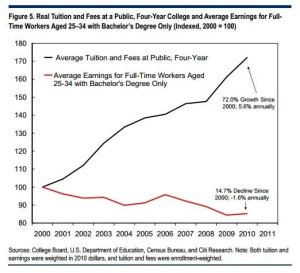
Tuition versus Earnings for Workers with a BA

The friends we mobilize to support our projects appear to us as a community, but to Kickstarter they are raw material to be converted into commodity—a conversion we must also embrace. Members of our networks become investors, not so much in our projects, but in Kickstarter itself. Every fundraising campaign that is launched reaches into our intersecting communities. Newer and newer layers of people are extracted to invest in Kickstarter. Like any other for-profit entity, its goal is to make money. Our projects that facilitate the funding are a side effect, a cost of doing business—the business of drilling our relationships for all they are worth. This is the logic we are allowing to dictate the whos, hows, and whats of cultural funding in our society.

Clearly, Kickstarter extracts value from our communities—10 percent of the capital raised and an unknown amount of networked and social value—but it does something less obvious as well. It converts support and community building into a shopping experience. By building a commodity-based rewards system into the platform, Kickstarter naturalizes the idea that supporting a friend is similar to any other online purchasing experience. You charge your credit card and something cool shows up in the mail in the future.