Living Cheaply

The campaign this year is asking students to think specifically about whether they’re “living cheap enough,” Ainsworth said, and encouraging them to forgo immediate gratification for the payoff of graduating with minimal debt.

“I understand that it’s poverty wages,” he said of many students’ budgets, “but [they] have to understand what [they] do now, [they’ll] pay for later.”

That’s A. Jerald Ainsworth, dean of the Graduate School at the University of Tennessee at Chattanooga, quoted today over at Inside Higher Ed, on making sure poor people are acting poor enough. The article gets moderately better later on, when discussing other options such as limiting fees or raising loan limits, and makes a less than passing reference to maybe providing more assistantships to graduate students, but that quote is a kicker.

Graduate students work a lot, and are paid very little. Ainsworth even acknowledges that we’re talking about poverty wages. But his solution isn’t to provide more support, instead it’s making sure students continue to be poor, but do it better. But we all know that living cheap takes its toll on those doing the living, and when the very same people are doing the researching and the teaching, it’s students and work that are dragged down too. And if you put impoverished grad students alongside impoverished adjuncts, you’re talking about a bulk of the work being done on most campuses being a casualty to a lack of support or even adequate pay.

Living cheaply means pretty much everything is more time-consuming and life-draining. It’s difficult to teach at your best when you had to wait half an hour for the bus before sitting in the bus for another half hour to get to class on time, all the while lugging your bag full of assignments you had to grade while sitting at the laundromat. And since living cheaply means cooking instead of eating out, you might have to make that return trip for lunch. And keep in mind that amidst all of this, you’re trying to do top-quality research in order to move forwards, all the while trying to excel at living cheaply.

I’m curious how cheaply these people expect graduate students to live. I’m lucky enough that I have a manageable, rather than unbearable, amount of debt thanks to help from my parents with tuition and my wife working all of the time. Meanwhile I walk a couple of miles a day and frequently devise plans to get free food. I suppose that Ainsworth’s campaign might tell me to assess my utilities and turn the heat down a little, but they could make the required hospitalization insurance cheaper or provide more teaching positions or provide better notification of scholarships. And these are mostly PhD students we’re talking about. In some ways, they have it far better in that they receive tuition stipends and are first in line for teaching fellowships. Often times, MA students are self-financed and (if they’re lucky) get the leftover teaching assignments. Only one in my cohort of eleven are teaching this semester, and only some of us received funding for tuition.

Rather than teaching graduate students to be better at being poor, maybe provide a little more support for them?
Weekend Reading

Click on some links:

Earlier this year, Iowa and Utah became the latest states to approve “Ag Gag laws” that criminalize undercover investigations of animal abuse on factory farms. When activists enter a Concentrated Animal Feeding Operation under false pretenses (usually by getting hired) for the purpose of secretly videotaping the daily gratuitous atrocities committed against pigs, cows, chickens and other livestock, their conduct in states with Ag Gag laws is criminal. The FBI has recommended they be prosecuted as terrorists.

Who knows how much this cost. But be reassured, Californians, it’s not your tax dollars at work, here, and that’s kind of the point. Your opinions matter only the shrinking percentage of the university’s budget that the state actually pays for, down from $16k per student in the 1990’s to less than $7k today, and still falling. The state needs that money for building new prisons, for keeping property taxes low, and for not charging vehicle registration fees. But that’s why the state isn’t trying to impress its citizens, isn’t it? It’s appealing to the tech industry, signaling its desire to hook up for the night with all the subtlety and finesse of a 17 year old at a frat party. It even makes a certain kind of sense: instead of serving the public good by educating students, the university’s fiscal strategy is now a matter of attracting donations and customers, so image and advertisement are the important things. Enter the magic of design.

So we’re living in a period of uneasy truce: people around the world are sharing their voices on the internet like never before in history, but they’re doing so under private censorship regimes equally unique in time. There is more speech than ever under more potentially unchecked control than ever. It is “a double-edged sword,” says Electronic Frontier Foundation attorney Trevor Timm, with large corporations both enabling and controlling the ability for average people to reach a much larger audience than previously possible. “The top decision maker at YouTube has more censorship power than any Supreme Court justice,” he says. “We have to develop policies that better protect free speech from not only government interference but also corporate censorship.”

Only Nixon, Only Reagan – International Treaties and the Presidency

A lot of people have been lamenting the US Senate’s failure on Wednesday to ratify the UN Convention on the Rights of Persons with Disabilities by a vote of 61-38 (treaties need 67 votes to be ratified), and rightly so. There is virtually no reason not to ratify the treaty, and many GOP senators even went back on promises at the last minute by voting no. It’s really terrible that the United States is so unwilling to ratify international conventions, many of which are great treaties, on the absurd fear of losing all American sovereignty (or whatever it is they’ve convinced themselves).

But the fact is, we shouldn’t be surprised. The Unites States is the only country other than Somalia that hasn’t ratified the UN Convention on the Rights of the Child. And we’re in the minority of non-ratifiers for a host of other conventions and treaties, from landmine bans to climate change protocols to international justice. The next time the U.S. signs onto anything like this, it will be because a Republican President wants to.

Sometimes people look at me with a bit of skepticism on that point, but it’s true. In an only-Nixon-could-go-to-China way, only a Republican president could twist the arms of enough GOP senators to vote alongside Dems, who for the most part already support such measures. The only reason the U.S. ever signed onto the Genocide Convention was because Ronald Reagan accidentally visited a Nazi cemetery (and didn’t visit any concentration camps) on a trip to Germany. To solve the controversy, he pushed for the Genocide Convention’s passage and voila. That is almost the only route for America to sign anything.

So we just need the next GOP President to fuck up on an issue, I guess.

Weekend Reading

Let’s read. First. a list of writings on Lincoln:

When Lincoln sets about abolishing slavery–out of the goodness of his heart, essentially–his first adversaries turn out to be the radical abolitionists, in whose number the movie is careful not to place the great emancipator. Before anything can happen, in other words, the first order of business is to steamroll men of principle like Thaddeus Stevens and James Ashley into doing what Lincoln wants them to do. Stevens is too wildly idealistic and unrealistic to be allowed to speak his mind; he isn’t quite a caricature—if only because Tommie Lee Jones brings too much gravitas to the part—but he’s the uncle everyone is embarrassed of, even if they love him too much to say so. He’s not a leader, he’s a liability, one whose shining heroic moment will be when he keeps silent about what he really believes. And James Ashley is portrayed as too cowardly and weak to even bring the amendment to a vote (while casting David Costabile for the part speaks volumes for what kind of a role they think it is). The two radical abolitionists in the film, in other words, cannot be trusted to take charge of a radical project like the abolition of slaves. A radical and revolutionary change must be placed in the hands of a compromising moderate.

The number of Purdue administrators has jumped 54 percent in the past decade—almost eight times the growth rate of tenured and tenure-track faculty. “We’re here to deliver a high-quality education at as low a price as possible,” says Robinson. “Why is it that we can’t find any money for more faculty, but there seems to be an almost unlimited budget for administrators?”

Purdue is among the U.S. colleges layering up at the top at a time when budgets are tight, students are amassing record debt, and tuition is skyrocketing. U.S. Department of Education data show that Purdue is typical: At universities nationwide, employment of administrators jumped 60 percent from 1993 to 2009, 10 times the growth rate for tenured faculty. “Administrative bloat is clearly contributing to the overall cost of higher education,” says Jay Greene, an education professor at the University of Arkansas. In a 2010 study, Greene found that from 1993 to 2007, spending on administration rose almost twice as fast as funding for research and teaching at 198 leading U.S. universities.

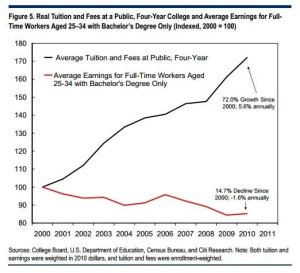
Tuition versus Earnings for Workers with a BA

The friends we mobilize to support our projects appear to us as a community, but to Kickstarter they are raw material to be converted into commodity—a conversion we must also embrace. Members of our networks become investors, not so much in our projects, but in Kickstarter itself. Every fundraising campaign that is launched reaches into our intersecting communities. Newer and newer layers of people are extracted to invest in Kickstarter. Like any other for-profit entity, its goal is to make money. Our projects that facilitate the funding are a side effect, a cost of doing business—the business of drilling our relationships for all they are worth. This is the logic we are allowing to dictate the whos, hows, and whats of cultural funding in our society.

Clearly, Kickstarter extracts value from our communities—10 percent of the capital raised and an unknown amount of networked and social value—but it does something less obvious as well. It converts support and community building into a shopping experience. By building a commodity-based rewards system into the platform, Kickstarter naturalizes the idea that supporting a friend is similar to any other online purchasing experience. You charge your credit card and something cool shows up in the mail in the future.